
Australian playwright, screenwriter, novelist, and librettist Joanna Murray-Smith adapted her original play Switzerland into the film A Talent for Murder.
Set in 1995, towards the end of Patricia Highsmith’s life—the renowned and controversial writer of thrillers, including the infamous Tom Ripley novels—the play is a tense duet between Highsmith and a young man from a New York publishing house, Edward Ridgeway, sent to the writer’s self-imposed exile in the Swiss mountains. Like his predecessor, who has mysteriously disappeared, Ridgeway has been tasked with convincing her to write another instalment of her Ripley novels.

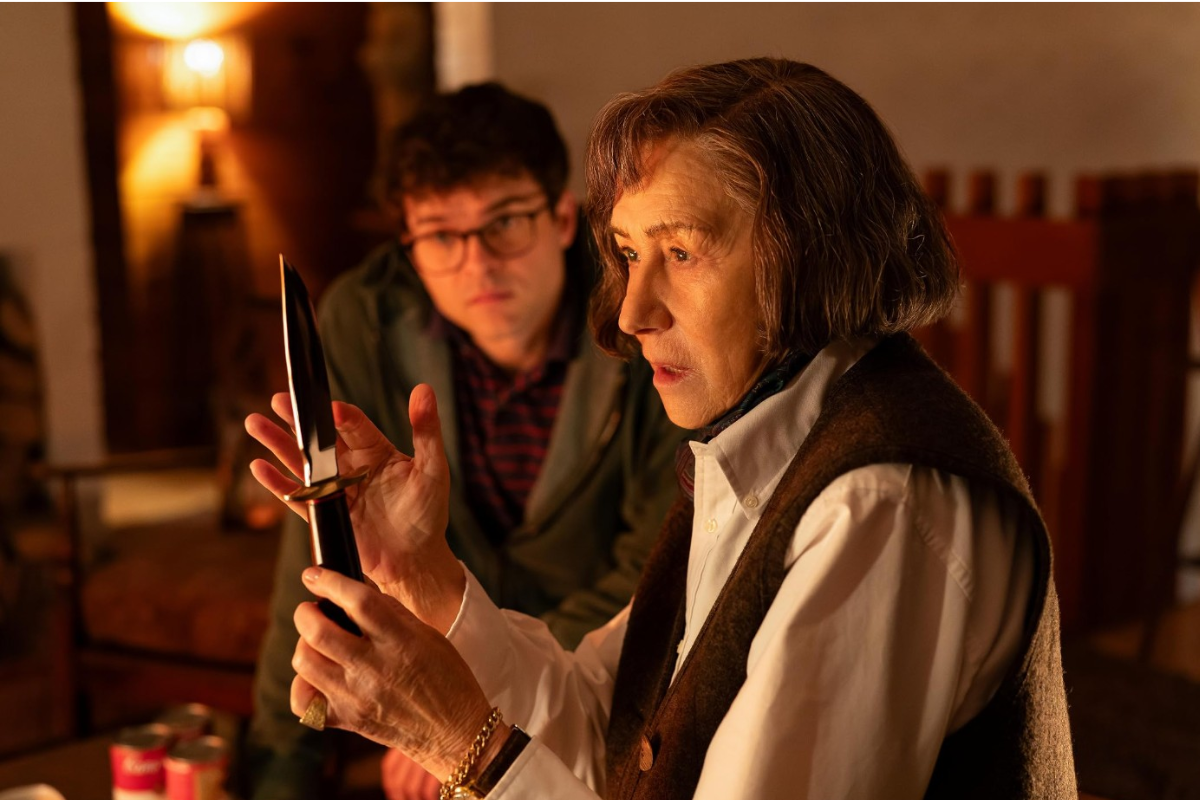
The film follows a mysterious young man from a New York publisher (Alden Ehrenreich) who is sent to Switzerland to persuade the renowned writer Patricia Highsmith (Helen Mirren) to write one final instalment of the Ripley anthology.
Murray-Smith had always been fascinated by Highsmith’s real-life complexity as a public figure and how elements of her personality surfaced in her work
“She was fascinating to me as a writer because, like a lot of writers, she wasn’t a terribly nice person. And there’s something about her astonishing psychological insight into the dark side of the human character that was more proficient than almost any other writer in the 20th century. She was unbelievably good at understanding people’s darkest motivations and building plots around them.”
Switzerland was written as a two-character chamber drama, but Tana saw the play’s cinematic potential. Before searching for a director to helm the project, Tana and Murray-Smith spent some time opening up the world of the story for the screenplay. When the script was ready, Tana thought director Anton Corbijn would be a strong fit. She’d worked with Corbijn before, and he already had a few thrillers under his belt, including a John le Carré adaptation, so Tana trusted him to see the film’s aesthetic potential. “He’s somebody who’s great at creating visual universes that are so sublime,” she shares.
Given the dialogue-heavy script, Murray-Smith agreed that they needed a director “who could draw the film out into the visual and the aural.” Corbijn’s extensive background in portrait photography and videography proved ideal for this. “In terms of creating a world around the words, he’s kind of painterly and musical,” Murray-Smith adds. “He has a very complex vision for how to make the words belong to the atmosphere of the film.”

By the time Tana approached Corbijn with the adapted script, he’d declined almost every feature film project offered to him for the past eight years
Like Tana, Corbijn was instantly compelled by the script. “The conversations were so tight and so wonderfully developed,” he recalls. He’d become a fan of Patricia Highsmith through film adaptations of her work—The American Friend (1977), Wim Wenders’ adaptation of the third Ripley novel, remains one of his favorite films.
While working on the adaptation, Murray-Smith was determined to keep the cat-and-mouse intensity of her original play. She expanded the script’s tight confines by introducing an extra storyline that frames the film: while on the train from Zurich to Tegna, the small Swiss town where Highsmith lived, Edward Ridgeway meets Clementine Balfour, a young woman from New York who happens to be heading to visit her only living relative, the very wealthy Aunt Peggy, who lives in the same town. Clementine is visiting in the hopes that Aunt Peggy, who holds the strings to her trust fund, will release it earlier than planned.
It was the strength of the script that also prompted Helen Mirren to take on the role of Highsmith. “I wouldn’t have been remotely attracted to playing her if it had been a bad script,” Mirren shares. “I mean, she’s not a character in history that I’ve ever had a yearning to play.” She’d also found it unusually thrilling to read. “It was a page turner, and not all scripts are like that,” Mirren recalls.

After Mirren came on board, Tana and Corbijn spoke to a few other actors for the role of Edward Ridgeway, but after a Zoom meeting with Alden Ehrenreich, their choice was clear. “We just thought, this is our guy,” Tana recalls. “He looked perfect, and he’s so smart. He really understood it and immediately did enormous research for the role.”
Ehrenreich was compelled by the script’s mix of genre thrills and psychological acuity: “you’re engrossed in the suspense and the tension of the story, but you’re also getting an exploration of the darker sides of human psychology.”
Olivia Cooke then joined the cast as Clementine Balfour, a role she was drawn to out of familiarity. “I just felt like I knew Clementine. I lived in New York for five years, so I knew those girls with very wealthy backgrounds—that have trust funds—yet they live in the Lower East Side and act like they’re a starving artist,” Cooke recalls. “But they’ve got the confidence of a safety net, a parachute, because they know they’ll always be fine ultimately.”
“And with that comes this amazing flippancy to sexuality and relationships because everything sort of is ultimately okay. There’s this lightness, a devil-may-care attitude to her that I really enjoy accessing,” Cooke adds, “it’s a really fun dynamic to play—the total opposite of me.”
Clementine and Edward are instantly drawn to each other. “They’re both outsiders in the world that they’re entering into,” Murray-Smith shares. “They’re both in Switzerland for very specific reasons—they’re trying to elicit a response from the two people that they’re interacting with in this town. Clementine is trying to elicit something from her Aunt Peggy, and Edward is trying to persuade Highsmith to write the book. So they both are on a mission, and I think they feel a certain kinship because of that.”
For Juliet Stevenson, who plays Clementine’s Aunt Peggy, the chance to work with Corbijn was a big draw for joining the project. “He’s had a very interesting route into filmmaking. He’s so delightfully approachable and easy going,” Stevenson shares. “He doesn’t come with set ideas. He likes actors—he’s very light of touch when it comes to the acting. Really warm, really egalitarian.”
Stevenson was also a long-time collaborator of Anthony Minghella, who directed The Talented Mr Ripley (1999). “I felt that was sort of a good omen,” Tana adds. Corbijn’s openness during production extended to the script, too. Murray-Smith was on set for the entire shoot, “always open to changing things if we wanted them to be changed,” Corbijn recalls. “When the actors became more involved, there were also suggestions from them.”
Given some of the controversial statements that Highsmith made in her lifetime, Tana spoke to several people who knew Highsmith personally to get a fuller sense of who she was. “I realized that it was really not black and white,” Tana shares. “She was a tortured soul in a lot of ways. It’s all of those ambiguities that make for really interesting characters.”
While the story is inspired by the final stretch of Highsmith’s life, the production team and cast make very clear that the film is in no way a biopic. “Obviously some elements are biographical,” Corbijn shares, “but I was mostly interested in making a solid thriller.”
Mirren similarly stresses the film’s fictionality: “We are not making a documentary about Patricia Highsmith. We are not even making a docu-drama about Patricia Highsmith. She is a character within a story that is a mystery, a thriller, a psychological investigation—not unlike her novels—one that’s obviously very inspired by her writing. It is not a literal presentation of the last days of her life at all. It’s a journey into the imagination.”
Amidst the film’s ample thrills, there are also brief moments of dark humor, which Murray-Smith attributes to Highsmith herself. “When people think of Patricia Highsmith, they don’t think ‘funny,’ but actually she was very funny, very witty. She was a very dark character, but she was so intelligent and so quick that there’s a lot of humor in the film. That’s probably the unexpected part of the equation.”
LD Entertainment’s involvement in A Talent for Murder began on the set of another film. Producer Pete Shilaimon was working with producer Troy Lum on the shark thriller Dangerous Animals when Lum mentioned a project he was developing, then titled Switzerland. Shilaimon asked to read the script. He fell in love with it immediately.
“I read it in one sitting. There’s a version of this story that’s just a thriller, but what Joanna wrote is really about a woman at the end of her life deciding what she wants to leave behind.” Shilaimon recalls. “I couldn’t stop thinking about it.”
From there, Shilaimon traveled to Berlin to meet producer Gabrielle Tana, and the conversation turned to the shape of the film itself: the heads of department, the casting, the logistics of a production that would eventually move across Rome, northern Italy, Switzerland and London. By the end of it, LD was in, and Pete Shilaimon and Mickey Liddell joining as producers. “A Talent For Murder is exactly the kind of project we want to make at LD: it is simultaneously smart, powerful, thrilling, and entertaining,” says Shilaimon.
For Tana, the real focus was not the biographical detail of Highsmith’s life, but the dramatic ebbs and flows of an artist at work. “She has been very well explored—there have been biographies of her diaries, and she’s got a lot of baggage,” she notes. “But here, what we’re really doing is exploring the life of an artist.”
Anton Corbijn – Director
A polymath in photography, music videos, feature films, graphic design, and commercials, Dutchman Anton Corbijn is perhaps best known for immortalizing some of the greatest artists of our time. His iconic portraits of musicians, directors, and artists like Joy Division, Depeche Mode, Tom Waits, U2, the Rolling Stones, Martin Scorsese, Clint Eastwood, Gerhard Richter, Ai Weiwei, Marlene Dumas, Naomi Campbell, Christy Turlington amongst others, are praised for the way they capture the soul and charisma of his subjects.
Effortlessly moving from photography into music videos in the early 80’s Corbijnhas since made over 80 promos for people like U2, Johnny Cash, Arcade Fire, Depeche Mode, Nirvana, Metallica, Nick Cave, Coldplay and The Killers. He is the Artistic Director behind the visual output of Depeche Mode. For U2 he has done the principal promotion and sleeve photography for four decades.

In 2006, Anton Corbijn started working on his first feature film Control about the life, and death, of Ian Curtis, Joy Division’s lead singer. Corbijn has since made The American (2010), A Most Wanted Man, based on the novel by John Le Carré (2014), and Life (2015)
Anton’s work has been exhibited at renowned museums all over the world. 2025 marked his 70th birthday, which was celebrated with a traveling exhibition from Stockholm to Tallinn, and is currently in Berlin.
Joanna Murray‑Smith is an Australian playwright, screenwriter, novelist, and librettist
Joanna Murray‑Smith’s psychologically sharp, actor‑driven writing has made her one of the most internationally produced dramatists of her generation. Born on 17 April 1962 in Mount Eliza, Victoria, she grew up in a politically and intellectually charged household shaped by her father, Stephen Murray‑Smith, the influential editor of Overland, and her mother, Nita Bluthal, a Polish‑Jewish refugee.
This environment steeped her in literature, debate, and ideological inquiry from an early age, forming the foundation of her lifelong fascination with human psychology, moral ambiguity, and the stories people tell themselves.

Renowned for plays like Honour, The Female of the Species, Switzerland, and Julia, she has also authored novels such as Truce and Sunnyside and co-written films like Palm Beach. Her accolades include two Victorian Premier’s Literary Awards, the Mona Brand Award, and appointment as a Member of the Order of Australia.
After completing a BA (Hons) at the University of Melbourne, Murray‑Smith studied writing at Columbia University on a Rotary International Scholarship—an experience that catalyzed her breakthrough play Honour, later produced on Broadway, the West End, and in more than three dozen countries. Her career since has been prolific and internationally visible, spanning more than fifteen plays, several novels, screenplays, and opera libretti. Her work is known for its incisive wit, emotional precision, and exploration of power, identity, and middle‑class anxieties.
Switzerland (2014), the play from which A Talent for a Murder was adapted, is one of her most celebrated psychological thrillers. It imagines the final days of Patricia Highsmith, blending Murray‑Smith’s trademark sharp dialogue with a taut, suspenseful structure that pays homage to Highsmith’s own narrative style. The play has been widely produced and is considered a modern classic in contemporary theatre.
Across her career, Murray‑Smith has received numerous honours, including the Mona Brand Award and appointment as a Member of the Order of Australia for her contribution to the performing arts. She continues to write for stage and screen, often engaging publicly with cultural debates around feminism, politics, and artistic freedom. Murray‑Smith lives in Melbourne with her husband, journalist Raymond Gill, and their three children.
Patricia Highsmith was an American novelist and short‑story writer whose psychologically charged, morally ambiguous thrillers reshaped 20th‑century crime fiction.
Raised initially by her maternal grandmother and later in New York with her mother and stepfather, she developed an early fascination with the darker corners of human psychology. After graduating from Barnard College in 1942, she supported herself writing comic‑book scripts while crafting the unsettling, tightly engineered narratives that would define her career. Her debut novel, Strangers on a Train (1950), became a sensation—adapted by Alfred Hitchcock the following year—and established her as a major new voice in suspense fiction. The Talented Mr. Ripley (1955) introduced Tom Ripley, the charming sociopath who would anchor five novels and become one of literature’s most enduring antiheroes. Highsmith published 22 novels and numerous short stories, many adapted for film, television, and stage, and her work was praised by figures such as Graham Greene, who called her “the poet of apprehension.” She spent much of her adult life in Europe—first England, then France, and finally Switzerland—where her reputation grew even as her misanthropic, racist, and antisemitic views generated controversy. Her groundbreaking novel The Price of Salt (1952), published under the pseudonym Claire Morgan, offered one of the first lesbian love stories with a hopeful ending in American fiction. Highsmith died in Locarno, Switzerland, on 4 February 1995, leaving behind a body of work that continues to influence contemporary psychological thrillers.
