
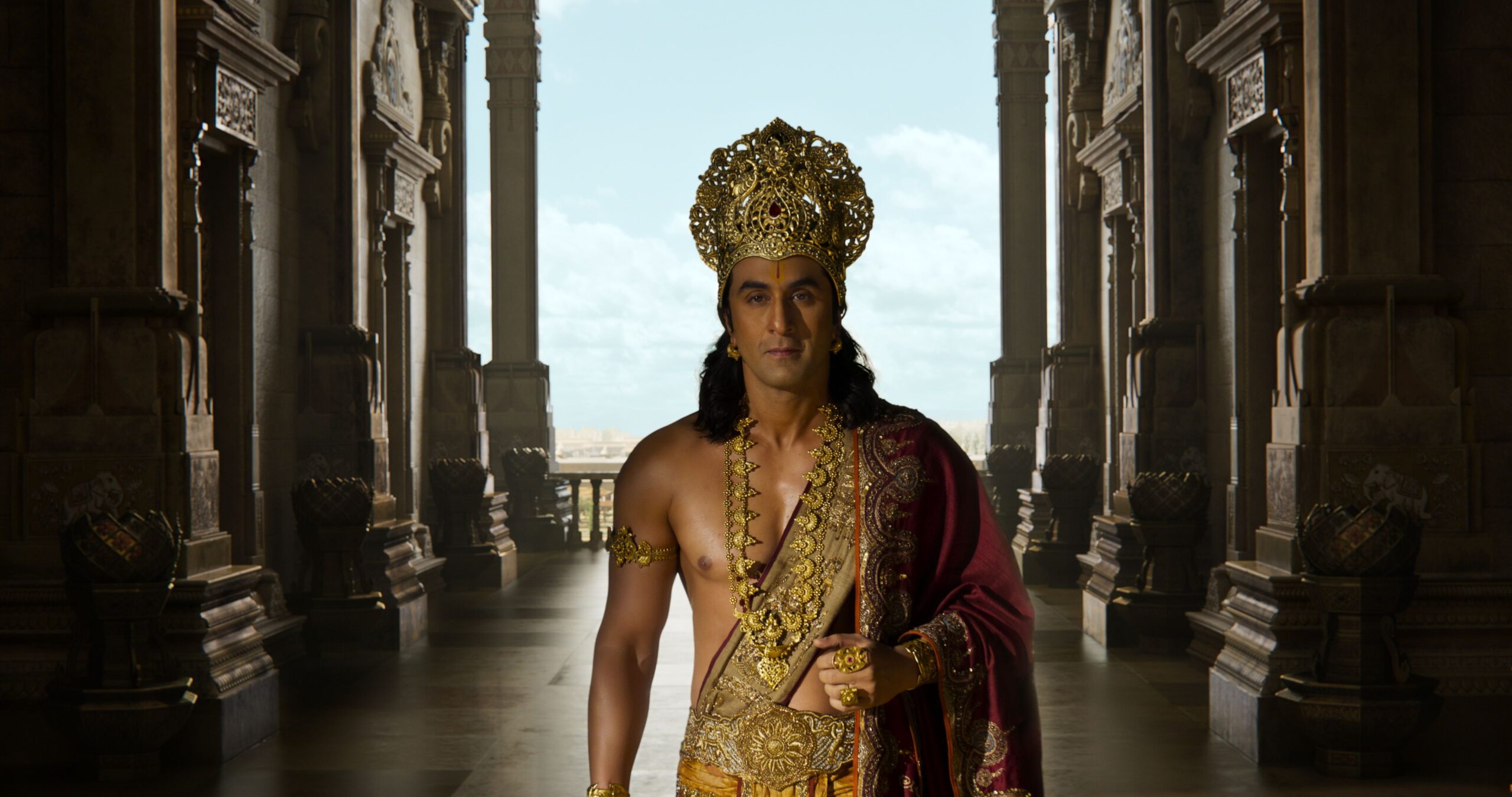
Discovery, adventure, and spectacle come together via epic storytelling and cutting-edge technology in Namit Malhotra’s Ramayana: Rise Of A Legend. From the visual effects artists who have won Academy Awards for their work on films such as Dune and Tenet, the film is brought to life on the big screen with the most immersive 3D experience ever.
Based upon the celebrated ancient epic known to billions,Namit Malhotra’s Ramayana: Rise Of A Legend tells the story of Rama, a prince bound by sacrifice; Ravana, an immortal king driven by vengeance; and the prophecy that binds their fates together.
Making History
As the first global release of a film from India, Ramayana: Rise Of A Legend is making motion picture history. “For the people of India, this is their Star Wars, or Avengers, or Lord of the Rings,” says Malhotra.“Our film has the scale that audiences around the world know and love, but it presents a culture and story that is new to the West. It is a classical representation of family, emotions, and sacrifice.
“It’s great for Hollywood to bring out something original, and it’s exciting for us because the film dissolves those lines of culture,” Malhotra continues. “It becomes one audience, one movie, one story, and one emotion.”
The story told in the text of The Ramayana, traditionally attributed to the great sage Valmiki,is far more than an ancient adventure tale. It has shaped religion, ethics, literature, politics, and family ideals across South and Southeast Asia for more than two millennia. Those themes, presented like never before in Ramayana: Rise Of A Legend, will resonate with audiences everywhere.
“This is an opportunity to bring a new kind of cinematic experience to the rest of the world,” Malhotra elaborates. “It’s a production that’s like any large-scale, event motion picture; in fact, the storyprecedes – and gave birth to – many epics we all know. It’s the ‘OG’ of the biggest storytelling that exists today!The spectacle is written into the original Ramayana; it’s the fundamental framework, but we never lose sight of its humanity.”
Director Nitesh Tiwari notes that the film is both multi-cultural and multi-generational. “It touches all age groups and all genres of filmmaking,” he points out. “That universality is very rare.”
VISUAL EFFECTS → EMOTION
Ramayana: Rise Of A Legend presents an incredibly vivid world, much of which has been brought to life by the visual effects house DNEG, which has won eight Academy Awards.
Malhotra, who as head of DNEG is among the visionaries creating those worlds, points out that the leading-edge effects employed by the filmmakers are “the glue that holds everything together. That meant always building new tools, technologies, and pipelines, all of them interacting in a unique way
“I can say,” he adds, “that Ramayana: Rise Of A Legendis the most challenging project DNEG has undertaken in its 25-year history. All these technologies and tools were integrated, running simultaneously, on set.”
Still, as Tiwari reminds, the tech is serving a greater purpose. “This is a story about relationships and emotions. At the end of the day, audiences don’t connect with your story, no matter how inventive the effects, unless they empathize with the characters and feel their joy and sadness. VFX is the icing on the cake, making the experience even more impressive. It’s a tool that enables a filmmaker to dream bigger and to think bigger, and to tell a story in a way that’s never been done before. VFX brings to life the characters and their worlds. But at its heart, this film remains an emotional story.”
IMAX + 3D
The filmmakers designed Ramayana: A Legend to be one of the grandest stories ever told. “So,” says Malhotra, “we had to tell it in the most expansive formats – IMAX and 3D – to maximize the immersive experience.”
To that end, the filmmakers tested different cameras, formats, and screen resolutions, ensuring, says Malhotra, “that we’d have the maximum impact of scale and emotion.”
Malhotra points to DNEG’s Academy Award-winning collaborations with Christopher Nolan on Interstellar, Inception, Tenet, and The Odyssey as an inspiration for shaping the film’s striking theatrical presentations. “Chris continues to innovate the use of IMAX and has pushed the boundaries of what’s possible. We’re all beneficiaries of his efforts, and we made sure we maximized our use of IMAX and 3D.
“This will be 3D unlike anything you’ve seen before,” he continues. “DNEG has been at the forefront of that technology since its work on Avatar and has a strong perspective on how we can make a filmthat’s powerful, emotionally and artistically. We wanted to make sure that what we’re showing audiences feels seamless. That is the most authentic part of telling this story.”
Rama
According to Hindu tradition, when the universe faces a severe threat, the deity Lord Vishnu, who sustains cosmic order and preservation, takes an avatar to protect it. Rama, prince of Ayodhya, is that avatar. A warrior of unparalleled skills, Rama is committed to dharma – proper conduct and duty – even when that duty leads to personal loss.
Rama’s unwavering commitment to his father’s word brings heartbreak to him and the people of Ayodhya, as he embarks upon a 14-year exile with his wife Sita and his loyal brother Lakshmana. Together, they face incredible adventures and a shocking kidnapping that will change them forever.
International superstar Ranbir Kapoor, who portrays Rama, says he felt significant responsibility embodying such a cherished figure. “What interested me most about Rama is his compassion, courage, ability to forgive, and his righteousness,” he says. “There is a saying in our scriptures that translates to: ‘Dharma protects those who uphold it.’ That’s something that really stayed with me.
“For thousands of years, Rama has been the conscience keeper for hundreds of millions of people,” Kapoor continues. “His story tells you about the choices in life between duty and desire, compassion and revenge, and self and selflessness. Rama is the epitome of sacrifice and duty. He is the ideal man: the perfect son, husband, brother, father, teacher, and disciple. For an actor to try and capture all that is a daunting prospect.”
But then, Kapoor notes, “I became a father around the time I was offered the role. “So, over the three years of making the film, I began telling my daughter about the stories of The Ramayana, while actually performing these stories. It was a period of significant spiritual growth for me, for which I’m grateful.”
Indeed, as Kapoor points out, this is a role unlike any other he’s experienced. “You can’t really play Rama; as an actor, I’m telling my version of the character. I think that’s where it all begins,” he explains.
Kapoor says even the experience of being approached to portray Rama still lingers. “Namit offered me the role, asking how I would feel about it. My instant reaction, out of fear, was to say no, and that I wasn’t fit enough for it. But over time, Namit took me through what he and Nitesh were doing with the film. Then, I met Nitesh, who narrated the story to me. I realized then how thankful I was to be in the right place at the right time. Portraying Rama is nothing less than a turning point in my career and in my life.”
Ravana
Ravana, the king of Lanka (now Sri Lanka), is a formidable tyrant who rules over three kingdoms: the heavens, the earth, and the world of the dead. As the ultimate sovereign, he is extraordinarily powerful, learned, and accomplished. Ravana’s tragedy is that his brilliance is overwhelmed by pride, desire, a refusal to accept wise counsel – and his fateful kidnapping of Rama’s wife, which sets the two on a collision course for the ages.
Rama and Ravana follow very different paths: Rama is born to protect; Ravana is ruled by revenge. Still, when Ravana promises an agonizing and humiliating death for Rama, the latter is undeterred, vowing that all three realms over which Ravana rules will witness his death.
The actor who personifies Ravana, Yash, calls the character, “The original villain.” He explains: “This story has been around for 5,000 years. Many great movie villains have been derived from Ravana.”
The fact that the character has existed for millennia was a significant draw for Yash. “Thousands of years later, people still burn Ravana’s effigies to celebrate the victory of good over evil,” he says. “As a kid, The Ramayana was the first story I heard. Even then, I respected Ravana and the way he stayed in my memory. At the same time, I learned that even the smartest and most talented people can believe in something that is dangerous.
“For this film, I wanted Ravana to be relatable, even though he’s so much larger than life. Audiences should feel, ‘I could have been that guy in this situation.’ That’s how I prepared, mentally and emotionally, to play Ravana.”
To that end, Yash got inside of the character’s mind, emotions, and ambitions. “That meant, of course, putting aside my personal ideology and making sure I understood Ravana’s thought processes and emotions,” he remembers. “I had to believe that Ravana was right, because we are all heroes in our own minds, and that sometimes the world really does seem to revolve around us. So, imagine Ravana, who owns three worlds, and his ego! Ravana believes in what he’s trying to do.”
“Ravana has so many aspects,” Tiwari points out. “He was a great warrior, an accomplished musician, a scholar, and, in his unique way, a benevolent king. So, there’s so much more to him than being an antagonist. It was important to showcase all these aspects of Ravana because it points to an important lesson: you can have all these admirable qualities, but if you govern by vengeance and are driven by ego, the result is a foregone conclusion. There’s a great lesson hiding in that character.”
Tiwari remembers that when Yash agreed to take on the role, the director “almost jumped with excitement. Having seen his work in [the Indian blockbusters] KGF and KGF 2, I knew Yash carried the requisite aura to capture Ravana. Yash comes with everything necessary to be Ravana – the emotional intensity, physicality, and swagger. He plays Ravana to the hilt.”
Malhotra recalls, “Yash had just completed KGF 2, which became a megahit, and his popularity exploded. After seeing that film, I knew the energy he could bring to Ravana would be very powerful. Once Yash came on board, his excitement and ambition for the project continued to build, so he also became a producer to help ensure Ramayana: Rise Of A Legend became a global event.”
NITESH TIWARI (Director, Screenplay) is a renowned Indian film director, screenwriter, and lyricist, celebrated for his contributions to Bollywood. After graduating from IIT Bombay, he worked as a creative director at Leo Burnett for a while, honing his expertise in visual communication and narrative before moving into filmmaking.
He made his directorial debut with Chillar Party (2011), a co-directed project that won the National Film Award for Best Children’s Film. Tiwari then directed the supernatural political drama Bhoothnath Returns (2014).
In 2016, Tiwari scripted and directed the blockbuster Dangal (2016), which became a cultural phenomenon and one of India’s highest-grossing films of all time. In China alone, the film earned over $190 million, making it one of the most successful Indian releases worldwide. Dangal was screened at both the Beijing International Film Festival and the BRICS Film Festival
Tiwari has won several accolades, including the Filmfare Award for Best Director and the Telstra People’s Choice Award at the 2017 Indian Film Festival of Melbourne.
His comedy Chhichhore (2019) earned him widespread acclaim and a National Film Award.
Tiwari has continued to develop high-profile projects, including the epic Ramayana: Rise of Legend, one of India’s most celebrated cinematic creations to date; and Bawwaal (2023).
SHRIDHAR RAGHAVAN (Story, Screenplay) is a National Film Award-winning screenwriter whose work spans cinema and television. His writing credits encompass crime dramas, political thrillers and major action films, combining intricate plotting with character conflict and emotional stakes.
His early television work includes CID and Aahat. In cinema, his credits include Khakee (2004) and Apaharan (2005), for which he shared the National Film Award for Best Screenplay, with Prakash Jha and Manoj Tyagi.
Raghavan’s subsequent work includes War (2019), Pathaan (2023), Tiger 3 (2023) and War 2 (2025), contributing to the expanding world of Yash Raj Films’ spy franchise. These projects demonstrate his experience in developing action narratives that connect individual motivations with larger conflicts.
For Namit Malhotra’s Ramayana: Rise Of A Legend, directed by Nitesh Tiwari, Raghavan brings his screenwriting experience to the cinematic adaptation of the epic, extending a career that moves between intimate human drama and storytelling on a large canvas.
