
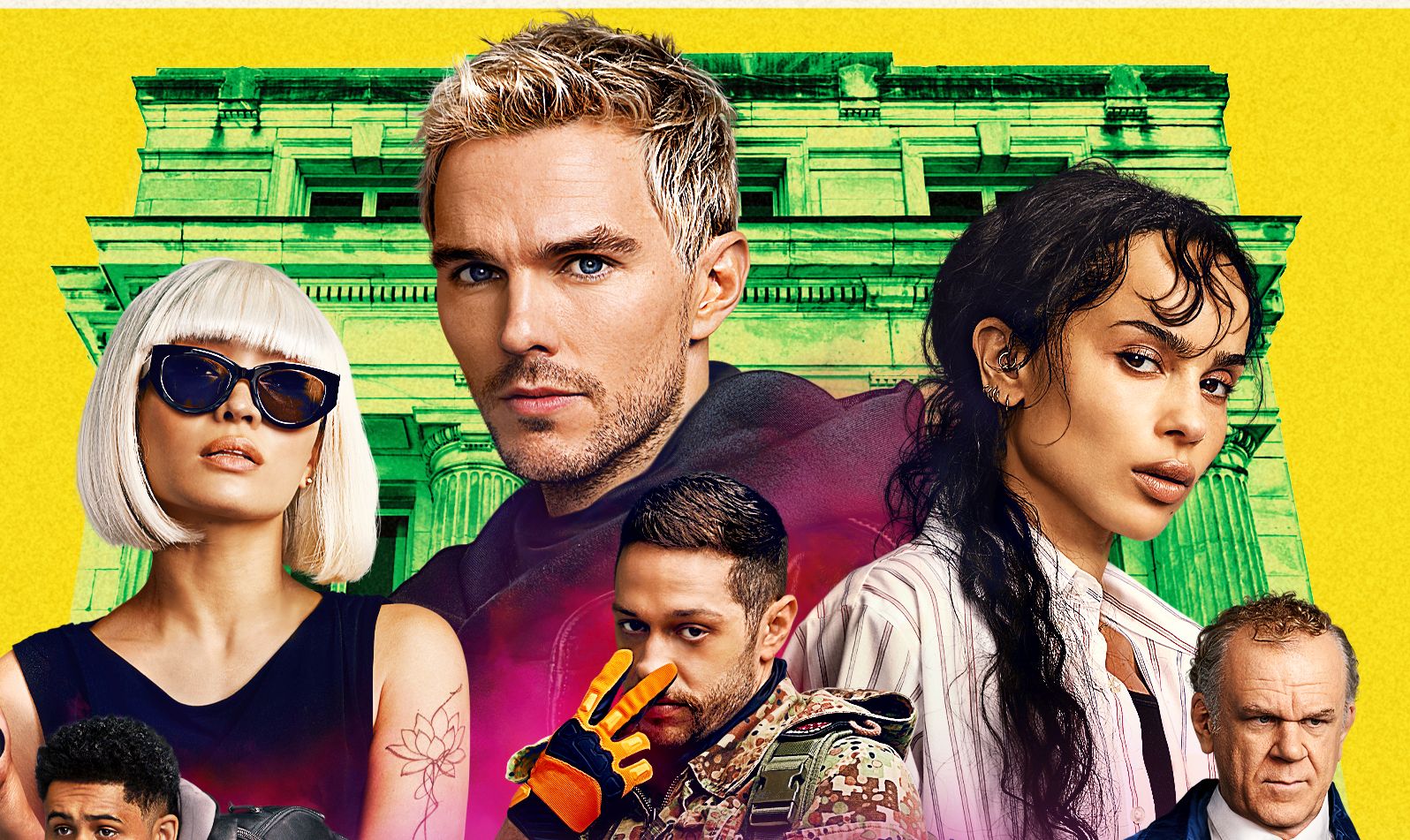
For decades, the best heist films have followed a familiar playbook: assemble the crew, plan the job, and disappear without a trace. How to Rob a Bank begins with the same irresistible setup, then immediately breaks the rules. Here, the getaway isn’t the end of the story – it’s the beginning. Every robbery is filmed, edited and uploaded online, transforming a masked crew of bank robbers into internet celebrities whose audience grows with every crime.
The premise feels tailor-made for the age of YouTube, TikTok and livestreaming, but screenwriter Mark Bianculli first conceived the idea long before creator culture became the dominant language of the internet. The initial spark came from an unlikely pairing: an online video showing thieves stealing an ATM in roughly a minute using nothing more than a truck and a cable, and an FBI statistic revealing that most first-time bank robbers actually make it out of the bank with the money.
“Suddenly the question for me wasn’t just how someone robs a bank, it was why,” Bianculli says. “If the barrier to entry is so much lower than most people imagine, what would it take to convince you to cross that line? From there, everything else was born.”
That question became the engine of Bianculli’s screenplay, and social media gave it its edge. As online creators built enormous audiences by teaching viewers everything from home repair to financial advice, How to Rob a Bank found an unexpected lens through which to tell a heist story for the next generation. Instead of treating the internet as a backdrop, the script imagined it as another member of the crew, a tool every bit as essential as a getaway car or a carefully timed escape route.
Once the screenplay was complete, it quickly attracted attention across Hollywood. At Imagine Entertainment, producers Brian Grazer, Allan Mandelbaum and Jeb Brody recognized that Bianculli’s work offered more than an inventive genre exercise. It was a crime thriller that seemed to be speaking directly to the present moment. As they further developed the material with the writer, they realized the most compelling version of the story wasn’t simply about people robbing banks. It was about understanding why ordinary people might believe so desperately that they had run out of options.
“It felt really raw and it had a message that intersects with what young people in America are experiencing today,” Grazer says of the script. “There are so many smart, hardworking kids who believe they’re pursuing the American Dream, only to graduate with enormous debt and discover that even if they’re qualified, the system makes it incredibly difficult to get ahead.”
Adds Mandelbaum: “I loved the core concept of a heist movie that wove in some of these social media perspectives, but it wasn’t until we really started to break down the characters and their backstories and their motivations that we started to get really excited about what this could be.”
That emotional foundation became the difference between a clever premise and a film with something larger on its mind. The scores would provide the thrills. The people behind the masks would provide the reason to care.
The result is a story that could not feel more of the moment. Economic uncertainty, mounting debt, rising costs and a growing distrust of institutions give the film’s central question real urgency. Rather than presenting its robbers as master criminals chasing wealth, How to Rob a Bank asks what happens when people who have done everything they were told to do begin to feel as though the system has stopped working for them. Each member of the crew arrives with a different history, but they share the same growing conviction that the traditional path toward stability has failed.
“I think all of us started to feel like there was this boiling frustration and anger from a younger generation of people,” Mandelbaum says. “We were sold this vision of the American dream, and that wasn’t really the reality.”
For Brody, that idea immediately elevated the screenplay beyond the usual conventions of the genre.
“We’re living in a time now where we’re seeing over and over again that the current younger generations are not going to do as well as their parents did,” he says. “We made a movie that could speak to that.”
Indeed, How to Rob a Bank isn’t interested in celebrating criminals nearly as much as it is examining the circumstances that create them – and in blurring the line between law and justice often enough to leave audiences asking difficult questions long after the final getaway.
“I think one of the fun things about the movie – and you see this in the best action-packed heist films – is that you begin with the good guys and bad guys, the cops and the robbers, but as the movie progresses, you start questioning who’s right, who’s wrong, who’s good and who’s bad,” Brody says.
A crew of social media-savvy bank robbers broadcasts their daring heists, unaware that their growing viral fame has put them in the crosshairs of a veteran FBI agent and a brilliant software engineer. Despite the unlikely duo closing in, the crime ring pushes past their limits, putting everything on the line for their most ambitious heist yet.
Finding the Vision
As the script gained momentum, Grazer and his team found themselves searching for collaborators who could embrace its contradictions. How to Rob a Bank needed the visceral excitement of a great caper movie without sacrificing the emotional authenticity that had become central to the story. It would have to speak the language of contemporary internet culture while remaining grounded in the timeless pleasures of cinematic storytelling.
The search eventually led to director David Leitch and his longtime producing partner Kelly McCormick, whose 87North banner had become synonymous with redefining the modern action film. Yet what ultimately drew Leitch and McCormick to the project wasn’t simply the excitement of staging elaborate set pieces. It was the unusual opportunity to tell an action story that reflected the helplessness of the present moment without ever losing sight of its humanity.
“It was almost a week later, after we first read it, I said to David, ‘I can’t stop thinking about that script,’” McCormick recalls. “And he was like, ‘You know, me either. There’s something about it, isn’t there?’”
Bianculli’s work had stayed with them because it felt unlike anything they had encountered before. Beneath its high-concept premise, Leitch and McCormick saw the chance to push beyond the conventions of the genre while remaining true to the kind of ambitious, audience-driven filmmaking they had built together.
“We were thinking about the sort of energy behind that frustration people are feeling,” McCormick says. Was there something to this script? And could we be part of that conversation in a way that felt very 87North, that felt very David Leitch-ian – that it could be fun and wild, but also put a message forward – be part of an important conversation our society is having right now, and strike a chord that so many people are feeling today?”
For the producers at Imagine, the pairing immediately made sense.
“David and Kelly and what they’ve built at 87North – it’s undeniable,” Mandelbaum says. “They have really found a way to tap into mainstream culture and audiences in a way that very few filmmakers do. They have their finger on the pulse of the culture and what audiences respond to.”
Brody had known Leitch and McCormick for years and had long hoped to find the right project to bring them together. The stark contrast inherent in this material struck him as a beautiful match.
“We felt David could certainly get the action and the power out of it,” Brody says, “but he also understands people who go to work every day, do their best work, put their lives on the line and aren’t always necessarily rewarded with the same benefits that other people are. I think the movie really spoke to him in that way.”
Leitch’s contribution was to take the action audiences have come to expect from films like Bullet Train and The Fall Guy and connect it even more tightly to the characters and their emotional stakes. From their earliest conversations, Bianculli recalls the director focusing on dramatic tension as much as physical spectacle, looking for ways to heighten every emotional clash while preserving the humanity at the center of the tale.
“David is the right guy because this movie needed style, and David obviously oozes style,” Bianculli says. “But he also stressed the idea of collision, and not just physical collision. He wanted every character pushing against someone else, every scene to have tension, every set piece to be earned. I always joke that he took my script, plugged it into an amplifier and played the electric version.”
For Leitch, the challenge wasn’t simply to make bigger action sequences, but to find a cinematic vision that could honor the tactile craftsmanship of classic heist films while tackling the fragmented, participatory way modern audiences experience stories.
“Our job was to build one cohesive world out of two very different visual languages,” Leitch says. “The movie had to feel cinematic, but it also had to feel immediate and authentic to the way this generation creates and consumes media. Every choice we made came back to serving the characters and making those two worlds feel like they belonged together.”
That vision would ultimately shape every corner of the production. Leitch and McCormick assembled a creative team capable of making the film feel simultaneously tactile and contemporary, grounded and heightened – from its production design and camera work to its action and ensemble cast.
ASSEMBLING THE TEAM
For all of its elaborate set pieces and viral spectacle, How to Rob a Bank asks one simple question: would audiences follow these people anywhere? That’s the question that guided Leitch from the moment he came aboard.
“What I really liked about Mark’s script was not so much that I wanted to learn about how to rob a bank,” Leitch says. “I wanted to portray to the audience what it means when robbing a bank actually sounds like a reasonable plan. These characters really have no other options. Because of that, they’re super empathetic and relatable.”
Building that ensemble was a job McCormick knows well. Navigating an ensemble cast is one of the things she does for 87North and for Leitch, and here the task was to find actors who could each carry a different piece of the film’s emotional puzzle.
“You’re not just casting individual roles, you’re collecting the right individuals,” McCormick says. “We wanted a really unique combination of people who could represent so many different emotions in this film – anger, grief, hope, humor, loyalty. Put them together and the audience should be able to find themselves somewhere in that crew.”
The casting search began with the character of Ryan, known online as “The Wolf.” In the end, all roads led to one actor: Nicholas Hoult.
“Nick was our first choice,” Leitch says. “He’s one of those actors who can be incredibly charismatic while also carrying a real vulnerability. Ryan needed to be smart, idealistic, funny, frustrated and occasionally naïve – all at the same time. The character isn’t a traditional hero. He’s a young man trying to make sense of a system that feels stacked against him. Nick understood that immediately. He never played Ryan as a revolutionary or a genius. He played him as a human being who wants to believe things can be better.”
If Ryan becomes the movement’s public face, Emi – played by Anna Sawai – becomes its emotional anchor. She is the one person who understands the man behind the mask, but she is also far more than his partner. As the crew’s strategist and emotional ballast, Emi continually reminds the audience that every robbery carries consequences extending well beyond the next getaway.
“Anna is a very subtle actor, and I mean that in the most complimentary way,” Leitch says. “There’s so much portrayed with just a look or just a presence. Her role in the team is just that. She’s the quiet confidant but also part of the mastermind of what’s happening. To have an actress like her portray Emi was so beneficial to the film.”
Around Ryan and Emi, Leitch and McCormick built a crew whose members each represent a different response to the same grievances. They’re united less by criminal ambition than by the feeling that the conventional paths they were promised have failed them.
Vince embodies that idea perhaps more than anyone else. A military veteran and father, he has devoted his life to serving others, only to find himself struggling to provide for his own family. For actor Pete Davidson, that paradox became the character’s emotional core.
“I think because of Vince’s experience in the military, he brings very useful skills to the bank robbing operation,” Davidson says. “But he’s interesting because he served for the country and now he’s robbing from it. They’re activists. Their main message is that the system’s wrong and it’s corrupt. People who are first responders, they should be compensated better.”
Rhenzy Feliz rounds out the crew as Hugo, the gifted editor and technical architect whose optimism provides an important counterweight to the group’s growing desperation.
“I saw Hugo as this kind of firecracker personality,” Feliz says. “He’s carrying his own stuff internally, but he’s able to push it down and present this brighter face to the world. That’s his role in the group, too. He shapes how the audience – both the YouTube followers within the film, and the viewers in theaters – sees the crew. If people misunderstand who they are and what they stand for, then their mission fails. Hugo controls the messaging and presentation of what they’re doing.”
DESIGNING AN ‘AMERICAN FAIRY TALE’
From the beginning, Leitch and McCormick knew How to Rob a Bank had to feel like a big, cinematic ride. Working with their longtime collaborators, production designer David Scheunemann and cinematographer Jonathan Sela, they set out to create a visual world that could embrace the scale and craftsmanship of theatrical filmmaking while capturing the immediacy, energy and unpredictability of modern creator culture.
The result is a film built around two distinct visual worlds that constantly collide. The dramatic narrative is grounded in the tactile look of 16mm film, while the robberies themselves explode into the kinetic, anything-goes language of the content Ryan and his crew create for their online followers.
“On one hand, this is a story about real people struggling within systems that feel increasingly inaccessible,” Leitch says. “On the other, it’s about a generation that experiences the world through screens, social media, livestreams and self-created content. The idea was to move seamlessly between the analog and digital worlds, the personal and the performative, the cinematic and the participatory, while still feeling like one cohesive experience.”
To capture the world beneath the masks, Leitch and Sela made the conscious decision to shoot much of the dramatic narrative on 16mm film, drawing inspiration from classic American counterculture films like Badlands and Dog Day Afternoon.
“We wanted texture, imperfection and grit,” Leitch says. “The grain itself became part of the storytelling.”
But when the crew goes to work, the movie kicks into another gear.
“We drew inspiration from internet culture, documentary photography, livestreams, user-generated content and the incredible sophistication of modern prosumer filmmaking, then we tried to push the boundaries a bit,” Leitch says.
The filmmakers created a dedicated “YouTube unit” to capture the robberies from the perspective of Ryan and his crew, using an arsenal of compact cameras, drones, 360 cameras and other specialized equipment to put the audience directly inside the action.
“You’re able to stretch the boundaries just a little bit,” says second unit director and stunt coordinator
Greg Rementer. “These cameras allow us to create shots that you’ve never seen before.”
For McCormick, that collision is where the film finds its heart, not just its style.
“The drama of our characters’ real lives is on film, and it’s juxtaposed with this flat, wild shooting style of the prosumer cameras,” she says. “That’s a conversation that feels so real right now. What’s on your phone feels so different from life, but it’s such a huge part of your life. That was something David had to fight for, and it makes an incredible difference in the experience of the movie. The YouTube world and real life feel so different and special, and that’s part of the genius of the film.”
The distinction was important to the filmmakers because Ryan and his crew aren’t trying to hide what they’re doing. In a traditional heist movie, the robbers disappear into the shadows. Here, they’re putting on a show.
“What I found cool and fresh about this one is that Ryan and the crew are trying to be as loud as humanly possible,” Feliz says. “They’re trying to get as many views as they can get. They’re trying to rake in all that viewership and excitement about what they’re doing.”
That spirit extended to the actors themselves. As the crew’s getaway driver, Sawai had to learn to handle a car like Emi does. She trained with Rementer and his team, eventually mastering a 180-degree turn.
“Initially, I was afraid,” Sawai says. “But once I did it a couple of times, and finally went full force, it was very exciting. So, I’m pretty confident doing it now.”
Feliz likewise embraced the physical demands of the film, undergoing weapons and stunt training before production began.
“We were vaulting over things and jumping over obstacles,” he says. “It’s pretty exciting and it’s so fun.
But then before you know it, we show up on the day and it’s actually time to get up and do it.”
For Kravitz, the appeal of Leitch’s action filmmaking lies in more than the mechanics.
“David’s so skilled at incredible action and I think what makes his action so good is not just the technical side, but the emotional side of it,” she says. “He combines them and you feel the emotion in the action, which is hard to do.”
That balance is at the heart of the film’s visual approach: the action is big, inventive and often outrageous, but it is always rooted in the characters and their emotional stakes.
Scheunemann had been thinking about that idea from the moment he read the script.
“It came immediately to me to design the perfect American fairy tale,” he says. “It’s really a social commentary on present day and on the world in total. It’s a commentary on big money and big tech. That’s what really inspired me the most to do this.”
That philosophy informed the environments surrounding the characters. The Vitality Trust building, for example, is a deliberate collision of old and new: the Gulf Tower provides its exterior, while interiors were filmed in the Carnegie Museum of Art, with new-money minimalism layered into historic spaces.
“The Vitality Trust building is one of the key places in the film,” Scheunemann says. “It’s basically a collage of architecture. What I did with those period environments was to bring new money and a certain kind of minimalism into these old spaces. It’s almost like a blend between a bank and a tech company.”
As Ryan’s movement grows, the visual world around him grows with it. Graffiti and original artwork begin appearing throughout Pittsburgh, eventually becoming an increasingly prominent part of the film’s imagery.
“Graffiti plays a vital role over the course of the movie,” Scheunemann says. “We fed it into the texture of the film and it grows into something much bigger by the finale.”
Costume designer Jocelyn Pierce took a similarly grounded approach to the characters, allowing their identities to become heightened as they embrace their lives as bank robbers.
“What we did was take each character’s personal style and amplify it whenever they start robbing banks,” she says. “They don’t become different people during the robberies; they become heightened versions of themselves.”
For Ryan, that meant maintaining the classic silhouette of an everyman even as his alter ego, the Wolf, became increasingly larger than life.
“There was pressure around who the man leading a revolution should be,” Pierce says. “We settled on a really classic silhouette for him because he’s grounded and relatable. He’s an everyman. We’re talking about working-class Americans, so we didn’t want to do anything cartoony or fake.”
But the Wolf’s mask offered room for something more mythic. The masks themselves were never just a costume choice. They grew out of Leitch and McCormick’s thinking about who these characters are and who the film is speaking to.
“We specifically wanted characters that felt vulnerable, that felt closer to kids than adults,” McCormick says. “That’s why we ended up with these furry, almost stuffed-animal faces – the wolf, the rabbit, the bear. Not nuns, not presidents, not a skeleton or something scary. Something that feels vulnerable, chosen specifically for the young people we’re talking to and about, who are the victims of this systemic problem in our society. It’s their turn to go back and get theirs.”
The Wolf carries an even more personal meaning. As the filmmakers deepened Ryan’s backstory, they made the Big Bad Wolf his son’s favorite book – an image Leitch then wove visually throughout the film, including looming over Ryan as he records his confessional.
“That wolf lingering over Nick in that confessional moment is so powerful,” Leitch says. “It’s bigger than a mask with a backstory. It’s meant to connect on a big level with the youth we’re talking about.”
Pierce and her team brought that idea to life.
“The character takes inspiration from a children’s book that appears in the story, so we wanted this dark, imposing, mysterious black wolf intensity,” Pierce says.
Together, those choices give How to Rob a Bank a visual identity that is both grounded and heightened, intimate and explosive. It is a world where a 16mm portrait of two people grieving can give way to a bank robbery filmed like a viral stunt video; where a Pittsburgh street can become a canvas for a growing movement; and where the people behind the masks remain at the center of all the spectacle.
Mark Bianculli is a screenwriter known for his work in film and television, particularly in character-driven drama and genre-forward pacing. His credits include notable projects such as Lincoln Rhyme: Hunt for the Bone Collector (2020), Cliffhanger (2027), and How to Rob a Bank (2026). Bianculli has been recognised for crafting tense, propulsive narratives and dialogue that support both plot momentum and performance. His writing often emphasises clear world-building, escalating conflict, and satisfying payoffs. While specific details about his early life and personal background are limited, Bianculli’s professional output continues to define his profile in the industry. As his body of work grows, he remains a notable creative voice for viewers seeking smart, high-energy storytelling.
David Leitch / Director & Producer is a prolific director and producer known for his high-octane, boldly distinctive, character-driven tentpole films, which have collectively grossed over $2.9 billion worldwide. A visionary filmmaker who transitioned from the world’s elite stunt circles to the director’s chair, Leitch has refined the visual language of the modern action epic. He made an immediate impact with his 2014 directorial debut, the runaway critical and box-office phenomenon John Wick. , Beyond co-directing the original film, his influence on the franchise’s DNA continued as Executive Producer on John Wick: Chapter 2, John Wick: Chapter 3 – Parabellum, and John Wick: Chapter 4. His subsequent directorial work solidified a sophisticated, action-based storytelling aesthetic evident in his films Atomic Blonde (2017), the neon-noir cult favourite thriller; Deadpool 2 (2018), the record-breaking Marvel sequel; Fast & Furious Presents: Hobbs & Shaw (2019); Bullet Train (2022), the ensemble action-comedy; and The Fall Guy (2024), a love letter to cinema. Alongside his wife and producing partner, Kelly McCormick, Leitch founded 87North Productions in 2019, the world-renowned production and action design powerhouse that serves as the creative engine for their expansive slate. Leitch is widely recognised as a pioneer in the action film genre and a tireless advocate for the stunt community. In 2024, following McCormick’s leadership in creating and securing a new “Stunt Designer” credit with SAG-AFTRA and the DGA, the duo premiered the title on The Fall Guy to properly honour the artistic contributions of Stunt Coordinators. Furthermore, Leitch was the driving force behind the successful multi-year push to establish “Achievement in Stunt Design” as an official Oscar category. In 2025, his efforts were realized when the Academy of Motion Picture Arts & Sciences formally approved the award, which is set to debut at the 100th Oscars ceremony in 2028. Leitch continues to be one of the industry’s most in-demand directors with a robust pipeline. Currently, he is directing Jason Statham Stole My Bike for Black Bear Pictures. Upcoming on his directing and producing slate are Netflix’s feature adaptation of Gears of War, one of Xbox’s flagship video game franchises, and the highly anticipated Ocean’s 14 for Warner Bros. As producers, Leitch and McCormick are the architects of Universal Pictures’ Violent Night franchise, with its sequel, Violent Night 2, arriving in theatres December 4, 2026. Earlier this year, the company dominated the 2026 SXSW Film Festival with the world premieres of Pretty Lethal, and Maddie Ziegler. Looking ahead, Leitch and McCormick are also developing several high-profile projects, including Fast & Loose for Netflix, and a film adaptation of the video game Just Cause. Prior to establishing himself as a director, Leitch spent a decade in the stunt business as the premier 2nd Unit Director, Stunt Coordinator, and Fight Choreographer on blockbusters like The Wolverine, Captain America: Civil War, Logan, and Jurassic World. His legendary stunt performer career included doubling Matt Damon on Bourne Ultimatum and Brad Pitt on Fight Club and Mr. And Mrs. Smith, among others. In 2022, Leitch and McCormick expanded their impact by launching 87North’s action design arm and stunt facility. Located in the heart of Hollywood, the state-of-the-art studio provides a comprehensive, safe, and skilled environment where world-class stunt designers create action stunts and train actors for 87North’s own productions as well as for outside filmmakers and projects. Also in 2022, Leitch and McCormick founded the 87North Action Foundation, a non-profit dedicated to supporting the industry’s ecosystem by empowering young filmmakers and providing them with platforms to showcase their work, advancing the stunt community through education and exposure, promoting pet ownership for positive mental health, and environmental causes.