
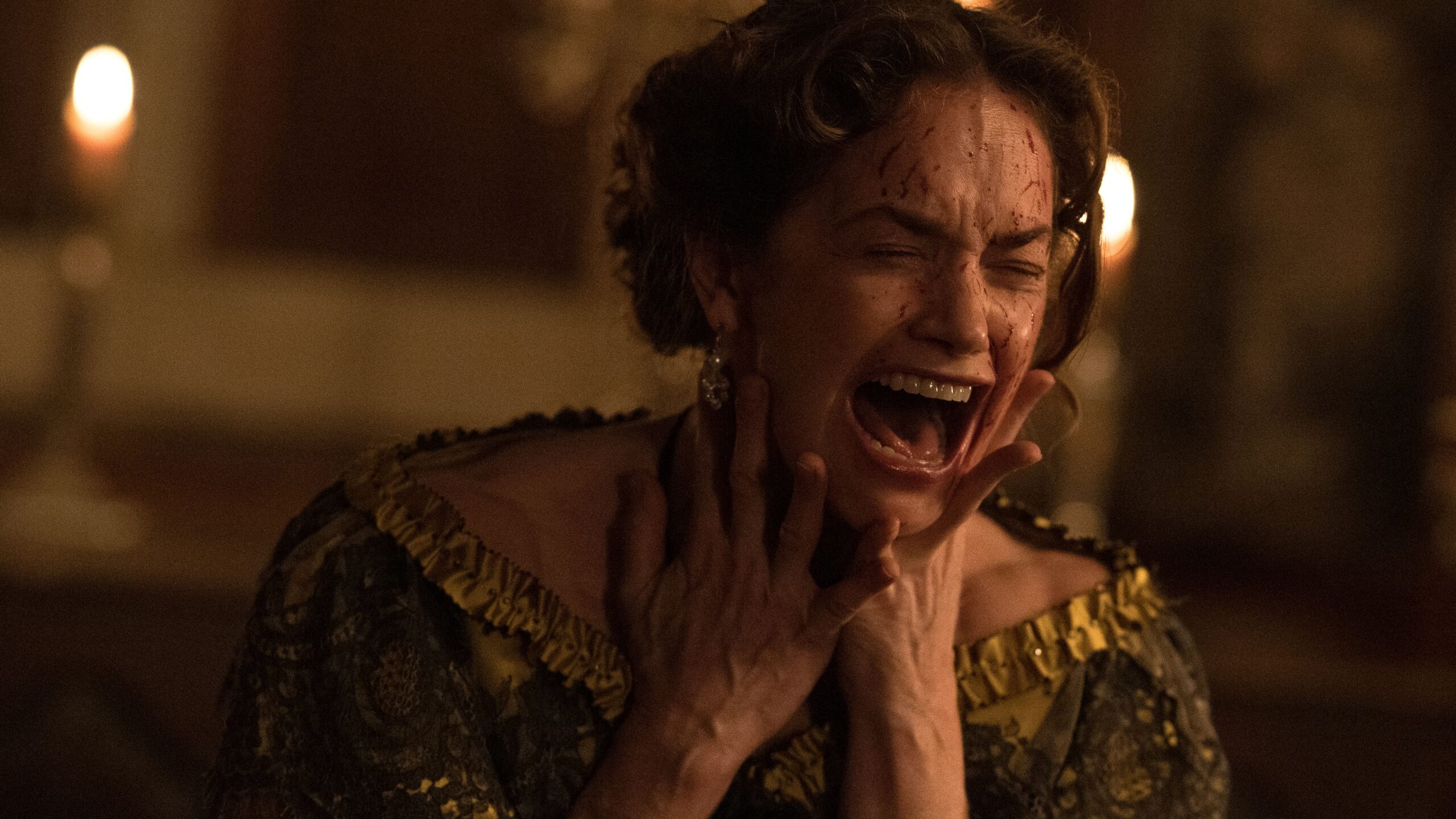
Victorian Psycho was born out of a question: why are so many of the great literary psychopaths’ men? And, when they are women, what changes in their depiction? Do they become softer, crueller, more monstrous, victimised? “I was interested in the gender play,” says author Virginia Feito.
Her first novel, Mrs March, a 21st-century invocation of Patricia Highsmith, was a wire-taut gothic thriller about an Upper East Side housewife sent into disarray. But she was interested in placing her second protagonist, this female psychopath, in the Victorian era, a period she discovered to be brimming with unfathomable violence.
There, she came across women and children living without rights or agency, stifled, and abused without a drop of consequence. “I was grasping with, like, ‘Is it relevant to be angry about this now?’” she says. “But it was making me really angry.”
Victorian Psycho, its title an allusion to Bret Easton Ellis’s seminal novel American Psycho, adapted for the screen in 2000 by Mary Harron, became a place for Feito to channel that anger. At the time, Feito had been working with director Zachary Wigon on the development of an original film and they had, in her words, “developed this great working relationship. I trusted his creative opinion implicitly.”
So, she sent him the very first draft of her book – purely for feedback (“I don’t know… compliment me!” she jokes) – only for Wigon to immediately pounce on the idea of an adaptation.

“I just couldn’t shake it, you know?” the director says. “Every page was another outrage, another sense of madness and fury. And, in the days that followed, I just kept thinking about it. And the more I thought about it, the more interested I became in this intellectual idea of: in an insane society, who’s truly crazy? The crazy people or the sane ones? Movies, when they’re compelling, they tend to be built on paradoxes. And that was a paradox that was really interesting to me.”
Feito began the work of translating page to screen and finding ways to visualise the inner workings of Winifred’s dangerous mind. As Wigon says, “Virginia has this incredible ability to blend a comic, observational, sort of mordant wit with a very real sense of losing one’s sanity. That’s a very rare quality for a writer to have.”
Victorian Psycho would become Wigon’s third feature film, after The Heart Machine (2014), about a man on the trail of a potential internet catfish, and Sanctuary (2022), in which a dominatrix and her client battle for superiority. All three take a keen interest in gendered dynamics within unexpected spaces.
“Zach and I had met over the years,” says producer Dan Kagan. “I was a huge fan of Sanctuary, and he was a big fan of Longlegs [Osgood Perkins’s 2024 horror which Kagan produced]. I said send me the script. And it was a very quick, “I love it. Let’s do it.”’

In the Year of our Lord 1858, an unusual governess named Winifred Notty arrives at the gothic manor known as Ensor House. Winifred’s responsibilities include teaching the children table manners and educating them about their family history – all whilst hiding her own psychopathic tendencies. But as staff members begin disappearing, the owners of the estate start to wonder if there may be something amiss with their new governess… Victorian Psycho invites us into the mind of a psychopath – trapped in a world she cannot control, living on the border between insurrection and madness.
From Page to Screen
The role of Winifred would go to the star of Longlegs, Maika Monroe. There, and in other roles like It Follows (2014) and 100 Nights of Hero (2025), the actor possesses a simmering, repressed intensity, a quiet that holds back an unseen storm. Here, she could finally let it all out.
“It’s always fascinating to me when an actor has inherent quality “A” and then you push them in the opposite direction of that without stultifying the inherent quality,” says Wigon. “Holding those two things in tension – that’s where I think you start to get these really complex and defined characters.”
“I’ve read a lot of scripts and this one just stood out immensely,” says Monroe. “It had such a specific tone that you could feel even just reading it. And, also, there’s something that really scared me about the role, that intrigued me. I don’t think I’ve ever done anything like this before and I knew this was going to push me into new territory.”
Monroe underwent a physical transformation, disappearing behind a frizzled auburn wig and fake teeth. She also, for the first time on film, used an accent: a Northern twang consciously concealed behind the Queen’s English, though it slips away as Winifred’s facade slowly crumbles.
“What was really interesting about working with the dialect coach [Gerry Grennell] was that, of course, in the beginning you’re just sort of working on the accent, but then you start integrating all these lines,” says Monroe. “And, by the time I was filming, the script was ingrained in my brain and in my body, which was really kind of a new experience for me. Normally you’re memorising throughout as you’re filming, but this – I knew every scene, every small, little detail, a month before even starting to film.”
It brought of an even greater sense of control over what, to the outside world, might seem a slippery, undefinable character. “She’s so brilliant,” says Kagan. “You don’t even realise the subtle nuances that she’s putting forth until you’re in the editing room. There are things happening in her eyes and in her mannerisms that only she’s able to track, you know, in scenes that are shot weeks apart.” Feito adds, “Part of how exciting it was to watch her, and still is to watch her, was just how unexpected her choices were. I can’t believe how lucky we are to have Maika as Winifred. It’s a dream.”
When it came to the Pounds family, casting directors Michael Hooley and Carla Stronge sought to mix breakout and established UK talent. Jacobi Jupe, who plays Andrew, drew significant awards attention for his role as William Shakespeare’s doomed son in Chloé Zhao Hamnet, while Evie Templeton, who plays Drusilla, gained viral fame following her scene-stealing routine, set to Lady Gaga’s “The Dead Dance”, in the Netflix series Wednesday.
“When we saw Evie’s audition tape – she just has these eyes that pull you right in, you know? She has such a presence for her age,” says Kagan. Hamnet’s festival release took place during production, meaning Jupe had to travel back and forth, from Telluride to Toronto. But the actor operated like a seasoned pro, so much so that Monroe jokes he was like a 45-year-old man in a 12-year-old’s body.
“When we were filming, he was telling us that, in between takes, he was working on his fifth novel,” she continues. “Just to get an idea of the level of intelligence that young boy has, in the way that he speaks, the questions that he asked. We were all like, what? How old are you? How do you know this? It was pretty incredible.”
For Mr. and Mrs. Pounds, Kagan says it was key to bring “weight and gravitas” to the role, so they naturally turned to two stalwarts of the industry, Jason Isaacs and Ruth Wilson. “Zach called me, and he was like, ‘I think Jason is interested.’ And immediately I was like, it’s perfect. He will nail this. He was incredible,” says Monroe. “And Ruth, every day she would do something that would just blow me away. She was hilarious but also deep. I think her performance is just incredible.”
New Zealand-born Thomasin McKenzie was cast as Miss Lamb, the nurse. “I have been obsessed with Thomasin for a very long time,” the actor continues. “She is so incredibly talented, like beyond. It was such a dream to work with her.”

Winifred’s World
Ireland would offer the perfect veil of history and intrigue for this macabre tale – so much so, in fact, that the castle chosen as the film’s primary location, just outside of Dublin, came with its own whispers of ghosts. “I think there was a certain spirit and a certain air to the castle that felt good to be around, but a little spooky after hours,” says producer Elizabeth Siegal. “It had an energy, there’s no doubt about it.”
It was important to Wigon that the film’s violent, hallucinatory elements were grounded by the world around Winifred. He was inspired, in that respect, by the films of Brian De Palma, particularly Dressed to Kill (1980). “His work is something that resonates with me directly,” the director says. “Where the use of the camera angles is sensational, but the treatment of the makeup and special effects is done as realistically as possible. It creates this interesting tension.”
“What I’m more interested in is trying to conjure something that feels like a dream. The things that happen in dreams are totally insane, because your unconscious doesn’t understand how to communicate things, but they feel so real. You can have a dream where you’re in a restaurant, but it’s not a restaurant, it’s an apartment building, right? So it’s the same thing with this, where you are doing something that is very off in the clouds, then you have to bring it back down to earth. [Allison Byrne’s] costumes have to be as realistic as possible. [Jeremy Reed’s] production design has to be as realistic as possible.”
“What I loved is, yes, it’s very grounded but you notice certain things – like, in the hallways, there were these purple walls that felt slightly heightened,” adds Monroe. In the final sequence, Winifred wears an emerald, green gown that the actor describes as a “standout, iconic dress”.
But, while Wigon may have found those “sensational” camera angles on Victorian Psycho, letting the frame twist and turn with Winifred’s sanity, he ran his set on the principles of logic and preparation. “Everything that went into each scene, Zach knew exactly what he wanted,” says Siegal. “We were in a historical place. There were certain places that we could not walk into, certain places that we could not necessarily bring our equipment to. But Zach always found a way to make it work, and our DP Nico Aguilar was incredible when it came to how we could fit a camera into the various nooks and crannies of this castle.”
“I think Zach is so, so gifted,” adds Monroe. “He’s one of those people that you just know were born to direct. He’s going to continue to make incredible, incredible films. I think he’ll be one of the greats, for sure.”
Feito was on set for the duration of filming. “I maybe overstayed my welcome because I didn’t want to leave,” she jokes. “I felt very lucky. We had the most outrageously delightful crew. It was like, ‘I kind of want you all to be my best friends and invite you to Christmas dinner.’ It’s definitely one of the best experiences of my life. Way better than my wedding, way better.”
“Having Virginia on set was one of the biggest assets we had as a production,” says Siegal. “She was incredible to bounce ideas off of and talk to about how the characters got to the place where they were.”
Ariel Marx, who previously scored Sanctuary, was then brought in to write the film’s mesmeric score and add further insight into Winifred’s psyche. “I think Ariel is truly astounding,” the producer says. “Between Sanctuary to here, you can see this lyrical storytelling that she does through her music, and it added another layer and another character to the film itself.”

The Darkness
“There are two kinds of madness that the movie is interested in, and the novel is interested in,” says Wigon. “One is madness that is labelled as an outlier, as aberrant, that we all can look at and say that’s insane because it’s outside the bounds of accepted social and cultural behaviour.”
“But there’s another kind of madness in the story, which is socially accepted madness. There are certain things that we all live in so deeply that they essentially become invisible. And, in this story, it takes someone who is an outsider to be able to point that out, but, paradoxically, the character is herself mad, because that’s how she’s able to sit outside cultural norms.”
“How much is this Winifred reacting normally to an insane situation?” Feito adds. “But, once that question is asked, I also wanted to ask, how far can we justify it? Femme rage is so satisfying, the revenge of the abused female is amazing, but also – how far do we justify it? Is it even condescending, somehow, to justify her as a female psychopath?”
Victorian Psycho, then, is a portrait both of liberation and monstrosity. Monroe, in order to create Winifred’s physical tics and expressions, watched police interviews with real-life serial killers like Ted Bundy. She also took inspiration from Jack Nicholson’s performance in The Shining (1980). “What I loved about Jack’s performance is that he was smiling all the time even when things were going horribly wrong,” she says. Wigon, in turn, would listen to Georges Montalba’s pipe organ rendition of Camille Saint-Saëns’s “Danse macabre” to put him in the right mindset.
The film externalises Winifred’s darkness as a kind of coloured, lit coil. “That was always the idea,” says Wigon. “That was how it started and that always was what felt right to me. But then, where this stuff gets interesting is you can have an abstract idea, but there are many different ways that you can execute that. And what I’ve found is when you want to do something visually sensationalistic, a lot of the details become critical. A lot of the work with the ‘darkness’, with the coil, has been to make it feel as realistic as it could given how unrealistic it is.”
What emerges from Winifred, in all its violence and rage, is at least truthful. It makes her fascinatingly complex. Because, as Siegal points out, for all the madness, “she gets to be wholly her own self. She is uniquely authentic.”
ZACHARY WIGON – DIRECTOR
Zachary Wigon is a film director living in New York. His latest feature, Victorian Psycho, starring Maika Monroe, Thomasin McKenzie, Jason Isaacs and Ruth Wilson, will premiere in Un Certain Regard at the 2026 Cannes Film Festival. Previously, he directed Sanctuary, starring Margaret Qualley and Christopher Abbott, which premiered at the 2022 Toronto Film Festival. Wigon was also a writer on the Amazon TV series Homecoming (2018-2019). Prior to working as a filmmaker, he contributed film criticism and journalism to numerous outlets, including Vanity Fair, The Village Voice, and Filmmaker Magazine, amongst many others.
VIRGINIA FEITO – WRITER
Virginia Feito was raised in Madrid and Paris, studied English and Drama at Queen Mary University of London and advertising at Miami Ad School. In 2018 she quit her successful career as a copywriter to write her acclaimed debut, Mrs. March (pub. 2021), which was translated into multiple languages and optioned by Blumhouse, with Elisabeth Moss attached to star. Feito then published Victorian Psycho in 2025, to critical acclaim. The adaptation by Zachary Wigon and starring Maika Monroe will premiere as part of the Un certain regard official selection at Cannes Film Festival this year.
She lives in Madrid and writes regularly for Vanity Fair Spain.
