
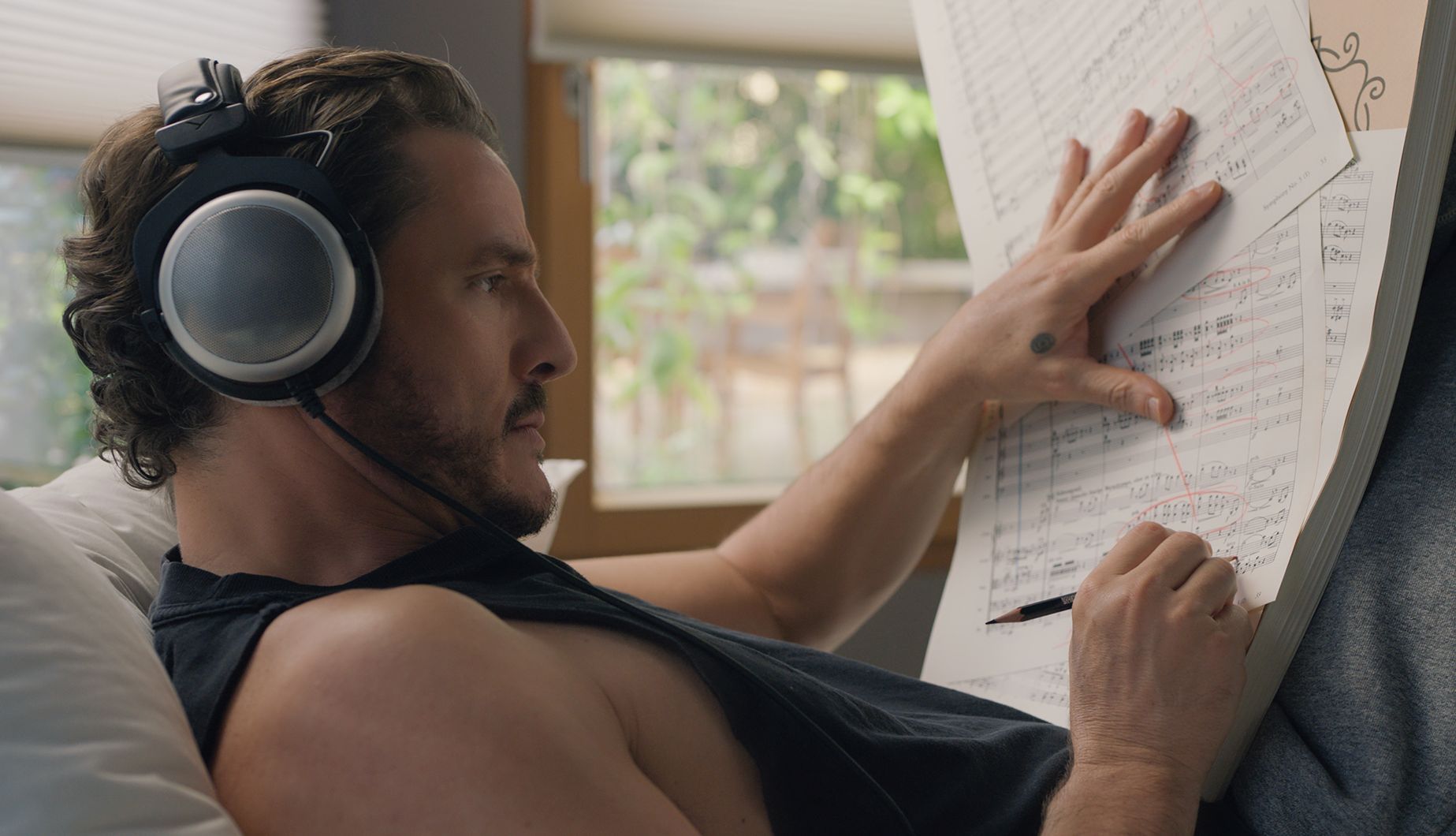
Behemoth! is a thoughtful meditation on music, memory, and the search for identity. Through the story of a musician confronting his past, the film explores how art preserves our experiences, shapes our understanding of ourselves, and offers a path toward reconciliation and renewal.
A gifted cellist, Alex Serian (Pedro Pascal), returns home to Los Angeles after 20 years on the road. Music, which has been the constant, all-consuming river of his life, begins to carry Alex on an adventure that will change him forever.
The idea for the film first came in 2016 when writer-director Tony Gilroy was recording Michael Giacchino’s score for Rogue One.
He’d directed three previous films and been deeply involved with the music, but the scale and pressures of the Rogue One sessions made him wonder why no one had set a movie within the remarkable ecosystem of Hollywood’s scoring stages.
“I’m always looking for someplace that people haven’t gone before, looking for something fresh,” says Gilroy. “When we scored Duplicity and Rogue One at the MGM/Sony stage — a scoring studio since the 1930s, with so many landmark films scored there — I remember thinking, ‘This is just such an exciting, historic place. There’s got to be a movie in this room.’”
Gilroy interviewed studio musicians, contractors, composers and arrangers for years, building relationships, letting the idea for Behemoth! percolate while showrunning two seasons of “Andor.” Over two seasons, Gilroy and composers Nicholas Brittell and Brandon Roberts parked themselves in the studio for months, humbled by the scale of the show and the variety of music required.
Six years later, Gilroy now had supervised twenty-four hours of original score with two different composers, an experience that had him diving back into the story, setting it on the scoring stage when he realized what a gift it would be to live completely in the music as they made it.

“Behemoth! is a love letter to the movie music of Southern California, the tradition and value and beauty of it,” says Gilroy. “I want audiences to lean in and say, Is that how they create a film score? We’re taking you someplace you’ve never been, but that’s always been part of your life. No one’s ever really gone into an appreciation for where the music comes from in cinema — really looked at it or the people who make that music.”
Gilroy has always been interested in characters performing at the very top of their game. For Behemoth!, that meant exploring the scoring world through an exceptionally talented, third-generation cellist from a first-call LA “session family”. For Alex, music is his everything and the language that allows him to connect to other people. Gilroy also felt the film was an opportunity to explore the universal quality music has as a catalyst for memory and was specifically interested in how memory could structure the plot.
Says Gilroy, “Music is an incredible trigger for memory. There are songs, if I hear them, I’m right there, back in time. For Alex, this sensitivity is massively amplified. He’s been deep diving into music every day of his life, and it’s a life that’s always had the shadow of something incomplete, so as the cues begin pulling him back in time, he begins to feel he’s being led somewhere. He’s a passenger on an unexpected quest that comes into focus musically.”
This musical journey through Alex’s past will lead finally to a resurrection.
Says star Pascal, “This is rich, nuanced, subtle storytelling through the experience of this character. And so much of it is a love letter to movies and to movie music, told through memories that are triggered by music. You’re on a journey with this person, understanding what’s happening to him as he comes to understand it. All of these puzzle pieces are coming together for him.”
In a time where this once-great industry could not be in a more vulnerable place, it was incredibly important to Gilroy that Behemoth! was entirely prepped, shot, scored and finished completely in Los Angeles. In addition to the composers and their full teams and studio crews, 303 AFM musicians also worked on the film on-camera and on the stage.
Pedro Pascal: Hitting Every Note
Pedro Pascal’s Alex Serian feels part of a longer lineage of creatives whose inner and outer journeys are defined by their art. When writing the character, Gilroy mapped out Alex’s psychology, biography, and trajectory in comprehensive detail.
“There’s never not been music in his life. Music is like oxygen to him,” adds Gilroy. “He’s a working musician, in demand everywhere. He’s a nomad, going where music takes him. He’s an incredibly gifted cellist and had every opportunity to become a principal soloist. He could’ve been First Chair or Concertmaster in any orchestra, but he’s always kept back, always kept himself a bit outside the spotlight.”
Says Producer/Editor John Gilroy, “When we meet Alex, he’s come back to LA, where he grew up. He comes from a multi-generational family of ‘movie music people,’ and he’s at an age where you’re starting to lose both your parents. His mother’s health is failing, and he’s coming back to take care of her. He’s trying to get away from some problems he’d had in previous cities. And as the story unfolds, you realize he’s really back for a whole other reason.”
The women Alex has dated throughout the decades have shaped him as well. Although he’s the kind of person who chooses relationships with a clear end in sight, Alex’s charisma as well as the world he inhabits still appeal to the people around him. Bronte, a fellow musician Alex meets during the present-day scoring session, connects with him in a very different way. Their mentor-mentee connection shows Alex what a great father he could have been, but also how a long-term connection can be rewarding. To portray both levels of connection, the role required an actor with that level of charm and ease. Gilroy felt Pedro exuded that magnetic quality: an almost gravitational pull.
After multiple Emmy nominations and a career that has included landmark TV series (“Game of Thrones,” “Narcos,” “The Mandalorian,” “The Last of Us”), blockbuster movies (Gladiator II, The Fantastic Four: First Steps, Star Wars: The Mandalorian and Grogu), and dramas and comedies with unique viewpoints (Eddington, The Materialists), Pascal brings a rich tapestry of experience and tones to Behemoth!in a role he’s never quite been seen in before.
“There are many reasons why Pedro was perfect for the role,” says Gilroy. “We’d seen all the work, we knew how gifted and skilled he was, and that was confirmed every single day we worked, but that only gets you almost all the way there. The temperature of this character, his footing in the world, his charm, his anxiety — everything intangible was a perfect fit with Pedro. We needed effervescence and that’s a tricky thing to balance against the hard edges of the story. Pedro has access to all of that. The discipline of the craft, the cost of loss, the loneliness and exhilaration of a nomadic life, these are real to him. Alex appeared fully-born the moment Pedro committed to the part.”
Pascal, in turn, felt he’d never worked with a director as collaborative as Gilroy. “Nobody has ever made me feel in such equal measure, like, we are in this together. That’s the way that he works with everyone. Together, we were all completely focused on this story. And as scared as I was by certain parts of the role — like learning the cello — I couldn’t have asked for a project more inviting, more generous, safer or more demanding in all the right ways.”
“Playing the cello is incredibly difficult, and Pedro was so dedicated to all the technical things he had to do,” says John Gilroy.
Alexa Swinton, who plays Viviana, was particularly struck by Pedro’s charisma and energy both in larger scenes, such as the “Your God Is Sleeping” scene in the LA warehouse club, and the more intimate moments, where music is the only language their characters speak with each other.
“In our final scene, the music is so emotional and moving and Pedro wanted to get the perfect take every single time,” adds Swinton. “He needed it to be right. It was incredible to see someone who cared about every single thing coming together.”
In bringing Alex to life, Pascal portrayed someone who is simultaneously a master at their craft and uncomfortable in the spotlight. Explains Pascal, “As you start to understand his family history and perspective on intimate relationships, you recognize that he’s very much a passenger in his life. He moves through life by instinct and by following the music, often literally. He has revelatory and vulnerable discoveries to make, but this is not a man who regrets things — he just doesn’t come to certain understandings that may have helped him sooner. And we only understand those with him at a later point of his life and career.”
The elegance and magic of music written for the movies — and performed by session musicians energized by the images onscreen as they record — has been Hollywood’s secret weapon for decades. The score is essential to the experience of a film: imagine Lawrence of Arabia without Maurice Jarre’s stirring themes, The Godfather without Nona Rota’s singular trumpet, or Star Wars without John Williams’ triumphant and otherworldly score.
For Behemoth!, Tony Gilroy wanted distinct scores for each of the films Alex is scoring in the film, as well as specific music for the fictional TV shows and cartoons scored by his father and the songs written by Viviana. Gilroy cast the composers as if they were actors in the film – each project within the film needed its own voice.
“We had the music from the composers, and then we shot videos on iPhones to map the shots out and cut it all together to those little pretend versions. We would detail the shots and what would happen well beforehand,” says Gilroy. “The thing for my brother John and me is tempo — we’re tempo freaks. And in this case, it became more extreme, because we did all the music first.”
Says John Gilroy, “This whole project was in a way, inverted. What you usually do is shoot your movie, edit it together, and then you start to find the music. We did things totally backwards here: We had the music written for the movie before we ever started shooting, which is an odd thing to do. We did it that way because Pedro had to learn how to play certain sections of the music on the cello.”
“The music in the story is actually scoring Alex Serian’s life,” he continues. “So we had to know what that was all about because we were shooting against cues that we had made. We had nine composers, and every one of them hit it out of the park. Normally, I edit a scene together and I think about music later, but here the music was sort of waiting for me.”
The nine composers working on BEHEMOTH! all recorded their respective original scores in some of Hollywood’s most hallowed music rooms, including the former MGM stage — now the Sony Pictures Scoring Stage — where music for films including The Wizard of Oz, Gone With the Wind, An American in Paris, Singin’ in the Rain, Lawrence of Arabia, and Schindler’s List were recorded— and the Newman Scoring Stage at Fox (where the scores for Carousel, The Sound of Music, Jaws, and The Bourne Identity, among others, were recorded), as well as at Los Angeles’ EastWest Studios.
Tony Gilroy is a critically acclaimed, award-winning director, writer and producer. Most recently, Gilroy served as the creator of Lucasfilm’s critically acclaimed series “Andor. He made his feature film directorial debut with Michael Clayton. He then followed with his second directorial effort based on his own screenplay: the thriller Duplicity. A veteran screenwriter, Gilroy worked on the first three Bourne films: The Bourne Identity, The Bourne Supremacy and The Bourne Ultimatum. He then co-wrote and directed the fourth installment of the series, “The Bourne Legacy.” Gilroy also co-wrote the screenplay for 2016’s Rogue One: A Star Wars Story, which grossed more than $1 billion at the worldwide box-office. He brought a clear creative vision to the film and from that, “Andor” was born. Gilroy’s additional writing credits include Beirut; State of Play, Michael Bay’s blockbuster Armageddon, Michael Apted’s Extreme Measures, Dolores Claiborne, The Devil’s Advocate, and Proof of Life for director Taylor Hackford; and The Cutting Edge. Raised in upstate New York, Gilroy is the son of Pulitzer Prize-winning playwright and filmmaker Frank D. Gilroy. His brother Dan Gilroy is a screenwriter who co-wrote The Bourne Legacy, and his brother John Gilroy is a film editor who also worked on Michael Clayton, Duplicity and The Bourne Legacy. The brothers reunited to work together on “Andor,” with Dan serving as writer of three episodes and John as editor and executive producer.
