Celebrating the craft of writing and the art of storytelling.
Blue Film – A Night of Reckoning & Power
by Daniel Dercksen·Comments Off on Blue Film – A Night of Reckoning & Power
Blue Film, written and directed by Elliot Tuttle, is one of the most daring American independent debuts of its year, a chamber‑drama thriller that traps two men in a single Los Angeles Airbnb and refuses to let either of them escape the consequences of their shared past.
The film stars Kieron Moore as Aaron Eagle and Reed Birney as Hank Grant, delivering two of the most psychologically intense performances of 2026. Across eighty‑two minutes, the film unfolds as a claustrophobic confrontation between desire, guilt, exploitation, and the blurred line between performance and confession.
“I feel like a lot of sex in contemporary film is pretty conceptual. I really wanted to make something where sex felt like it had a real imprint on our lives, and it was laced with like danger or a life-changing feeling, because that’s how I think a lot of us experience sex. It does inform the way that we live our lives, even on a minute level. I would hope that audiences, more so than [the film] sparking a discussion, leave having felt seen or moved in some way. ‘
The significance of Blue Film lies in its uncompromising willingness to explore taboo territory without sensationalism
Tuttle’s film is not a thriller in the conventional sense; it is a moral autopsy, a slow, suffocating excavation of two men bound by a traumatic history. The film’s structure — a single night, a single location, two men circling each other like wounded animals — recalls chamber works by Pasolini, Catherine Breillat, and Agustí Villaronga, influences Tuttle openly acknowledges. Yet Blue Film never feels derivative. Its emotional violence is intimate rather than operatic, its tension built not from plot twists but from the unbearable proximity of two people who cannot escape what they once were to each other.
The inspiration for the film emerges from Tuttle’s fascination with the intersection of sexuality, power, and the camera — how performance becomes a shield, a weapon, and a confession
In interviews, Tuttle describes researching real cases of teacher‑student boundary violations, the psychological aftermath of grooming, and the ways adult performers use persona to reclaim or distort their own histories. The film’s title, Blue Film, evokes both pornography and melancholy, signalling the dual nature of the story: a transactional sexual encounter that becomes a reckoning with buried trauma. The director’s decision to thread home‑video footage of himself as a child into the narrative adds a meta‑cinematic layer, blurring the boundary between fiction and autobiography and reinforcing the film’s central question: what does it mean to be seen, and who controls the lens?
“It started as a conceptual piece of writing, but that’s not really a way to make a film. Maybe it is for some filmmakers! But there was a process of rewriting to narrativize it. When I’ve written something, that’s what happens. It starts with a couple of big ideas, and then [those] get synthesized through characters and plot over a series of rewrites. I never think of the story first, necessarily. It always starts with a feeling, and then I’ll figure out how to translate that feeling.”
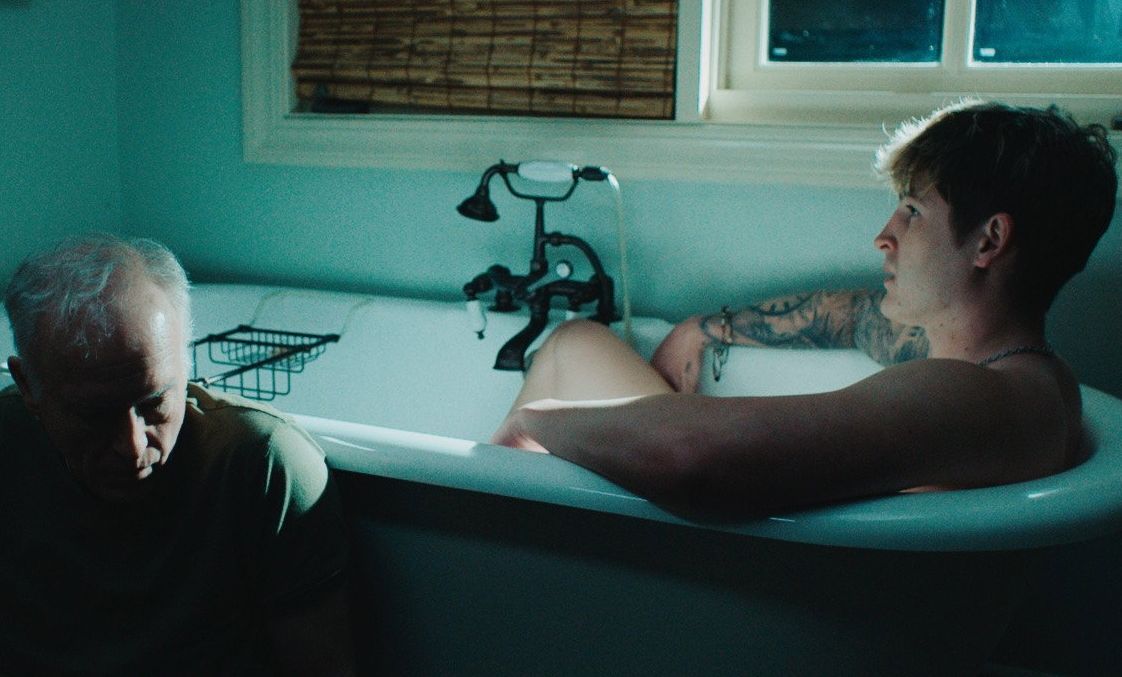
The plot centres on Aaron Eagle, played with terrifying precision by Kieron Moore. Aaron is a Los Angeles camboy specialising in financial domination, a performer who uses bravado and hypermasculinity as armour. He is hired anonymously for fifty thousand dollars by a masked client, Hank Grant, portrayed by Reed Birney, a former middle‑school English teacher who served seven years in prison for attempting to assault a student. When Aaron recognises Hank as the teacher who once groomed him — and who was once in love with him — the encounter shifts from performance to confrontation. The masks come off, literally and metaphorically, and the film becomes a marathon of confession, role‑play, accusation, and emotional dissection.
Moore’s performance is a revelation. He calibrates Aaron’s persona with exquisite control: swagger, cruelty, seduction, and sudden flashes of childlike vulnerability. In one interview, Moore describes the pivotal moment when Hank calls Aaron by his real name, “Alex,” as a psychological collapse — a moment when bravado evaporates and the character regresses to the frightened boy he once was. Birney, meanwhile, delivers one of the most heartbreaking performances of his career. His Hank is not a monster in the traditional cinematic sense but a man hollowed out by guilt, desire, and self‑loathing. The film refuses to absolve him, yet it also refuses to flatten him into a caricature. Birney’s portrayal is devastating precisely because it is human.
The film’s significance within 2026 cinema is multifaceted
First, it marks a bold return to art‑house chamber drama in American independent filmmaking
A style largely abandoned in favour of broader genre hybrids. Shot in twelve days in Hancock Park, the film uses its constraints as strengths: the Airbnb becomes a pressure cooker, the shifting camera formats — cinematic 4K, camcorder, webcam — create a fractured visual language that mirrors the characters’ fractured identities. Isaac Eiger’s score deepens the dread, threading unease through even the quietest moments.
Second, Blue Film stands out for its refusal to moralise
It does not offer redemption, nor does it indulge in voyeuristic punishment. Instead, it presents two men locked in a psychological duel, each trying to reclaim power from the other, each failing, each revealing more than he intends. The film’s ambiguous ending — a quiet, devastating dissolution rather than a dramatic climax — reinforces its thematic commitment to realism. Trauma does not resolve neatly. Confession does not heal. Performance does not liberate. The film ends as it begins: with two men trapped in the consequences of their shared past.
Third, the film’s exploration of queer masculinity is unusually complex
Aaron’s camboy persona is not portrayed as shameful but as a form of agency, a way of controlling the gaze that once harmed him. Hank’s desire, meanwhile, is depicted not as monstrous because it is queer but because it is predatory. The film’s moral clarity lies not in condemning sexuality but in interrogating power. This distinction makes Blue Film a significant contribution to contemporary queer cinema, offering a narrative that is neither sanitised nor sensationalised.
Finally, Blue Film is significant as a debut
Elliot Tuttle emerges as a filmmaker with a fearless voice, willing to merge psychological realism with formal experimentation. His influences are visible, but his vision is unmistakably his own. The film’s starkness, its emotional brutality, and its refusal to offer comfort mark it as a work of rare conviction.
In the end, Blue Film is a story about the cost of being seen — through a lens, through memory, through desire. It is a film about two men who cannot escape each other, who cannot escape themselves, and who spend one long night confronting the truth that performance can reveal as much as it conceals. With its intense performances, its claustrophobic structure, and its unflinching thematic depth, Blue Film stands as one of the most haunting and significant independent films of 2026.
Elliot Tuttle: A Biography
Elliot Tuttle is an American filmmaker, writer, and editor whose work is defined by its fearless engagement with taboo subjects, psychological intimacy, and the unstable boundary between performance and identity. He emerged as one of the most provocative new voices in independent cinema with his debut feature Blue Film (2026), a chamber‑drama thriller that confronts sexuality, power, and trauma with unflinching honesty. Tuttle’s background, early work, and artistic influences all converge in a filmmaking style that is both confrontational and deeply humane, positioning him as a rising auteur in contemporary American cinema.
Born in the United States, Tuttle began his creative career working across multiple disciplines, including directing short‑form projects and contributing to production departments. His early credits include The Steps (2020), in which he also appeared as an actor, and Lina’s Song (2022), a podcast series he directed. These projects established his interest in intimate storytelling and character‑driven narratives, themes that would later define his feature work. His growing reputation led to representation by Fusion Entertainment, marking a significant step in his professional trajectory as he transitioned from short‑form and experimental work into feature filmmaking.
Tuttle’s breakthrough came with Blue Film, a project that immediately attracted attention — and controversy — even before its premiere. The film was rejected by multiple festivals, including queer‑focused ones, due to its confrontational subject matter: a single night between a camboy and the former teacher who once groomed him. This notoriety created a rare situation for a first‑time director: the film became a topic of discussion long before audiences had the chance to see it. As Slant Magazine notes, Blue Film “achieved a rarity for a small indie from a first‑time director, as its reputation already preceded it,” with programmers wary of backlash for platforming a film that interrogates the nature of perversion, shame, and desire.
Tuttle’s artistic influences are wide‑ranging and deeply embedded in his work. In an interview with Filmmaker Magazine, he discusses the significance of the color blue in cinema — from Hays Code censorship to Portugal’s Estado Novo dictatorship — and how these historical associations informed the conceptual framework of Blue Film. He cites Ingmar Bergman as a major influence, particularly the Swedish director’s exploration of the dissonance between the assumed self and the true self. Tuttle’s fascination with identity, performance, and emotional interiority echoes Bergman’s thematic concerns, though filtered through a distinctly contemporary and queer lens.
His approach to filmmaking is marked by a desire to restore emotional weight to cinematic sexuality. Tuttle has expressed frustration with what he sees as the conceptual, sanitized nature of sex in contemporary film. In his own words, he wanted to create work where sex “felt like it had a real imprint on our lives, and it was laced with danger or a life‑changing feeling,” reflecting how sexuality shapes identity and experience. This philosophy underpins Blue Film, which uses eroticism not for titillation but as a vehicle for psychological revelation and confrontation.
Tuttle’s directorial style is characterized by minimalism, intensity, and a willingness to let discomfort linger. Blue Film was shot in twelve days in a single Los Angeles Airbnb, a constraint that he transformed into a strength. The film’s claustrophobic setting becomes a crucible for emotional and moral reckoning, with Tuttle guiding actors Kieron Moore and Reed Birney through performances that critics have described as transfixing, destabilizing, and brutally honest. His direction emphasizes the instability of identity, the fluidity of persona, and the ways in which people weaponize or retreat behind performance — themes that resonate strongly with queer audiences and with viewers interested in psychological drama.
Beyond his thematic interests, Tuttle’s career reflects a commitment to independent filmmaking and artistic risk. His willingness to confront taboo subjects has made him both a controversial and celebrated figure. While some viewers and critics have found his work challenging or unsettling, others have praised its emotional depth and intellectual rigor. As he noted in interviews, audience reactions to Blue Film vary widely: some viewers are deeply moved, while others struggle to sympathize with any of the characters. For Tuttle, this range of responses is not a flaw but a sign that the film is provoking genuine engagement — a core goal of his artistic practice.
Tuttle’s biography is still being written. As a young filmmaker with only a handful of credits, his career remains in its early stages, but the impact of Blue Film has already positioned him as a distinctive voice in American cinema. His work demonstrates a rare combination of intellectual ambition, emotional vulnerability, and formal experimentation. With his signing to Fusion Entertainment and the critical attention surrounding his debut feature, Tuttle is poised to continue exploring the boundaries of cinematic storytelling, particularly in areas where sexuality, identity, and power intersect.
In sum, Elliot Tuttle is a filmmaker defined by courage — the courage to confront taboo subjects, to explore the darkest corners of human desire, and to craft stories that refuse easy moral answers. His biography reflects a trajectory shaped by artistic curiosity, personal introspection, and a commitment to challenging audiences. As he continues to develop new projects, Tuttle stands as one of the most compelling emerging voices in contemporary queer and independent cinema.