
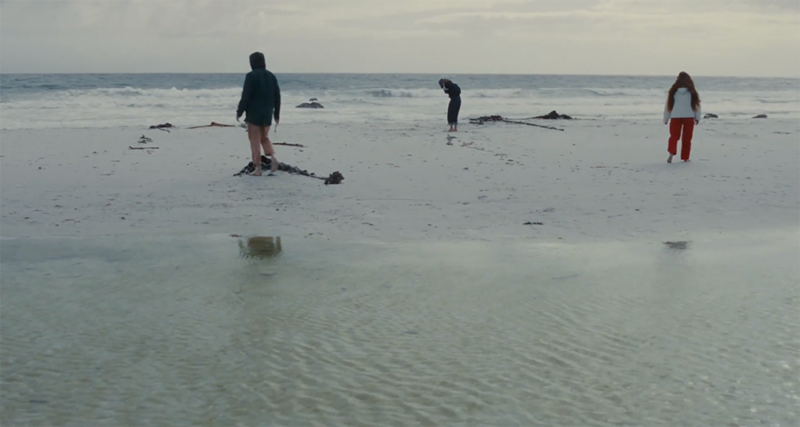
Landmyn is ’n besinning oor universele breuke wat binne families en gemeenskappe bestaan. Die film ondersoek hoe patrone van volharding, misverstand en verlange dikwels oor geslagte heen voortduur, ongeag individuele omstandighede. Deur hierdie temas binne ’n gestroopte kuslandskap te plaas en ’n waarnemende styl te gebruik, nooi Landmyn gehore uit om te reflekteer oor die breër menslike toestand — hoe wonde bly voortleef, hoe nabyheid gesoek word, en hoe onstabiliteit ons gedeelde ervaring vorm.
Scroll down for English Translation
DIE DRAAIBOEK
Twee beelde het by my gebly terwyl ek geskryf het: ’n weggegooide blik kondensmelk verstrengel in seewier, en ’n ma se skouertrek wanneer sy met haar seun se hunkering na nabyheid gekonfronteer word. Dit was nie uitgedinkte simbole nie, maar herinneringe, en ek het geweet ek kan ’n storie rondom hulle bou. Die atmosfeer van die grou kus in die winter gee die reünie ’n vae gevoel van verval, en verander die landskap in ’n emosionele terrarium waaruit die familie nie kan ontsnap nie.
In die regie het ek probeer om waarnemend eerder as interpreterend te bly. Die film is met ’n enkel lens geskiet om pretensie weg te stroop en ’n konstante afstand van die karakters te hou. Oordrewe musiek en skielike onderbrekings breek die neutraliteit, en hou die gehoor binne dieselfde onstabiele ruimte as die familie.
Ek weet nie of Landmyn hierdie vrae oplos nie. Wat ek wel weet, is dat die maak daarvan soos ’n poging tot begrip gevoel het, en ek sien uit na hoe kykers hulself daarin herken — of nie.
VRAE EN ANTWOORDE MET DIE REGISSEUR, Nico Scheepers
Baie families worstel met patrone wat onmoontlik lyk om te breek. Hoe ondersoek Landmyn hierdie universele tema van wonde wat weier om te genees, selfs terwyl die lewe voortgaan?
In sy kern gaan Landmyn oor die onsigbare kontrakte wat ons van ons families erf. Selfs wanneer ons die huis verlaat, loopbane bou, oorsee verhuis of nuwe verhoudings begin, vind ons dikwels dat ons patrone herhaal wat lankal vasgelê is, sonder dat ons ‘n sê daarin gehad het. Nou volwassenes, het Annatjie se kinders jare lank probeer om uit hul ma se invloed te ontsnap, maar haar aankoms trek hulle onmiddellik terug in bekende rolle en gedrag. Wat my geinteresseer het, was die spanning tussen groei en herhaling: die idee dat mense kan verander, maar dat ou wonde verrassend aktief onder die oppervlak bly. Die film vra of ware genesing kom deur versoening, konfrontasie, of bloot deur te leer saamleef met dít wat nie herstel kan word nie.
Jy het ’n waarnemende styl gekies, met ’n enkel lens en doelbewuste onderbrekings in klank en
redigering. Hoe nooi hierdie tegniek gehore uit om onstabiliteit as ’n gedeelde menslike toestand te
konfronteer eerder as ’n private verhaal?
Ek wou hê die kamera moes voel soos nog ’n familielid wat in die huis vasgevang is. Teenwoordig vir elke ongemaklike stilte, elke argument en elke poging tot versoening, maar nie in staat is om in te gryp nie. Die gebruik van ’n enkele lens het ’n konsekwentheid geskep wat ons toegelaat het om die karakters waar te neem eerder as om die gehoor se gevoel te te manipuleer. Die onderbrekings in klank en redigering is herinneringe dat geheue, persepsie en familiegeskiedenis nooit heeltemal stabiel is nie. Mense kan dieselfde gebeurtenis op heeltemal verskillende maniere ervaar. My hoop was dat gehore dele van hul eie families in hierdie oomblikke sou herken. Die film word minder oor hierdie spesifieke familie en meer oor die onsekerheid, teenstrydighede en emosionele warboel wat die meeste van ons saamdra.
Die akteurs het hul eie hare en grimering gedoen, soos in teater. Hoe het hierdie keuse die kreatiewe proses beïnvloed en hul aanklank met die karakters verdiep?
Die besluit het deels uit praktiese oorwegings gekom, maar dit het vinnig ’n belangrike kreatiewe hulpmiddel geword. In teater berei akteurs hulself dikwels voor voordat hulle die verhoog betree, en
daardie proses skep ’n gevoel van eienaarskap oor die karakter.
Dit het ook gehelp om die natuurlike tekstuur te skep waarna ons opsoek was. Landmyn gaan oor ’n gewone familie wat buitengewone emosionele omstandighede navigeer, so dit was belangrik dat niemand oormatig gestileer of opgesmuk gevoel het nie. Die familie moes “ingeleef” gevoel het.
Jy het die verfilmingsproses soortgelyk aan ’n teaterproduksie benader, met sterk klem op repetisie en karakterontwikkeling. Wat het jou gemotiveer om hierdie metode vir Landmyn te gebruik, en hoe het dit die vertolkings gevorm?
Teater is my eerste liefde, om daardie proses oor te dra na film voel vir my heeltemal natuurlik. Veral op ’n film soos Landmyn, wat regtig oor verhoudings gaan eerder as oor die storielyn. Gedrag. Spanning. Die dinge wat mense nie hardop sê nie. Daardie voorbereiding het ’n vlak van vertroue geskep wat die vertolkings spontaan en “geleef” laat voel het. So kon ons minder fokus op die verduideliking van emosies en meer op die waarneming daarvan.
Watter blywende indruk of emosionele reaksie hoop jy gehore neem met hulle saam nadat hulle Landmyn ervaar het?
Families bestaan uit teenstrydighede. Ons kan mense diep liefhê en steeds deur hulle seergemaak word. Ons kan iemand verstaan sonder om hulle te vergewe. Ons kan ’n familie ontgroei en terselftetyd daarna verlang. Landmyn bied nie maklike antwoorde nie, want regte families doen dit selde. Maar ek hoop dit moedig mense aan om te reflekteer oor die verhoudings wat hulle gevorm het, en miskien om daardie verhoudings met ’n bietjie meer deernis te benader.
NICO SCHEEPERS – Skrywer/Regisseur
Nico Scheepers is ’n Suid-Afrikaanse filmmaker en teaterregisseur wie se werk families, herinneringe
en die emosionele landskappe van plek ondersoek. Sy debuutrolprent, Hen (2025), het agt toekennings by die Silwerskermfees ontvang, wat ingesluit het dié van Beste Regisseur. In 2026 het Hen sy Britse debuut gemaak by die Glasgow-filmfees en was ook in kompetisie. Sy televisiereeks Donkerbos is in 2023 gekies vir die Berlinale Series Select in Berlyn, en hy het die SAFTA-toekenning vir Beste Regisseur vir die projek ontvang. Landmyn is Scheepers se tweede vollengte rolprent.
Landmyn is a meditation on universal fractures that exist within families and communities. The film
explores how patterns of endurance, misunderstanding, and longing often persist across
generations, regardless of individual circumstance. By situating these themes within a stark coastal
landscape and employing an observational style, Landmyn invites audiences to reflect on the
broader human condition — how wounds linger, how closeness is sought, and how instability shapes
our shared experience.
DIRECTORS’ STATEMENT – Nico Scheepers
Landmyn began with a question I still can’t answer why certain family wounds refuse to heal, even
when the lives around them have moved on. I grew up in a house where love often looked like
endurance, and my sisters and I learned early that shared history does not guarantee shared
understanding. I wanted to make a film about the patterns that survive people’s attempts to escape
them.
Two images lingered while writing: a discarded can of condensed milk tangled in seaweed, and a
mother’s shrug when confronted with her son’s hunger for closeness. They were not invented
symbols, but memories, and I knew I could build a story around them. The off-season atmosphere
of the wintry coast lends the reunion a faint sense of decay, turning the landscape into an emotional
terrarium the family cannot escape.
In directing, I tried to remain observational rather than interpretive. The film was shot on a single lens
to strip away pretence and keep a steady distance from the characters. Overt music and abrupt cuts
interrupt neutrality, keeping the audience inside the same unstable space as the family.
I don’t know whether Landmyn resolves these questions. What I know is that making it felt like an
attempt at understanding, and I look forward to how viewers recognise themselves, or do not, within
it.
Q&A WITH THE DIRECTOR
Many families struggle with patterns that seem impossible to break. How does LANDMYN explore this universal theme of wounds that resist healing, even as life moves forward?
At its heart, Landmyn is about the invisible contracts we inherit from our families. Even when we leave home, build careers, move abroad, or start new relationships, we often find ourselves repeating patterns that were established long before we had any say in them. The siblings in Landmyn have spent years trying to escape the influence of their mother, yet her arrival immediately pulls them back into familiar roles and behaviours. What interested me was the tension between growth and repetition: the idea that people can change, but that old wounds remain surprisingly active beneath the surface. The film asks whether true healing comes from reconciliation, confrontation, or simply learning to live with what cannot be repaired.
You chose an observational style, with a single lens and deliberate interruptions in sound and editing. How does this technique invite audiences to confront instability as a shared human condition rather than a private story?
I wanted the camera to feel like another family member trapped in the house. Present for every awkward silence, every argument and every attempt at reconciliation, but unable to intervene. Using a single lens created a consistency that allowed us to observe the characters rather than manipulate how audiences should feel about them. The interruptions in sound and editing are reminders that memory, perception and family history are never entirely stable. Different people can experience the same event in completely different ways. I hoped that audiences would recognise parts of their own families in these moments. The film becomes less about this specific family and more about the uncertainty, contradictions and emotional messiness that most of us carry.
The actors managed their own hair and make-up, much like in theatre. How did this choice influence the creative process and deepen the actors’ connection to their characters?
The decision came partly from practicality, but it quickly became an important creative tool. In theatre, actors often prepare themselves before stepping on stage, and that process creates a sense of ownership over the character.
It also helped create the naturalistic texture we were looking for. Landmyn is about an ordinary family navigating extraordinary emotional circumstances, so it was important that nobody felt overly styled or manufactured. The family needed to feel lived in.
You approached the filming process similar to a theatre production, placing strong emphasis on rehearsal and character development. What motivated you to adopt this method for Landmyn, and how did it shape the performances?
Theatre is my first love, so bringing collaborators of that process into film feels completely natural to me. Especially on a film like Landmyn, which is really about relationships rather than plot. Behaviour. Tension. The things people don’t say. That preparation created a level of trust that allowed the performances to feel spontaneous and lived in. It meant we could focus less on explaining emotions and more on observing them.
What lasting impression or emotional response do you hope audiences carry with them after
experiencing Landmyn?
Families are made of contradictions. We can love people deeply and still be hurt by them. We can understand someone without forgiving them. We can outgrow a family and still long for it at the same
time. Landmyn doesn’t offer easy answers because real families rarely do. But I hope it encourages people to reflect on the relationships that shaped them, and perhaps to approach those relationships with a little more compassion.
NICO SCHEEPERS – Writer / Director
Nico Scheepers is a South African filmmaker and theatre director whose work explores family, memory, and the emotional landscapes of place. His debut feature film, Hen (2025), won eight awards at the
Silwerskerm Festival, including Best Director, and received its UK premiere in competition at the Glasgow Film Festival 2026. His television series Donkerbos was selected for Berlinale Series Select in 2023, and he received the SAFTA Award for Best Director for the project. Landmyn is his second feature film.
SOUTH AFRICAN FILMMAKING

Visit Our YouTube Channel
