
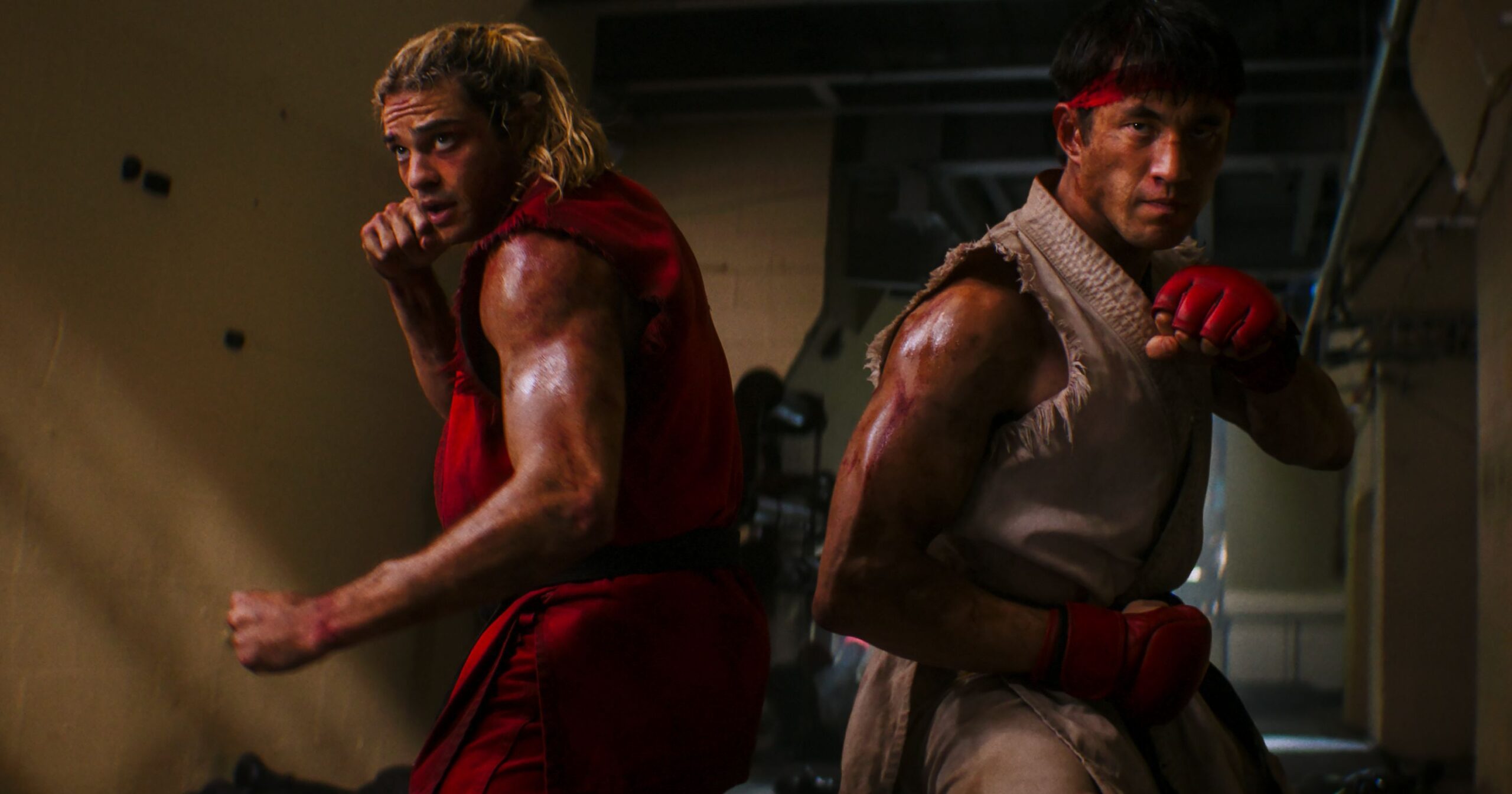
Street Fighter is one of the highest-grossing media franchises in history. It has inspired generations of martial artists and gamers. Its characters are beloved in pop culture. The film adaptation of this video game was co-written by T. J. Fixman and director Kitao Sakurai, based on a story by Dalan Musson and Gary Dauberman.
Caption: Noah Centineo, left, and Andrew Koji star in PARAMOUNT PICTURES AND LEGENDARY PICTURES In Association with CAPCOM. A LEGENDARY PICTURES Production “STREET FIGHTER”
“I remember when Street Fighter came out,” says Sakurai. “It was a huge moment culturally, and especially for me as a half-Japanese kid growing up in Ohio, it was the first time I saw a character in fiction who reflected who I was.”
Beyond representation, for Sakurai, Street Fighter launched a social revolution as well. “It broke out a whole market of arcades and people coming together to play Street Fighter,” he recalls. “Where I grew up, there wasn’t a convenient arcade, but my best friend had a home console. So I would go over to his house, and all our friends would come over to play, so his house was like a mini arcade.”
Legendary sought someone with both a deep emotional connection to the game and an authentic understanding of the culture of Street Fighter
Sakurai was the right filmmaker because his career had been defined by finding the precise point where tension, character and absurdity collide. He understood that Street Fighter should be fun without sacrificing story, character or stakes.
“I spent my childhood between Japan and America, and so Street Fighter was a really important game for me and for other Asian-American kids,” says Sakurai.
“It was the first thing from Japanese culture that really crossed over into American culture, and it was a way that other kids my age could understand a bit about where I came from. It was a first on so many levels – the first fighting game, first female character, first Black character, so what this game means to so many cultures and different groups of people is deep.”

It was this collective experience that was vital for the director to capture.
“Street Fighter is about an ensemble where you’re bringing these different characters and cultures into one world,” he adds. “Those characters became so iconic that they became a part of culture more broadly, and so when Legendary and Capcom talked to me about making a film, I told them that those characters are in me already.”
Sakurai knew that in order to make an honest representation of the game, he had to make Street Fighter a very personal film.
“You have to honor the game and what’s integral to the game, but the film has to be its own living, breathing entity,” he explains. “It has to have its own voice and feel like it was made by filmmakers who are taking you on a journey. The whole point of making Street Fighter is because people love the characters, they love that world, so it’s about bringing that to life in an honest and authentic way, to create a film that has a lot of energy and attitude.”
In late 2024, Legendary hired Dalan Musson to pen the screenplay, with revisions by Gary Dauberman, T.J. Fixman and Kitao Sakurai.
“First off, the early ‘90s just feels fun,” says Sakurai, “the music, the style, and the fact that the game came out of the ’90s, it just felt right. The film is set in 1993, but it’s a heightened, slightly ‘alternate’ version of 1993. It’s more about how we remember the feeling of that era”
Street Fighter follows estranged fighters Ryu and Ken, reunited by Chun-Li to enter the high-stakes World Warrior Tournament, only to uncover a hidden conspiracy that forces them to confront each other and their past. With a massive ensemble of actors, wrestlers, and martial artists, the film blends action, humour, and faithful nods to the iconic game.
