
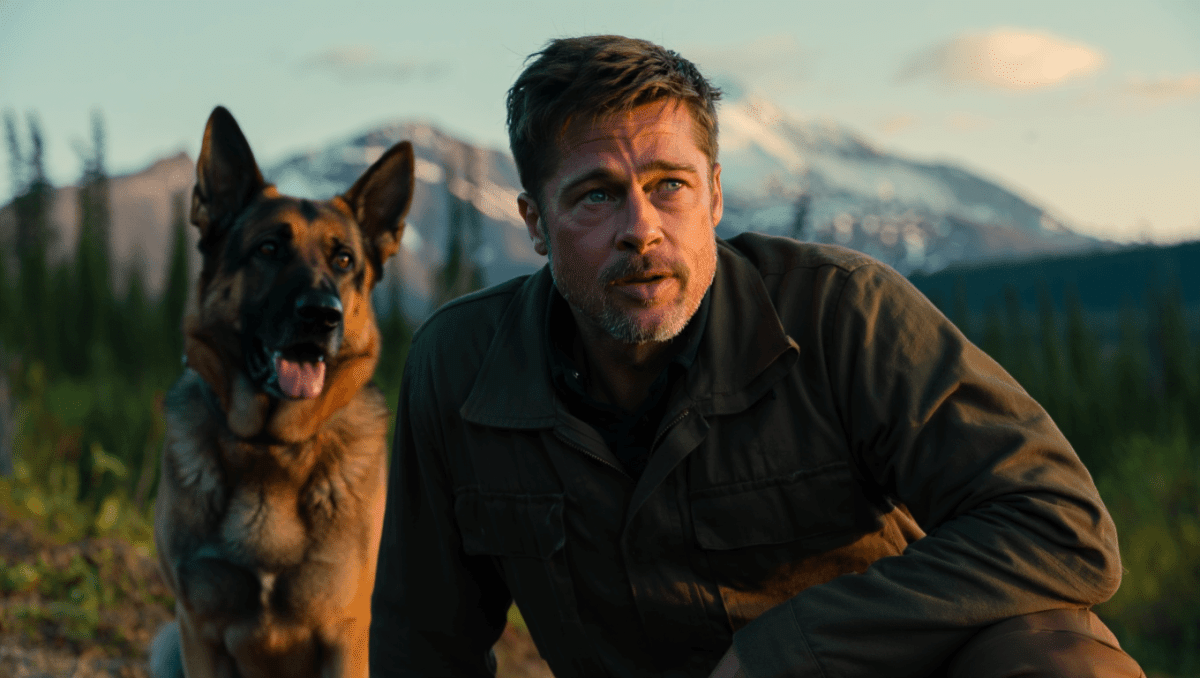
Director David Ayer believes that no great story should remain untold and once he read the script for Heart of the Beast, he knew that he wanted to be the person to tell this one. “It was simply one of the best pieces of writing I’d ever seen,” he says. “It didn’t just make me cry; it made me ugly cry. I’d have to stop and process a little bit, then start reading a few more pages.”
The director is well known for kinetic, hard-edged stories of brotherhood and perseverance, like the World War II action-adventure Fury and the gritty, documentary-style urban cop drama End of Watch. He recognized Sergeant Major James Belmont (Brad Pitt) and canine commando Odin as brothers-in-arms, each willing to do whatever it takes to keep the other alive.
“After surviving the unsurvivable in Iraq and Afghanistan, they face yet another challenge together,” says Ayer. “In my mind, James had made the dog a promise, something like, ‘If we survive this, I’m going to take you fishing.’ There’s something magnetic about being stranded in the wilderness. We’ve all been cold.
We’ve all been lost. We’ve all been hungry. This film takes audiences on that journey and makes them wonder, could I survive this? But it’s also the story of devoted partners that never give up on each other, that care more about each other’s safety than their own and who would sacrifice themselves for the other in a heartbeat.”
Producers Damien Chazelle, the Oscar®-winning director of La La Land, and his partner Olivia Hamilton had the same reaction. “The simplicity of the script and its description of man versus wilderness grabbed us,” says Hamilton. “It didn’t try to be complicated, and it spoke to a broad audience. Yes, it’s an action and adventure movie, but there’s also a ton of heart.”
There was never any question in their minds about who they wanted to direct. It had to be Ayer. “David has a way of connecting with the emotional, the mythical, the visceral experience of watching a film,” Hamilton explains. “He’s also ex-military himself, a submariner who enlisted at 19. He has stayed in touch with a lot of people in the military and was dedicated to making sure that every single detail on the screen was worthy of them. All the tiny details and nuggets in the film are drawn from real life.”
The producers and Ayer were pleased to realize that they had the same vision for the film. “Olivia and Damien understand how a director thinks and actually provided a lot of guidance that helped keep the process on track,” says Ayer. “We all saw something poetic in the depiction of the relationship between James and Odin. The movie is very much about their love for each other. It’s about trust. It’s about spiritual endurance and never giving up on someone who’s close to you. And then there was Brad. We all had a previous relationship with him, so it just felt like we were bringing the family back together.”
That shared vision was equally important to producer Marty Bowen, who was drawn to the emotional core of the story and the relationship at its center.
Chazelle and Hamilton were introduced to Heart of the Beast by co-producer Richard Raymond after the screenplay was named to the 2017 Hollywood Blacklist, the annual list of the most-admired unproduced screenplays. Screenwriter Cameron Alexander says that part of his inspiration for the film was his longstanding love of the outdoors and fascination with military culture. His admiration for warriors like Navy SEALs and Green Berets is evident in the script.
“Those guys are incredible,” he says. “During America’s most recent wars, they were joined by combat dogs capable of incredible tasks. There hasn’t been a tale focusing on what happens to the soldiers or the dogs when they get out of the military. I became fascinated with their stories and I thought it could be a really unique portrayal of the PTSD they both can suffer from.”
There was another, more personal inspiration as well. “I wrote it at a difficult moment in my life,” Alexander says. “At the time, I felt like my only real friend was my dog Hoss. There was no complicated calculus. I just wanted to write about my dog. Hoss was having a lot of health problems, so all my spare money went to trying to fix him. Right when he passed away, Olivia and Damien came into my life. I felt like I took care of Hoss and, after his death, he took care of me. He made my dreams come true. So I hope the audience takes away the message to keep fighting for the things that you love and to never give up. That’s the core of the film.”
Heart of the Beast is Alexander’s feature film debut as a writer. “I never dreamed it would be made at this level, with these producers, this director and this star,” he says. “Damien and Olivia are among the most talented and interesting filmmakers out there. When I first met with them, Damien said that they only planned to produce one film that year. They wanted it to be Heart of the Beast. Of course I said yes. There was an offer from Paramount the very next day.”
Ayer’s personal knowledge and understanding of life in the military impressed the writer from the beginning. “He had the right pedigree,” says Alexander. “And he understood the whole film’s about loving something more than you love yourself.”
Filmed on location and in studio in New Zealand, Heart of the Beast brings an otherworldly feeling to the country’s soaring mountains and deep valleys. Ayer and his Academy® Award-winning director of photography Mauro Fiore have imbued the landscapes with a sense of beauty, mystery and a whiff of magical realism. “Mauro has old-school craftsmanship, artistry and a creative soul,” says Ayer. “His ability to understand camera and light makes him an incredible collaborator. He is both a visionary and a skilled technician. His work here is all the more impressive because conditions were physically arduous. We were wet, cold, tired and miserable most of the time. There was something about being embedded in that way that comes across in the photography and brings truth to it.”
For Hamilton, Heart of the Beast is the kind of movie that Hollywood used to make but rarely attempts anymore. “There’s nothing cynical about this film,” she says. “It is a pure, wholeheartedly film that brings people together on an unforgettable ride. Expect an immersive experience that feels like you are on an adventure with our characters. It is a truly original, visceral movie that demands to be seen on a big screen.”
Looking back at a career packed with challenging projects, Ayer figures that Heart of the Beast may be the most difficult film he has made to date. “I’ve done a lot of action movies with big casts and witty dialogue, but I’ve never felt more exposed as a director,” he admits. “It’s just Brad Pitt and four incredibly
talented dogs. The focus and intensity were unparalleled. Every camera choice, every shot, the flow, the visuals, it was all critical.”
The characters, he says, will remain with audiences for a long time, pointing to a line early in the film in which the character Watkins refers to the region as “the heart of the beast.” “And that’s part of where the title comes from,” the director says. “But it also refers to Odin. He has an incredibly powerful heart. And so does James. For 30 years, all he’s known is war. War isn’t always military action. Everybody in their own life has their own struggles. So it’s about Odin’s heart and James’ heart and the beating heart of the environment they’re trying to survive in.”
“But I think this film is going to surprise people,” he continues. “It’s about always being able to take one more step and never feeling sorry for yourself. There’s something aspirational in that. It’ll take audiences to a place they’ve only imagined and make them feel things they haven’t felt before. It hits hard. It shakes you up emotionally and within that emotional journey there’s action, there’s adventure, and there’s fun. At a certain point it grabs you and the next thing you know, it’s over and the credits are rolling, and you have tears in your eyes.”
For Pitt, that emotional journey is ultimately what makes the film more than a survival story. “For me, this was a love story above and beyond a survival story,” he says. “And my hope is that that’s felt and that that’s experienced.”
Command Sergeant Major James Belmont spent 30 years in the military, becoming part of the legendary Delta Force and serving in both Iraq and Afghanistan, where he was assigned to the most complex, covert and dangerous missions imaginable. When James and Odin’s plane crashes and they are stranded in the wilderness, it will take all of their combined combat experience just to survive.
“We first encounter them landing this beautiful little Cessna pontoon aircraft in Alaska,” says Ayer. “They spend some time in the wild, but when they leave, the plane crashes. The environment becomes the antagonist. It’s still stunning, but now the glaciers and the ice fields and the trees make it difficult to navigate. But James is an experienced Special Forces operator, so he knows how to move through rough terrain with only a map, a compass and a pencil to guide him.
“James and Odin have gone through so much together,” adds Ayer. “They were just trying to find some peace to work through the darkness that’s still stalking them. Instead, they find grueling nonstop work.
As the seriousness of the situation sinks in, they never lose hope. They never give up on each other. And that’s the power of this story.”
Heart of the Beast is a near-wordless character study of one man, a tour-de-force that would be incredibly challenging for any actor. “It was profound to watch someone the caliber of Brad Pitt take on that challenge,” says Hamilton. “He can convey so much with just his eyes.”
Ayer, who had worked with Pitt when he played a battle-hardened tank commander in Fury, never considered anyone else to play James. “I knew his acting process could be very intense, but he went above and beyond,” says the director. “It was cold and miserable on set every day, but Brad was willing to forgo his own comfort to get inside this character. There’s nowhere for an actor to hide in this film so it was critical to have an actor like Brad, who knows how to tell a story physically. He delivers an incredible performance that, in my opinion, is one of his best.”
Pitt remembers reading the script for the first time sitting at his kitchen table. He admits he had to put it down several times and walk away. “I just silently wept. It just really, really moved me,” the actor recalls. “I read it again and had the same reaction. And I just said, well, I’m not sure what it is but there’s something in here worth doing, investigating, supporting, so let’s go. I called up my old friend David Ayer and off we went.”
As compelling a character as James is on his own, it was his relationship with Odin that hooked Pitt. “To me, it was less probably about James specifically and more about the relationship between him and Odin. And that bond between human and dog, dog and human, is something quite incredible,” he says. “The love and joy and even frustration I’ve had with my dogs are undeniable and unique in its relationship. I wanted to do something that was a tribute to that, to my dogs, and to what they’ve given me. A dog’s love is so unconditional, and there’s a lot to be learned from that.”
On the surface, Heart of the Beast is a survival movie, but it is also a love story between James and Odin. After retiring from the military together, they are at the beginning of what should be their golden years. “But both of them carry the war with them,” Pitt says. “They encounter great struggles on this journey, but it’s their bond that keeps them fighting and moving forward. Odin suffers from his own PTSD from the experiences of the war, which is a really heavy and beautiful idea that I think the film explores pretty well.”
Growing up in the Ozarks, Pitt spent a lot of time in the woods and on the lakes. He still finds comfort in the outdoors. The actor says that New Zealand, where the film was shot, is some of the most beautiful countryside he has ever seen. “It’s staggering. These deep enchanted forests with moss and amazing trees, these rock formations and rivers, and then we got up on the glaciers and it was stunning… the wilderness is certainly a character in this movie. It shapes and colors the entire experience, and we were definitely at its mercy.”
DAVID AYER, after writing screenplays for such Oscar-nominated films such U-571 (Jonathan Mostow, 2000) and Training Day (Antoine Fuqua, 2001), American director, screenwriter and producer David Ayer (Champaign, Illinois, 1968) began directing in 2005, and has been delivering gritty, character-driven thrillers and crime dramas for over 20 years, including End of Watch (2012), Fury (2014) and The Beekeeper (2024).
Visit Our YouTube Channel
