
Visit our YouTube Channel
One should always be in love. That is the reason one should never marry. The famous quote from renowned wit Oscar Wilde opens director Olivia Wilde’s masterful third feature, and it’s the perfect precursor to the evening of hilariously awkward conversation and explosive emotional revelations set to unfold.
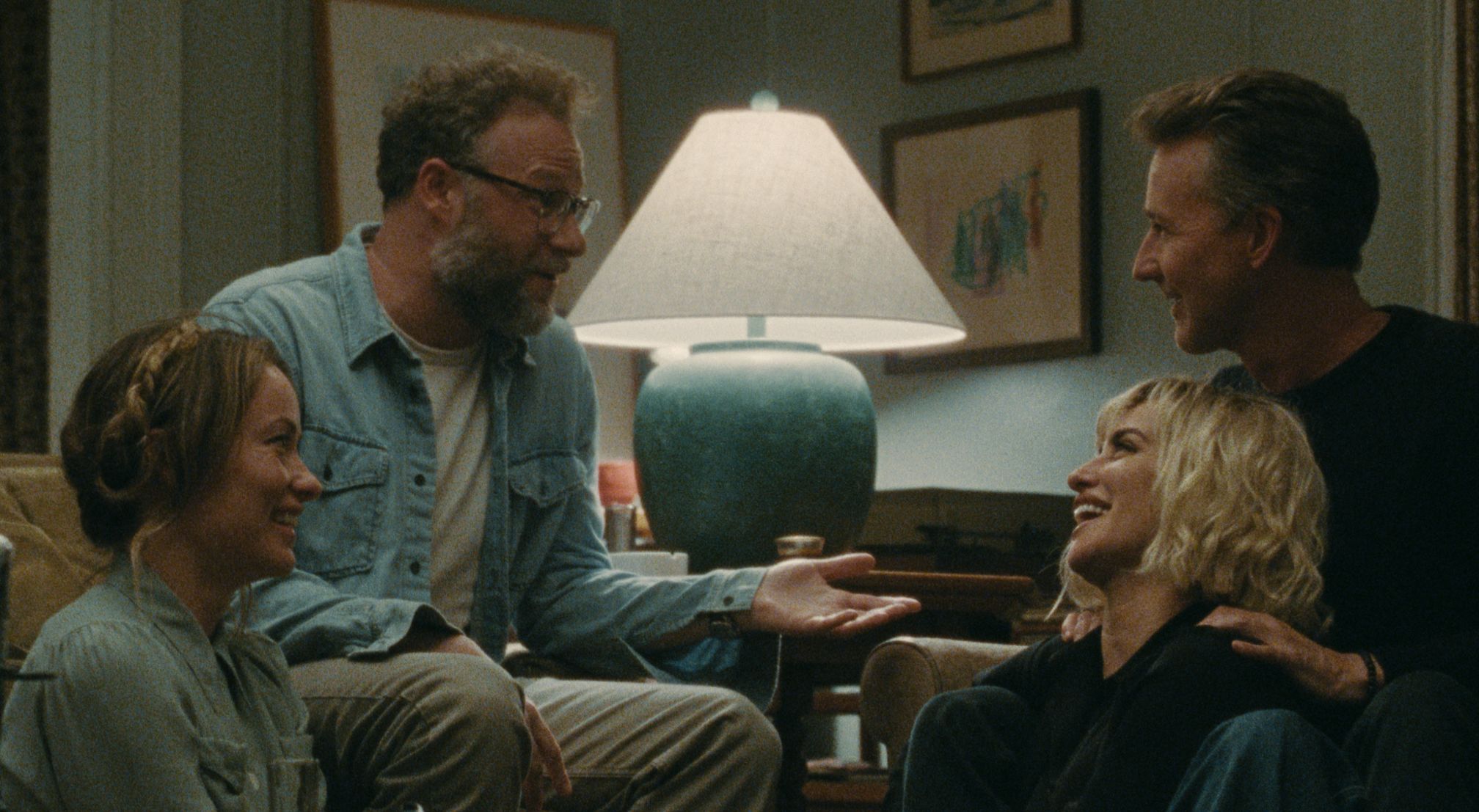
The Invite begins when beautiful, brittle Angela (Olivia Wilde) asks the free spirits from upstairs, Hawk and Piña (Edward Norton, Penélope Cruz), over for dinner, much to the chagrin of her exhausted, frustrated husband Joe (Seth Rogen). Joe insists that Angela never told him about the get-together, and when he urges her to reschedule, she refuses. With their daughter away at a sleepover, the neighbours are due to arrive at any moment.
For Angela, the impromptu gathering is a chance to showcase recent renovations to the historic San Francisco apartment she shares with Joe, and to apologize for the construction noise Hawk and Piña have graciously endured. Joe, realizing there’s no way out of socializing, decides — to Angela’s horror — that it’s also an ideal opportunity to confront the couple about their loud and frequent lovemaking.
Once Hawk and Piña arrive, anxiety threatens to overwhelm Angela, who valiantly attempts to steer the conversation in a pleasant direction. The guests, however, are all too happy to frankly discuss their intimate lives, suggesting that Joe and Angela might benefit from a similarly liberated approach to carnal pleasures. Maybe they could even begin to do so tonight?
An uproarious and insightful exploration of the complexities of adult romantic relationships, The Invite uses its surprising premise to springboard the characters into a funny, fraught and long-overdue evening of soul-searching. For Wilde, the invitation to direct the film was one she says she absolutely couldn’t decline.

Adapting the screenplay
Writers Will McCormack and Rashida Jones adapted the screenplay from writer-director Cesc Gay’s award-winning 2021 Spanish film Sentimental (released internationally as The People Upstairs), which in turn was based on Gay’s 2016 play, Los Vecinos De Arriba.
Although the production had previously been adapted for Italian and Korean audiences — underlining the universal nature of the themes it explores and their cross-cultural relevance — McCormack and Jones were keen to tell the story through an American lens. “It’s such a rare occasion where you have all this great source material — a great play and a movie that’s so rich and so specific culturally,” Jones says. “The structure was so solid and the themes were so relevant that it was easy for us to plug in and then stretch in areas that were of interest to us.”
Their initial draft found its way to Wilde’s inbox as a potential acting job several years ago. But when she was approached about the project more recently, with an offer to direct the film, she immediately sparked to the idea.
“I thought, at this point in my life, this film is exactly the conversation I want to be having — I think that’s what it takes for you to direct a film,” says Wilde, who carefully read McCormack and Jones’ screenplay several times after revisiting Sentimental. “I found myself wrestling with the themes of the original film as though I were in a relationship with it. It became this intense obsession, coming to me at a time when I realized I had so much to say through my own work.”
Having established herself as a talented and versatile actress, Wilde also proved herself to be an equally gifted and multifaceted director. Her directorial debut, 2019’s award-winning Booksmart, starred Kaitlyn Dever and Beanie Feldstein as over-achieving high-school seniors who decide to break all the rules in one epic night of partying before graduation. Wildly entertaining and stylishly made, the teen comedy was laugh-out-loud funny at the same time it centered the warm and relatable friendship at its core.
By contrast, Wilde’s second feature, 2022’s unsettling Don’t Worry Darling, was a tense and unnerving thriller in the vein of The Stepford Wives, starring Florence Pugh as a 1950s housewife who finds herself trapped in a suburban idyll far darker than it seems. Wilde herself also took on a supporting role in the film.
With The Invite, Wilde was eager to harness what she’d learned from those earlier experiences and creatively push herself into a different emotional space, focusing strictly on character dynamics. Inspired by the films of Mike Nichols, including his famed adaptation of Edward Albee’s masterful play Who’s Afraid Of Virginia Woolf?, Wilde was most interested in orchestrating the push and pull that emerges among the unlikely quartet over the course of one uncomfortable, unconventional evening inside Angela and Joe’s apartment.
“The thing that interests me most about directing is human relationships, and telling stories about relationships,” Wilde says. “This film was a chance to say, ‘If the thing that interests me most is relationship dynamics, what if I just make a film where there’s nothing else but that?’”

Workshopping the Screenplay
To dig as deeply as possible into the explosive dynamics at play, Wilde set out to workshop the screenplay with McCormack and Jones over a period of two weeks before the film shoot. The goal was to tailor the characters to each performer, refining the early banter in the script and perfecting the pointed, confessional dialogue that follows. But that meant she needed to quickly finalise the cast, finding actors who would be excited by her non-traditional approach to the production.
“I didn’t want to have a white-knuckled grip on the film and then cast people to fit my ideas — I wanted a cast who would show me what the film was,” says Wilde. “It was about finding people who were as interested in that process as I was, and it was exciting to gather a group of people together who could bring it to life.”
Wilde knew from the beginning she wanted Seth Rogen for Joe, a formerly successful indie musician who ekes out a living teaching. Famous for his congenial energy, Wilde knew that the veteran writer, director, producer and actor could easily land the character’s crackling barbs — while also conveying the loneliness and self-loathing he can barely conceal.
“Seth has this extraordinary ability to ground the most outrageously comic scenarios in such honesty — it’s like he has a pact with the audience where he respects them, but will never underestimate their intelligence,” says Wilde. “He’s sort of a comedy scientist who happens to have this deeply personal and emotional connection to the audience. With Seth as Joe, I wanted to warm people up with comedy, and then pierce their hearts with grounded emotional honesty.”
Serendipitously, Wilde was guest-starring on Rogen’s Emmy-winning Hollywood satire The Studio as she was embarking on the casting process, and although he had mentioned to her that he wanted to focus on writing and directing, Wilde’s passion for The Invite convinced him to take on the role in the film.
“When she described what she was hoping to do with The Invite, I was interested in that collaborative process, developing the characters together over time and then reworking the script based on the new ideas that were emerging,” Rogen says. “That felt like a great way to capture something special and unique — and she and I excelled at arguing with each other. Also, I tend to thrive comedically in situations where there’s a lot of tension and pressure and an underlying doom of some sort, and this was perfect for that.”
As retired firefighter Hawk, one half of the sexually adventurous couple from upstairs, Wilde recruited Edward Norton, whose filmography includes such landmarks as American History X, Fight Club, Birdman Or (The Unexpected Virtue Of Ignorance) and A Complete Unknown. As someone who had loved both Sentimental and Wilde’s earlier directorial efforts, he eagerly accepted the role.
“I’ve worked with Seth a lot, and I love working with him,” Norton says. “I was really excited about the idea of doing something with Seth where we weren’t just joking around — though I knew it would be really, really funny — with an undercurrent of vulnerability, and even pain or struggle in it. That was really appealing to me, and I love Olivia’s films — I thought they were just sharp, incisive, beautifully crafted.”
“Edward immediately had such a complex interpretation of that character,” Wilde says of Norton, who also previously wrote, directed and starred in the adaptation of the Jonathan Lethem novel Motherless Brooklyn. “He brought this heartbreaking and sophisticated backstory to Hawk, which took a tremendous amount of intelligence and confidence on Edward’s part.”
Finally, as Hawk’s seductive paramour Piña, Wilde cast Penélope Cruz, a singular talent revered for her collaborations with Spanish auteur Pedro Almodóvar among other filmmakers. Cruz’s excellent comedic timing — in addition to her tremendous facility with drama — was exactly what the character required.
“Penélope holds this amazing amount of strength while at the same time being the most warm and empathetic person,” Wilde says. “She has this elegant, graceful strength that I thought this character needed.”
For her part, Cruz was thrilled to find a script that was both smart and very, very funny. “I started reading it, and I was crying, laughing,” Cruz says. “It was incredible. I always look for comedies because I love that genre. I love watching them, and I love making them. They are so hard to find, good ones.”
With the three actors locked into their roles, Wilde continued to search for the right person to complete the foursome. The ensemble politely responded to her suggestions for who might play Angela before stating to her as a collective what felt obvious to them all along — that Wilde herself should play the character.
“I would never have thought that I could play Angela with this group of actors,” Wilde says. “I don’t think I would have thought I was up to par. Edward really is the one who, as an actor-director himself, gave me the confidence to do it.”
Offers Norton: “Seth Rogen and I both were like, ‘Half of the reason we want to do this movie is we love your movies, but also the other half is we want to work with you.’ I think she had to go through this process of allowing herself the permission to do both, and I am so happy she did. I think it’s the best performance of her career. It’s like a vintage Gena Rowlands, Diane Keaton kind of a performance that hits the high and the low, the real comedy, but with this core of struggle.”

Fron Script to Screen
With the actors in place, the workshopping process Wilde had envisioned took place at Sunset Las Palmas Studios in Los Angeles on the same stage where the pilot for I Love Lucy had been shot. “I feel very strongly that Lucille Ball was there with us, taking care of us,” Wilde says.
For the workshop, writers McCormack and Jones sat with director and cast around a table on an empty soundstage, crouched over their laptops with the script beside them. In raucous creative sessions, the group shared revealing personal anecdotes, ad-libbed pointed barbs and memorable one-liners, all while gut-checking every decision the characters made.
“We went through this period of sharing openly, and in doing that, you get into a comfort zone with each other to do some stuff that’s got some taboos and is a little risqué,” says Norton. “And it was fun.” Adds Cruz: “It was a very important part of this film, the fact that we were able to gather for eight days around a table with the writers, and they were so generous and open to hear our ideas and to bring things into our characters.”
For McCormack and Jones, the process was unlike anything they had experienced before, and they found themselves making revisions daily to reflect the conversations that were happening around the table. “The very first rewrite for this iteration of the movie started with that workshop,” Jones says. “Our job was to take in all this blue-sky energy and then ensure that the scaffolding of the story remained intact and could bear the weight of all these big, fun ideas. It was a very propulsive, iterative process and it was great to hear directly from the actors.”
Adds McCormack: “We were incorporating these brilliant, sometimes astonishing ideas from the cast and weaving them into the script in a way that was really interactive — to have that time with them, to hear things come to life, to volley ideas back and forth was totally thrilling.”
One key voice, however, influenced the direction of the script without ever being in the room. Wilde recruited renowned psychotherapist and New York Times bestselling author Esther Perel — known for such books as Mating in Captivity: Unlocking Erotic Intelligence — to serve as a consultant on The Invite.
“I admire the empathy that Esther brings to the conversation about relationships and I love her focus on personal responsibility in terms of one’s own happiness — the idea that we have agency within a relationship,” says Wilde. “She was much more than a consultant on this film, she was an oracle.”
Cruz was grateful to have the opportunity to speak to Perel to gain insights that helped shape her approach to playing therapist Piña. “I was a big fan of Esther’s work and then when I realized that we had the possibility to talk to her, it was very exciting,” Cruz says. “My profession gives me the opportunity to meet incredible people, and I feel so lucky that I was able to call her anytime I had a doubt or when we were working on the script. It was very important to have her input.”
Olivia Wilde is one of Hollywood’s most versatile and dynamic talents. Wilde’s first film, Booksmart, was awarded an Independent Spirit Award for Best First Feature; her sophomore film Don’t Worry Darling was a global success, earning nearly 90 million dollars worldwide. She will next be seen starring in Gregg Araki’s I Want Your Sex opposite Cooper Hoffman and Charli XCX, which premiered to rave reviews at the Sundance Film Festival this year and the upcoming film Behemoth, written and directed by Tony Gilroy. Additional acting work includes Her, Alpha Dog, Drinking Buddies, Meadowland, A Vigilante, Tron Legacy, Vinyl, and House.
Will McCormack is an Academy Award®-winning director, writer, producer, actor and author. He was nominated for an Independent Spirit Award for Celeste And Jesse Forever co-written with Rashida Jones, and he won an Academy Award in 2021 for his short film If Anything Happens I Love You. He is currently writing Tom & Jerry for Warner Bros. Animation, and he has several feature projects in development, including Challenger Deep to be directed by Bob Persichetti and The War And Treaty, which he co-wrote with Craig Borten (Dallas Buyers Club), to be directed by Numa Perrier and produced by John Legend. Will and Rashida’s company Le Train Train produced the hit TV show Claws on TNT and Kevin Can F*Ck Himself on AMC starring Annie Murphy. Other producing credits include A To Z for NBC and Centerpiece for Quibi, and other writing credits include Toy Story 4. As an actor. Will won a Lucille Lortel award for his performance in Pulitzer Prize-winning playwright Paula Vogel’s play The Long Christmas Ride Home. He’s appeared in dozens of films and TV shows including The Sopranos and Brothers & Sisters.
Rashida Jones is an award-winning actor, writer, producer, and director with a dynamic body of work spanning film, television, and documentary storytelling. Jones can next be seen in Lena Dunham’s Good Sex, alongside Natalie Portman and Mark Ruffalo, slated for release in 2026. She will also lend her voice to Disney’s upcoming animated fantasy film Hexed, which will be released on November 25, 2026. In addition to her work in front of the camera, Jones has built an acclaimed career as a writer, director, and producer. She co-directed the Grammy®– and Critics Choice Award–winning documentary Quincy and co-directed and co-produced the short documentary A Swim Lesson. As a writer, Jones credits include Tom And Jerry, the Black Mirror episode “Nosedive,” the Oscar®–winning Toy Story 4, and the Independent Spirit Award– nominated Celeste And Jesse Forever, in which she also starred. Jones and McCormack also run the production company Le Train Train, through which they have developed and produced a range of film and television projects.

