
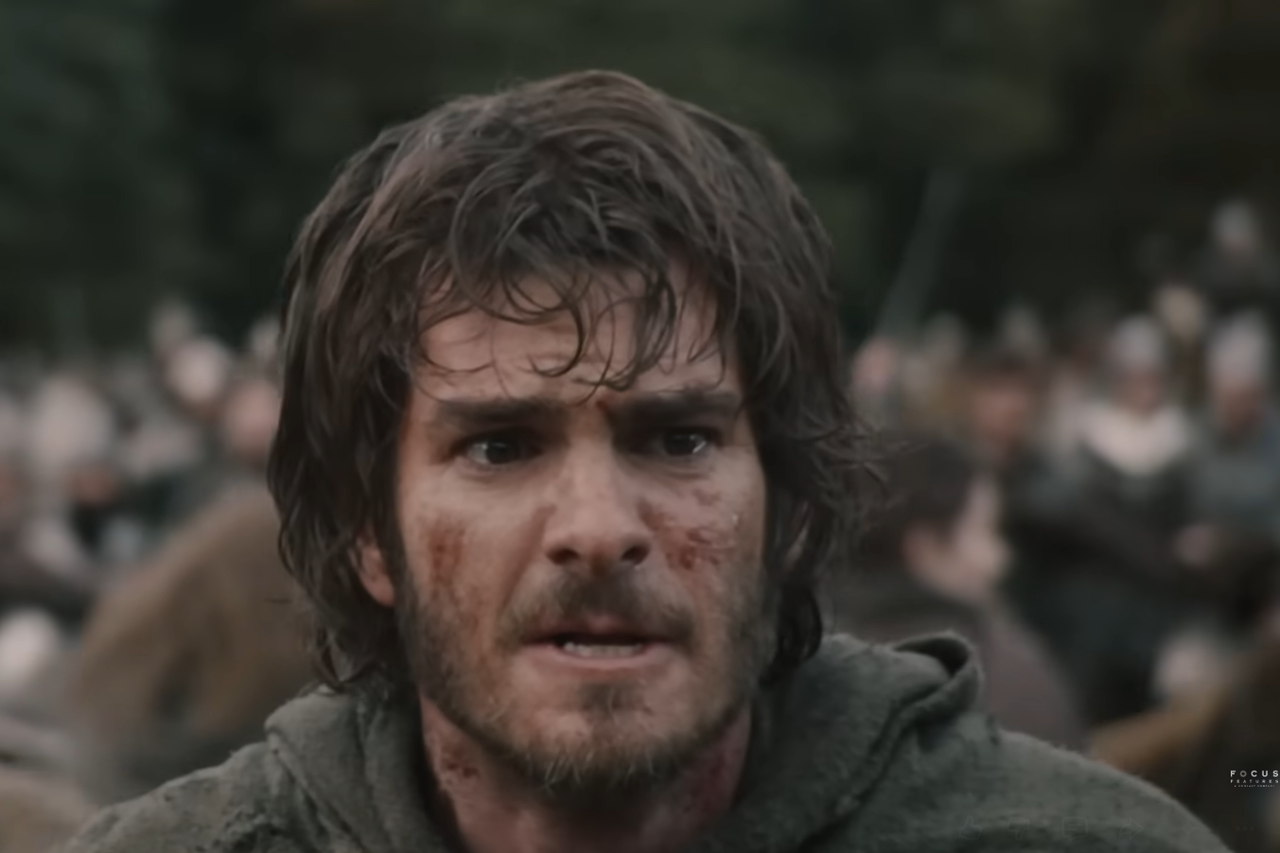
Written, directed, and produced by Paul Greengrass (Captain Phillips and the Jason Bourne franchise) comes The Uprising, a breathless ride through medieval England in the grip of revolution. From the wind-swept marshes of east England to the decadent court of King Richard II, and finally onto the blood-soaked streets of London as it is breached by the rebellion horde, The Uprising delivers urgent and visceral storytelling about a world turned upside down.
Producer Joanna Kaye states, “It’s an epic. It’s a medieval action film. It’s got action, it’s got romance but it’s also about something. And that is extremely appealing to an actor who likes to make thoughtful films, who likes to immerse themselves in interesting characters.”
For The Uprising, Greengrass assembled an all-star cast keen to dig into the meat of the story alongside the filmmaker.
“I knew this film was going to be a challenge,” Greengrass recalls. “It’s ambitious in scale, location and character, plus it’s set 600 years ago! But filmmaking is a collective endeavor. A group of people, often strangers, come together for a few short months and, if the alchemy is right, pull off the miraculous. And in the case of The Uprising, I have had a particularly special group of people to call upon: A cast of acting greats who brought urgency and soul to the characters.”
Andrew Garfield, the two-time Academy Award nominated actor most recently seen in Luca Guadagnino’s After the Hunt, was the first to sign up. “Andrew was in without hesitation,” Kaye says. “That anchored the project from the get-go. He has tremendous range, and it was just marvelous to see how all-in he was. You believe him as soon as you see him on the screen. He is that man. And he’s got a depth and emotional strength which really works with his part.”
Greengrass points out, “He’s very serious about his acting, he’s serious about his choices and he’s got a real point of view. How you are leading a company of actors is very important — how hard you work, how you endure, in this case, the privations of a shoot in the middle of nowhere in southern Germany, far from home, not a lot of creature comforts, trying to imagine yourself into the turmoils of late 14th century England. He inspired everybody around him with his unbelievable commitment and his good humour and his ability to nail it.”
“What’s powerful to me about this character and about the universal struggle that he represents is that he is an ordinary man who does extraordinary things because he has no choice,” says Garfield. “It’s either live or die — and when I say live or die, I mean live truly, live fully, live in connection to nature, connection to one’s own dignity. He would rather die if not live that way. So, he’s a very ordinary man who gets pushed and squeezed to the point where he has something that breaks, and he says, ‘None of us should have to live like this anymore.”
For Garfield, the role offered an opportunity to research a particular chapter in British history, which greatly informed his approach to the role. “I love doing research, and this had no shortage of it,” Garfield says. “I think for me, I needed to focus on what I would know within the context of my character. It’s very particular the knowledge that my character has, and it’s limited to the rhythms of an ox, the rhythms of the day, the rhythms of the harvest, the rhythms of working the land. It was a grim time to be a British peasant. It really sparks the imagination, playing a character like this.”
For the role of the legendary revolutionary English priest John Ball, who advocated social revolution, Greengrass cast Jamie Bell, who was excited to act side by side with Garfield, saying, “He’s a generation-defining actor. He’s delivered incredible performances movie after movie and on the stage as well. He’s just unbelievably versatile, but he leads with his heart. That is his skill. What sets him apart is his innate ability to communicate decency and care and hope.”
Greengrass has always wanted to work with Jamie. “Jamie brought to the part of John Ball an animal magnetism, a powerful zealotry but also by the end of the movie, an intense and moving humanity. Just an outstanding performance.”
“To be a revolutionary, what do you need? Love,” Bell says. “It’s not about ideology or belief or hatred. It’s about the love for the people that you’re representing and that you want change for. And I do believe that John Ball has an affection for who he represents. He wants a better world for himself. But more importantly, he wants a better world for his followers, for his parishioners. He believes they are deserving of it. It’s in the Bible that all are equal.”
Of equal importance is Wat Tyler, the English peasant leader who led the uprising of 1381. Early on, the filmmakers zeroed in on Cosmo Jarvis for the role. “When I first read the script, I really liked the fact that it was just concerned with this area of history and an event like this,” Jarvis says. “But also, the way that the script was written, it seemed very clear what the function of every character was and the story functions that they all served. There was very little ambiguity. I liked that clarity about it.”
England, 1381. The Plague sweeps across Europe. Half the population of England is dead. Grief, fear, and anger engulf those who survive. The stage is set for the Great Rebellion. Andrew Garfield stars as the legendary leader of a ferocious rebellion against the tyranny of King Richard II. As war burns across England, he forms an army of the people to face the King’s might in a fight for justice and survival. With the capital now under the control of the people, and his council in crisis, the young King Richard must decide the fate of his kingdom. With whom will he stand? Will the rebels succeed in their quest for a fairer society — or will their revolution bear only tyranny and blood? And what of the Ploughman? Will he find the peace that has eluded him his entire life?
When it came to setting up plans for the shoot, the producers set their sights on finding locations that would feel both authentic and cinematic.
They landed in Bavaria in the south of Germany. Kaye offers, “Germany is filled with medieval towns. There are all these real medieval buildings that have been brought stone by stone from various places and reconstructed with the most incredible care. That’s quite hard to find even in medieval London.”
Production commenced on September 15, 2025, at Penzing Studios near Landsberg am Lech, a 40-minute drive west of Munich. In mid-October, the filmmakers moved to Bad Windsheim, where scenes were shot at the Fränkisches Freilandmuseum, and then, at the end of the month, to Festung Lichtenau for one day.
The final leg of production took place in Nuremberg, with filming at the Heilig-Geist-Spital, the Pellerhaus and, most notably, St. Sebaldus Church, the oldest Evangelical Lutheran parish church in town, dating to the early 13th century.
Production designer Nikolaj Danielsen explains, “We basically sat down and went through the script to figure out how to employ this church. There is not an inch that we haven’t used. Every corner, every staircase, every crypt, every chapel has been utilized in some way to really add to the feeling of the period we are in and the scale of the power institutions of the story.”
Paul Greengrass as Cinematic Revolutionary—A Truly Singular Point of View
History never feels as alive on screen as it does when Paul Greengrass is behind the camera. Drawing from his background in non-fiction filmmaking, Greengrass infuses every scene with a sense of realism and emotional truth, plunging the audience directly into the high-stakes action. The Uprising cast had unreserved praise for his artistic technique and his tireless work ethic—and the dramatic results he is able to achieve on set and on screen. “This film feels like watching a Paul Greengrass film to the hilt,” Garfield says. “He’s singular in what he achieves in cinema. It’s visceral. It’s thrilling. It feels like you’re there. You feel immersed in the revolution. You feel like you’re part of the revolution, and you’re a revolutionary yourself. It’s an immersive experience like no other.”
Adds Bell: “Paul is concerned with the human side of things. How do people in this context deal with what is happening, who makes the decisions and how would I act if I was dropped into that moment? That’s what’s so brilliant about his films. In The Uprising, the audience never gets the sense that what is happening on screen took place 600 years in the past. The way Paul shoots and tells the story, the immediacy of the situation, really closes that distance of history. That’s his gift as a filmmaker, to make everything feel so profoundly real.”
“To get to work with one of your all-time favorite directors, telling an extraordinary story you believe is important, with a cast you greatly admire, is about as good as it gets for an actor,” says Jonny Lee Miller.
Thomasin McKenzie considers Greengrass’ background in non-fiction filmmaking one of his essential assets in shaping his films. “His roots are in documentary realism and finding the story and letting it come to the camera rather than the camera being in a set place at a set time,” she explains. “I remember when I watched Bloody Sunday, I remember thinking, There’s no way this isn’t a documentary., because it all felt so real. It’s been so exciting to see how Paul achieves making it feel like a documentary and making it feel so real.”
For Hollander, Greengrass is one of a handful of British film directors “who you could say are great and have their own unique style. This film falls into the category of Paul Greengrass films that are kinetic and present-tense. I think that’s a style that is uniquely his own… And Paul is loose with the dialogue. You’re allowed to chuck stuff in. There’s a genial, committed energy that he spreads through the set, and that is very creative. It can be chaotic, but it’s utterly committed from all sides.” Offers Townsend: “He somehow puts everyone at their ease and gives them real freedom and agency in the process.”
Even those closest to Greengrass — his producers Joanna Kaye and Gregory Goodman — aren’t entirely certain how he imbues every film with such tremendous energy, spirit, truth and relevance. But they agree that it’s a pleasure to watch him work.
“Every day, I don’t really know how Paul does it,” Kaye recalls. “We got through so many scenes in one day, but with chaos everywhere. That’s what Paul does; he gets order out of chaos. And in all his films, that’s what you’ll see, whether it’s Bloody Sunday or any of the Bourne films or a Californian wildfire that’s gotten out of control. Weirdly, when things are intense and he’s up against it, he often does his best work. It’s not good for your health, but it’s good for the film.”
Adds Goodman: “It’s a high-wire act in terms of documentary realism because he’s bringing these worlds to life but ensuring they’re cinematic and they’re not just verisimilitude. There’s more to it. There’s cinematic impact. The Uprising doesn’t feel like an artifact. It feels like you’re there. I hope that works for audiences to feel like they’re thrust in this world, that they’re on the streets and in the middle of this conflict. Then they can relate, hopefully. It feels truly alive and real.”
Ultimately, the cast and crew came together because they believed in the core ideas of the film, Greengrass says, hoping that the audience will be just as moved by the urgency and relevance of Ploughman’s call to action. “We are telling a story that is timeless about the fight between justice and tyranny,” Greengrass says. “Everybody wants to do a movie that has bows and arrows and soldiers in armor and swords and great crowd scenes. That’s kind of a childhood dream. All of us saw it as an epic cinematic experience — a brutal tyrant and ordinary folks seeking justice kind of a movie with a grand scale. It’s thrilling to see our ambitions realized in a way that speaks to what’s happening in the world today.”
DIRECTOR’S STATEMENT
This is a story set in 1381. But its themes are, of course, strikingly contemporary. Audiences will see, in its depiction of upheaval in medieval England, echoes of our own times—and discover their own truths.
I grew up with the Peasants’ Revolt the way most of us in Britain did. You learn about it in school—Wat Tyler and John Ball and the march on London—and then it sits somewhere in the back of your mind for the rest of your life. It came back to me during the Coronavirus pandemic. Half of England had once been wiped out by the Black Death, and what followed wasn’t only grief—it was fury, along with a complete collapse of trust in the people who ruled. After a few short weeks, tens of thousands of ordinary men and women set out for London to tear down a world they believed was rigged against them. That felt like distant history. It really isn’t.
I didn’t want to make a reenactment. I wanted to make something you experience rather than watch—immediate, alive, as if it were unfolding in front of you. And I didn’t want to tell it through the names we remember, like Tyler or Ball, but through someone history never named at all: a farmer. The first man to raise his hand in Essex. In Andrew Garfield’s Ploughman, I wanted him to stand for all the ordinary people who actually rose up, and paid the price for it.
Rebellions are anarchic by nature. It’s easy for films to romanticize them, and rebellions are very good at romanticizing themselves, but every one of them has a dark side. Order comes down, the rules fall away, and there is always a descent into violence. The question that interested me most is the one that comes after: what happens when it’s over? As Wat Tyler says in the film, we’ll only know what we hold when it’s done. You can’t draw up the ledger on a revolution until long after it has passed.
And that ledger, for 1381, is a profound one. Historians have long drawn a line from the Peasants’ Revolt to the idea of individual rights and representation—even to the American Constitution. That’s what makes it timeless.
Yes, “The Uprising” is an epic—it has armour and bows and great crowds and a young king on his throne. But underneath all of it is our own dangerous, dislocated world, consumed by anger toward the elite, with hope and democracy hanging in the balance. I don’t answer that for the audience. I’ve never believed that’s my job. I only want them to recognize the world when they see it, and to carry the question home.
– Paul Greengrass
600 Years Ago, Yet So Close: The Project
In the course of his storied career, Academy Award®-nominated director, writer and producer Paul Greengrass has taken audiences into some of the world’s most thrilling and dangerous events: the frontlines of the Irish Troubles in Bloody Sunday; inside one of the planes hijacked on 9/11 in United 93; onto the deck of a ship under siege by Somali pirates in Captain Phillips; inside a Norwegian courthouse during one of the most important criminal trials in that country’s history in 22 July; and into the midst of one of the most devastating fires in the annals of Californian history in The Lost Bus. His films brim with a visceral quality that puts you in the middle of the action — they are kinetic, breathless cinema you experience and feel rather than just watch.
He even took us to the frontier of the Wild West in News of the World, but now Greengrass really goes back in time to the late 14th century, for his first true period piece. He creates a thoroughly rousing adventure, like only he can, about the Peasant’s Revolt, as if it was happening in front of our eyes.
Also known as Wat Tyler’s Rebellion or the Great Uprising, the Peasants’ Revolt took place in 1381, following a series of drastic social upheavals set in motion by the Black Death almost 50 years earlier. Due to the long-standing war with France, the English Crown was in constant financial distress. In 1381, a poll tax was introduced requiring every adult male to pay one shilling.
On May 31, 1381, peasants and fishermen in Essex rose up against the tax collectors. Three days later, similar unrest broke out in Kent and London. On June 7, 1381, former soldier Wat Tyler emerged as one of the rebellion’s leaders. By June 10, the peasant army controlled the city of Canterbury, and the preacher John Ball, who had been imprisoned in Kent, was freed. Together with the rebels from Essex, the peasants marched to London, searching the city for members of the king’s entourage, opening the prisons and destroying the newly opened Middle Temple law college. The rebels then camped around the Tower of London, where King Richard II was in hiding.
Although he was only 14 years old at the time, the king negotiated directly with the rebels, who were seeking, among other demands, the abolition of serfdom. During the negotiations, Tyler and some of his men found and beheaded the Archbishop Simon Sudbury and the Lord High Treasurer Robert Hales, both of whom were held responsible for the poll tax. Then, on June 15, 1381, Wat Tyler was lured to a meeting with the king and assassinated. Richard II calmed the enraged rebels by promising them a general amnesty, but he later reneged, reportedly telling the peasants: “You are serfs, and serfs you shall remain.” The leaders were executed wherever they could be caught.
When the COVID-19 pandemic plunged the world into crisis in early 2020, Greengrass’ thoughts immediately turned to the striking connections between the upheaval caused by the pandemic and that wrought centuries earlier by the Black Death, the plague that spread to England from Europe and wiped out half of the country’s population. “That period of history, 1381, following the Black Death, there was a great national convulsion and uprising — it felt to me like a great story and an exciting basis for a movie,” Greengrass says. “Like today, people were enraged with the government’s failure. There was a complete collapse of trust in those who ruled. The people marched on London and three days of mayhem ensued as people sought to change the government.”
Of course, Greengrass wasn’t interested in making a by-the-numbers historical reenactment. He wanted to tell the story in a way only he knows how to do — as an epic action film that felt immediate, raw and spectacular.
“It sounds like distant history, but it really is not,” the filmmaker says. “In that story, you can see all the colors of today.That’s what I want this film to be about. It’s an action-adventure story. It’s got romance, it’s got politics, but most of all it’s the turbulent story of what happens when one farmer moves from the marshlands of East England into the streets of London in search of a better life.”
A World Torn Apart by Anger and Fear – The Genesis
Even after Greengrass set his sights on making “a visceral ride through a world torn apart by anger and fear – a world that feels not too far from our own,” he faced numerous hurdles in his quest to bring his vision to life. It took him several years, with starts and stops, twists and turns, to finally get The Uprising off the ground. Throughout the process, Joanna Kaye, Greengrass’ producing partner, worked tirelessly to help him adapt this vital chapter of history, which, despite being a part of the British national consciousness, had never been dramatized on screen. “Amazingly enough, this story hasn’t been told before, although it marks such a significant time in history,” Kaye says. “The Peasants’ Revolt was the first time that the common man rose up against the ruling classes.”
Before sitting down to write the script, Greengrass embarked on an intensive period of research, attempting to unearth as much information about the Peasants’ Revolt as possible, even going back to the original reporting about the rebellion by the French court historian Jean Froissart. As he worked his way through the different accounts that were available to him, he always remained mindful of what made the story relatable and relevant.
Still, at the same time that the filmmaker felt that this story of a righteous rebellion would lend itself to a rousing big-screen adventure, Greengrass was not interested in glamorizing the brutality that took place. “Rebellions, by their nature, are anarchic,” Greengrass says. “It is anarchy. It is tearing down. It’s very easy for movies to romanticize rebellion, but all rebellions have a dark side. Order is torn down, and all the rules and boundaries disappear. You always have a descent into violence. The question becomes, what happens when it’s all over?”
The 14th century English poem ‘Piers Plowman’ — a simple farmer’s dream about his hopes and fears — was the inspiration for the character of the Ploughman and helped the filmmaker settle on his approach. (Notably, the same poem gave birth to the legend of “Robin Hoode,” the ultimate British outlaw myth about a common man attempting to right great injustice and coming under threat from the authorities for his actions to serve the citizenry.) Greengrass remembers, “I decided to create a character who was just an ordinary farmer. It was the ordinary farmers, the ordinary members of small villages and towns – they were the people who rose up. They were the people that Wat Tyler and John Ball commanded in their thousands, and I wanted somebody to represent them. In my telling of the story, the Ploughman is the first to raise his hand in rebellion in Essex.”
As he worked, Greengrass consulted with historian Dan Jones, author of one of the defining books about the Peasants’ Revolt, Summer of Blood. “Dan was a great spiritual mentor for this project,” Greengrass says. “Hopefully our film has done a little bit of what his books do, bring that world to life, make it relevant to today and tell a cracking good story.”
“There are generally two tracks that go on with Paul as a filmmaker,” says Goodman, who has produced all of Greengrass’ films since 2013’s Captain Phillips and most recently worked on such films as Scott Derrickson’s The Gorge and Alex Garland’s Civil War. “Paul wants people to be engaged and entertained. The Uprising is meant to grab you by the throat and pull you along. In addition to being compelling dramatically, it is truly meaningful. It was the combination of those two threads that I think appealed to Paul. It certainly appeals to me.”
PAUL GREENGRASS (Director, Screenwriter, Producer) is an Academy Award®- nominated filmmaker who most recently co-wrote and directed the 2025 thriller The Lost Bus, a white-knuckle ride through one of America’s deadliest wildfires. Starring Matthew McConaughey and America Ferrera, The Lost Bus premiered at the 2025 Toronto International Film Festival and was released in theaters mid-September before launching on Apple TV+.
In 2020, Greengrass directed News of the World, a haunting, elegiac Western starring Tom Hanks and Helena Zengel. Set in post–Civil War Texas, it follows a former soldier turned itinerant news reader who vows to return a young girl rescued from the Kiowa to her surviving relatives. The film received critical praise, earning Greengrass a Best Adapted screenplay nomination from the WGA and four Oscar® nominations including Best Cinematography and Best Original Score.
Greengrass is also the writer and director of 22 July, which premiered in competition at the Venice Film Festival in 2018 and was later released by Netflix. The film chronicled the aftermath of Norway’s deadliest terrorist attack and the nation’s path to healing through the lens of one survivor’s journey.
He previously helmed Jason Bourne (2016), the fifth installment in the blockbuster franchise, with Matt Damon reprising his iconic role. The film earned more than $415 million worldwide. In 2013, Greengrass directed Captain Phillips, starring Tom Hanks, based on the real-life hijacking of the MV Maersk Alabama by Somali pirates. The film was met with widespread critical acclaim and received six Academy Award® nominations, nine BAFTA nominations and four Golden Globe nods.
His other credits include the Iraq War thriller Green Zone (2010) and The Bourne Ultimatum (2007), which won three Academy Awards® and two BAFTAs. The Bourne Supremacy (2004) was also a major critical and commercial success, cementing his place as a leading director of contemporary action thrillers.
Greengrass also wrote, directed and produced United 93, a real-time depiction of the hijacked flight on September 11, 2001. The film earned him an Academy Award® nomination for Best Director, a Writers Guild of America nomination for Best Original Screenplay and the BAFTA David Lean Award for Direction. It also garnered Best Director honors from the Los Angeles Film Critics Association, the National Society of Film Critics and the London Film Critics’ Circle.
In 2002, he wrote and directed Bloody Sunday, a powerful re-creation of the 1972 civil rights march in Derry, Northern Ireland, where 13 unarmed civilians were shot by British soldiers. The film won the Golden Bear at the Berlin International Film Festival, the World Cinema Audience Award at the Sundance Film Festival and Best Director at the British Independent Film Awards.
Greengrass also has had a distinguished career in British television, directing dramas with strong social and political themes, including The Murder of Stephen Lawrence (BAFTA winner for Best Single Drama), The Fix, The One That Got Away and Open Fire. He also co-wrote and produced Omagh (2004), which depicted the aftermath of the Real IRA car bombing in Northern Ireland. Omagh won the BAFTA for Best Single Drama and Best Irish Film at the Irish Film and Television Awards.
Earlier in his career, Greengrass spent more than a decade reporting on global conflicts for ITV’s World in Action and directed numerous documentaries, including the Live Aid film Food, Trucks and Rock and Roll. He is also the co-author of the controversial bestseller Spycatcher, written with former MI5 assistant director Peter Wright.
Greengrass was born in Cheam, Surrey, England, and studied at Queens’ College, Cambridge University.
Visit our YouTube Channel
