
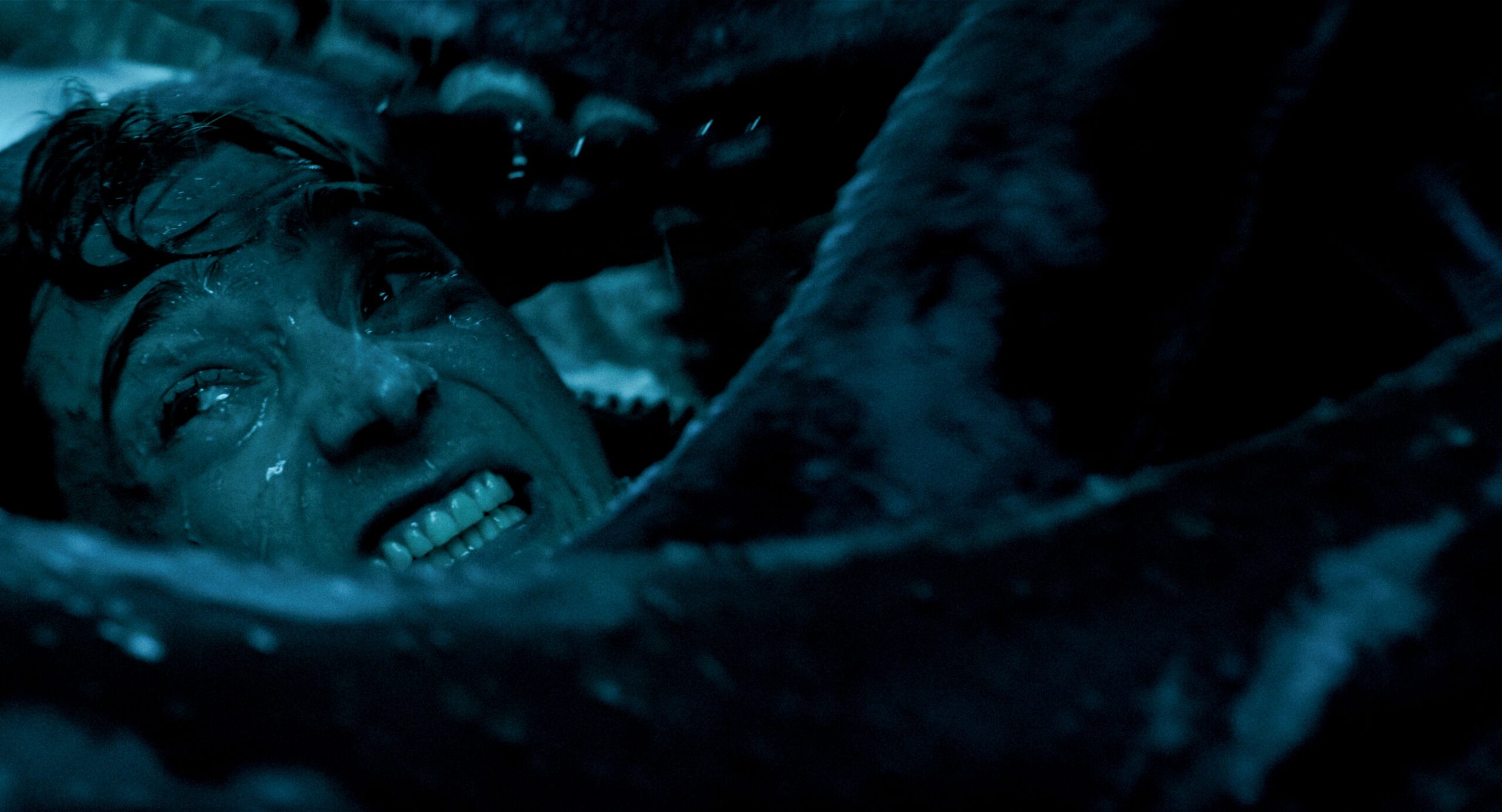
Director/co-writer/producer Brian Duffield first learned about the book Whalefall from Pulitzer Prize-winning author Daniel Kraus who was in the process of writing the book when he took to social media to talk about his next project.
“He [Daniel] tweeted that he had a book coming out about a teenage scuba diver who inadvertently gets swallowed by a sperm whale and has an hour of air left to figure out how to get out,” Duffield continues, “and when I reached out to him, he told me I could read it when he was done,” Duffield says.
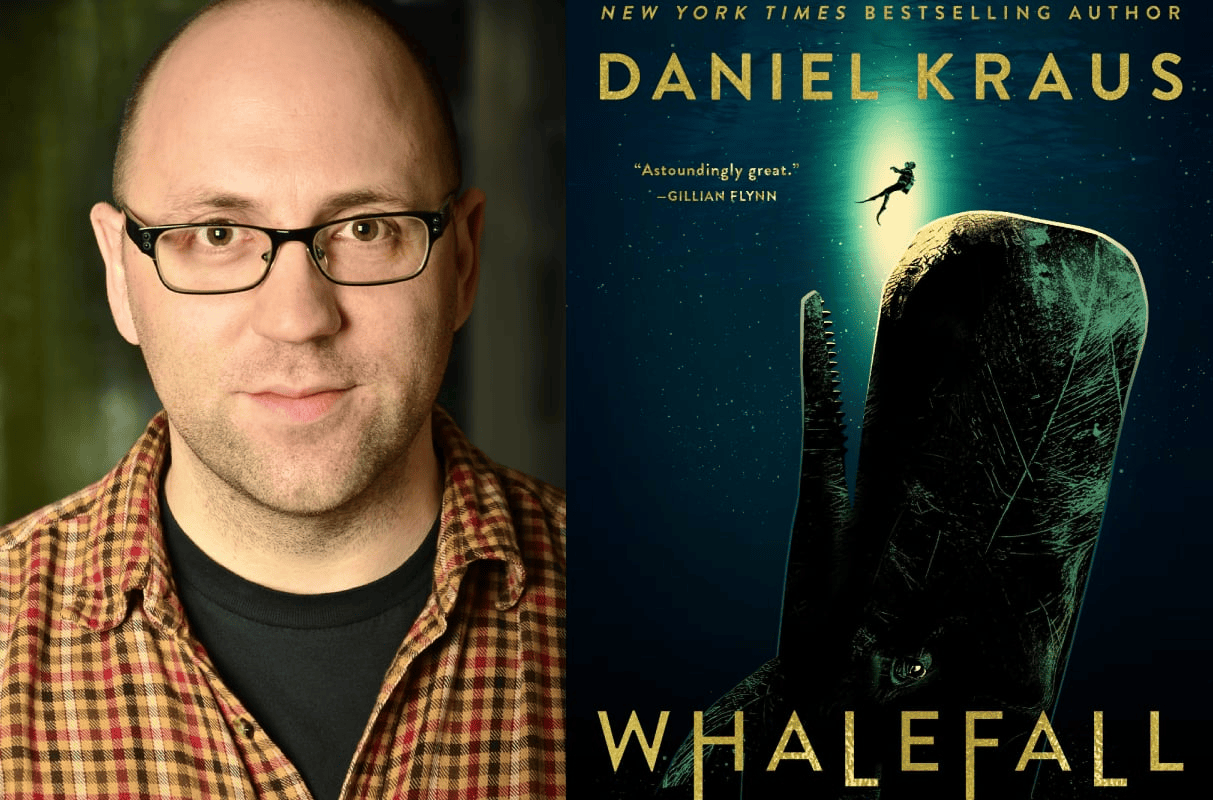
Kraus’ original inspiration for the story came from a viral video of two kayakers who nearly ended up in the mouth of a humpback whale. The author immediately became fascinated with the idea, wondering if it was indeed possible. “We’ve obviously seen it in religious stories, and have seen it done abstractly in things like ‘Pinocchio,’ but I wasn’t interested in that kind of approach because it has been done before,” explains Kraus. “I am a research fiend, and I became obsessed with the possibility of crafting a story in a realistic way that was 100% scientifically accurate.”
The author spent weeks researching sperm whales. He consulted with a number of different scientists and marine life experts, including Lara Horstmann, the associate dean for research and the director of Marine Science at the University of Alaska, and Dr. Joy Reidenberg, a professor of medical education and comparative anatomy at the Icahn School of Medicine at Mount Sinai in New York. He found out that, generally speaking, a person could not be swallowed by a whale…unless it was a sperm whale. “Most whale throats are not that big, so they are not swallowing anything huge,” says Kraus. “But sperm whales gobble up giant squids all day long, so they have huge throats.”
It was during a conversation Kraus had with Dr. Phil Clapham from the Alaska Fisheries Science Center in Seattle, one of the world’s foremost experts on whale behavior, that Kraus learned that while it has never happened, it could happen, which Kraus quickly confirmed with two other whale experts, and, within 24 hours, he was writing the book.
“I’ve never written a survival story before, but I’ve always been really enamored of that genre…stories like ‘127 Hours’ or ‘The Martian’ I really admire, predominantly because I like research so much,” says Kraus. “Any movie that has that kind of element where it’s four people in a room and that’s the whole movie has always really impressed me, and this story one-ups it in the sense that we are in a room smaller than your average room and most of the action is going to take place a few feet around you.”
Kraus continues, “I’ve always been interested in that conservation of elements, where you have so few materials to work with, so there’s a kind of a ‘MacGyver’ element to it as well…where you have to survive with the materials that you have on you, or that already exist inside the whale.”
“The setting was such an unusual setting that I wanted people to be able to hang on to something solid and something identifiable,” Kraus continues. “And because the main character was going to be young, I thought that his strongest, most problematic relationship was probably going to still be with one of his parents, so I thought, father, son: what could that relationship be? Maybe the father taught the son about whales and about the ocean, but he didn’t listen. And from there, things came together really quickly.”
It was the Fall of 2023 when the book was finished, and Kraus, as promised, slipped a copy of the manuscript to Duffield. “He probably had the same reaction a lot of people have when they read it, which is they go in expecting this white-knuckle thrill ride, which it is, but they are not expecting the other half of it, which is this extremely moving story about a father and a son,” Kraus explains.
And Duffield agreed. “I had just had a son of my own, so there I was reading this story with this baby boy, and it became very personal,” Duffield says. “And I knew I wanted it to be my next project.”
At the same time, producer Allan Mandelbaum, who is co-president of films for Imagine Entertainment, the prolific, award-winning production company founded and run by filmmakers Brian Grazer and Ron Howard, heard about the story. And as luck would have it, Mandelbaum had produced “No One Will Save You.” “It was still a manuscript at the time,” he explains. “A book scout of ours told me she thought it would be great for Imagine, but I’ll admit, when I heard the concept, it sounded kind of crazy, and it wasn’t until I actually sat down and read it that I realized how emotional it was and fell in love with it. “
Mandelbaum continues, “The story was equal parts riveting, ticking-clock survival thriller adventure and a heart-wrenching father-son story, and it was the two halves that really sold it for me. The survival story is crazy, but without the emotion and heart of the father-son story, I don’t know that it would work as well as it does.”
Oscar®- and Emmy Award®-winning producer Brian Grazer (“A Beautiful Mind,” “8 Mile”) agrees. ‘It is a life-or-death survival story, which I love. To me, ‘Apollo 13’ (which Grazer produced) is a life-or-death survival story, as is ‘A Beautiful Mind,’ John Nash’s story, which is about mental disability and life or death, because you’re wondering, will he die? Will he survive? And if you’re as involved in the characters as you are in this story, it becomes a real, palpable emotional experience.”
Since Mandelbaum was already familiar with Duffield’s work, he knew he was the only filmmaker he wanted to tackle the project. “Brian has this incredible ability to take an outrageous concept and turn it into a movie,” says Mandelbaum. “Our first film [“No One Will Save You”] was a 90-minute genre exercise with no dialogue, but at the same time was incredibly character-driven and heartfelt in the way it told a story of a person dealing with the trauma of her past and mistakes that she’s made, but in the real time of the movie, dealing with an alien invasion. And the way that he was able to convey emotion and character without any words was proof that he was the perfect filmmaker to bring ‘Whalefall’ to the screen.”
Once the book was published in August 2023, Imagine Entertainment acquired the rights, and Duffield and Kraus began work on a screenplay. At the time, Duffield was in Los Angeles, and Kraus was in Chicago. “I would wake up, and there would be 4 or 5 great pages in my inbox, and then I would send him 4 or 5 pages, and it went really smoothly and really fast,” Duffield says. “He was, and is, a great collaborator.”
“Working with Daniel was great,” Duffield continues. “The book is already so cinematic, and the story takes place in real time, so a lot of our work together on it was just figuring out how to make it a movie, especially in terms of taking out the inner monologue throughout the story and centering it. In the book, Jay is a quiet and angsty young man, and you are always inside his head, so taking out that narrative device and really streamlining things to reduce the 60 or 70 flashbacks in the book and streamline them to really make them count.”
“Straight up, the collaboration with Brian Duffield was the best collaboration I’ve ever had, period, by a country mile,” says Kraus. “We were just in sync from the very, very beginning, and, as far as I can tell, he is an egoless person, or as close to an egoless person as I’ve ever met. And that is a beautiful thing when you’re collaborating on something, because you both have the freedom to be happily honest with each other. Like, ‘I don’t think that idea works,’ or ‘nice scene, but I think we can do it better like this.’ It was just completely free, and a real joy from start to finish. And I know that sounds like a cliché, but it really, truly was.”

The title “Whalefall” isn’t just the film’s name. It is an actual scientific term
Renowned comparative anatomist Dr. Joy Reidenberg, PH.D., breaks down the process of the ocean miracle. “A whale fall is when a whale dies, and its carcass actually falls to the bottom of the ocean. What happens biologically is very interesting because when a whale dies, initially it’s heavy and it sinks. If it sinks in greater than 200 feet of water, it will stay sunk because the pressure is so great that the bacteria can’t make all the gases of fermentation that would raise that carcass back up.”
Reidenberg continues, “As you get deeper in the ocean, the life that’s there is not dependent on sunlight anymore. It starts to be dependent on other things because it is very sparse. So, when a whale carcass falls, suddenly there’s a tremendous amount of nutrients gathered in one place. You’ll see octopuses, all kinds of rays, interesting fish, deep-water sharks, and lots of other animals come and live off the whale carcass for a long time until there’s nothing left to eat anymore.”
“When a whale dies, and it goes to the bottom of the ocean, and as it decomposes, it creates this like shockwave of life,” says author/co-writer Daniel Kraus. “It creates generations upon generations of life forms from its decomposing body. I took that as the central metaphor for the book and film in that, when someone dies, their death is just the beginning. While they may die in the physical sense, they continue to spread their life outward to everyone who knew them.”
“One of the most incredible things Daniel [Kraus] did in the book is take the title of Whalefall and the concept of a whale fall and marry that thematically into the story, which is this idea of a whale, when it dies, it sinks to the bottom of the ocean, and essentially creates an entire ecosystem of new life for an entire generation,” says producer Allan Mandelbaum. “And so, in death, it creates life, which is an important theme in Jay and Mitt’s relationship. And through this gauntlet of needing to figure out how to escape and survive, we find Jay reborn essentially by the end of this movie, and in some ways also accepting the difficult relationship that he thought he had with his father, but looking at it through a new lens now.”

Swimming with Whales
For actor Austin Abrams, one of the keys to unlocking his character in “Whalefall” was getting to see sperm whales in person. Prior to the start of principal photography, he had an opportunity to visit a sperm whale sanctuary near the island of Dominica in the Caribbean with Patrick Dykstra, an acclaimed whale documentarian, where they were able to scuba dive and view sperm whales in their natural habitat.
Dykstra’s award-winning PBS documentary, “Patrick and the Whale,” explored the remarkable intelligence and social lives of sperm whales, so the actor couldn’t have asked for a better partner and guide. “Austin approached me about introducing him to sperm whales in the real world and coaching him through that process of getting underwater to dive with them,” Dykstra explains. “He said, ‘Look, I’m going to be inside the belly of a sperm whale, so I want to do it as authentically as possible.’ We both decided the best way to do that was to spend some time underwater with real sperm whales—to see how they react, to feel their vibe and their energy, and let that experience inform the character.”
While Dominica is home to a resident population of sperm whales, actually finding them was never guaranteed. “It was a roll of the dice,” explains Dykstra. “People come down to dive with the sperm whales, but they’re wild animals, so you don’t find them every day.”
Fortunately, Abrams and Dykstra were able to find them and had numerous positive encounters. One instance was particularly memorable. “The sperm whales really took to him right off the bat,” says Dykstra. “One day, three females approached him, and just kind of lay in the water with him. Austin was able to float quietly while the whales bobbed in front of him. You could see this incredible exchange of energy. Austin loved it, the crew loved it, and everybody had a great time. I think it had a profound impact on him and helped him unlock part of his character.”
For Abrams, it was a one-of-a-kind experience. “I was surprised at how much time I actually got to spend with them. They hadn’t seen any sperm whales in the previous nine days, so I was lucky that both days I was there, they showed up and let me observe them. It was almost like being with an alien…very surreal.”
Dykstra believes the whales responded to Abrams’ genuine curiosity. “When you get someone like Austin, who doesn’t have a ton of experience at this, but has a pure heart about it and good intentions, the whales show up, and they’re curious, and they come over, and they hang out,” says Dykstra. “I have hosted people who are just there for a photograph or a video clip and to check a box on Instagram, and the whales almost sense that sometimes. With people like Austin, who come with a genuine interest and curiosity, I really believe the whales sense it.”
For the filmmakers, however, watching their lead actor free dive with wild sperm whales before production was both exciting and a little terrifying. “As soon as Austin was cast, he got advanced certified in scuba diving,” says director/co-screenwriter/producer Brian Duffield, “So, he was fully committed to the character from the get-go. Austin wanted real experiences to draw upon for the character. He always goes above and beyond, even at times when we get a little bit nervous about what he’s doing. What’s great about that is he cares so deeply and completely immerses himself into it.”
For Abrams, preparations for “Whalefall” meant more than just learning how to scuba dive. To build the endurance needed for the film’s demanding underwater sequences, the actor took his training into everyday life—walking the streets of his neighborhood wearing full scuba gear. The extra weight and resistance helped prepare him for the long, physically demanding days of diving in the Pacific Ocean.
According to producer Allan Mandelbaum, “Austin really wanted the performance to be all him, and to be uniform throughout. He was truly the biggest asset we had, because we never had to worry about him. He was always there, and he was always willing to do whatever we needed. And he really worked his ass off on this film. He was put through the wringer and never once complained, never once complained about being tired or exhausted, and he was always excited for new challenges. Every time we moved into a new set or a new environment, you could sense his enthusiasm.”
“Austin’s commitment and dedication were off the chart,” confirms executive producer Doug Merrifield. “He gave the proverbial 110% from the day he was cast in everything he did, but when we heard that he was walking through his neighborhood with his BCD (Buoyancy Control Device) and a full scuba tank just to get acclimatized, everyone knew we made the right choice.”
“Brian [Duffield] has this childlike enthusiasm, which is infectious, but he is also the kind of person who enjoys the process of trying to figure out how to film things, and to do it in a way that is hopefully very captivating, and ultimately, entertaining,” says Austin Abrams. “I don’t know how he did it, but he found ways to film everything, which on paper seemed impossible, and to do it in a way that made it feel like it wasn’t locked, but was dynamic, and could be changed if someone came up with a better idea.”

Filming Inside a Sperm Whale
Before director of photography Aaron Morton and his camera team could even begin thinking about cameras, they needed to figure out a way to light the inside of the stomachs, knowing that the most traditional filmmaking techniques would not work on this film. While motion capture and robotics are used all the time in feature films, they, unfortunately, would not afford filmmakers the necessary flexibility on these sets.
“The remarkable thing about this project is that there were limited visual references,” says production designer Ramsey Avery. “It’s not like people have gone and stuck cameras down sperm whale mouths before.”
Morton, too, was concerned about lighting, but once he read the book, it made sense, as Jay is able to see via the bioluminescent lighting and the jellyfish in the stomach. “Some of the lighting issues were touched on and solved already, either in the book or in the script, or both,” he says. “That said, it was very challenging, actualizing that bioluminescent look inside the sets, but I think we came up with a pretty cool system working in tandem with Guillaume [Rocheron] and our amazing VFX artists.”
Manufacturing the Head of a Sperm Whale
Studio Art & Technology (SAT) and the company’s founder Louis Doty were tasked with a unique job: building a giant 30-foot sperm whale head and mouth for use in the terrifying sequence when Jay is chased and inadvertently swallowed. The resulting build was then attached to an internal steel mechanical framework inside the water tank built by the special effects team.
Since WĒTĀ Workshop had their hands full building multiple stomachs, SAT worked closely with special effects supervisor Mark Hawker and production designer Ramsey Avery on the task, which they miraculously completed in 12 weeks, and which also included fabrication of the whale’s esophagus, larynx, and tongue.
“We created it so Austin (as Jay) could interact with it,” explains visual effects supervisor Guillaume Rocheron. “The whale’s head is mounted on a six-rig axis that moves, and it is an enormous set piece moving in a very large volume of water. It basically starts with a whale head in the tank, and then visual effects create all the underwater environment around it. But every time Austin is touching the whale, he is touching a real set piece that we created.”
BRIAN DUFFIELD, p.g.a. (Director/Co-Screenwriter/Producer) is an acclaimed writer, director and producer known for blending bold genre concepts with emotionally grounded, character-driven storytelling. His latest film, “Whalefall,” is an epic survival thriller from 20th Century Studios and Imagine Entertainment, based on Daniel Kraus’ bestselling novel. Duffield directs, produces and co-wrote the screenplay with Kraus. Starring Austin Abrams, Josh Brolin, Elisabeth Shue, John Ortiz, Jane Levy and Emily Rudd, the film opens exclusively in theaters October 16, 2026.
Duffield previously wrote, directed, and produced “No One Will Save You,” the critically acclaimed sci-fi thriller starring Kaitlyn Dever. Told with almost no dialogue, the film earned Duffield a Writers Guild of America Award nomination for his screenplay and received a Critics’ Choice Award nomination for best movie made for television, with Dever also nominated for best actress. The film was widely praised for its inventive approach to genre filmmaking and its intimate exploration of grief, isolation, and forgiveness.
Duffield made his feature directorial debut with “Spontaneous,” the acclaimed genre-bending coming-of-age film starring Katherine Langford and Charlie Plummer. Adapted by Duffield from Aaron Starmer’s novel, the film blends romance, comedy, and horror and earned widespread critical praise, including a 96% score on Rotten Tomatoes.
Prior to directing, Duffield established himself as one of the industry’s most distinctive genre screenwriters, with credits including “The Divergent Series: Insurgent,” “The Babysitter,” “Underwater,” and “Love and Monsters.” His producing credits include “Cocaine Bear” and “Borderline,” and he created and executive produced the animated series “Skull Island.”
Duffield’s upcoming projects include “Siren Head,” which he is set to direct from a screenplay co-written with filmmaker Zach Cregger, and “Crumble,” which he will write and direct for Laika, with Phil Lord & Chris Miller producing. He also wrote the screenplay for the upcoming creature feature “Skeletons,” directed by J.T. Mollner, on which Duffield serves as an executive producer.
DANIEL KRAUS (Co-Screenwriter/Based on the Book by) is a New York Times bestselling writer of novels, TV, and film. His novel Angel Down was the 2026 Pulitzer Prize for Fiction winner, a New York Times Top 10 Book of 2025, and a national bestseller. His novel Whalefall received a front-cover review in the New York Times Book Review, won the Alex Award, was an L.A. Times Book Prize Finalist, and was a Best Book of 2023 from NPR, the New York Times, Amazon, Chicago Tribune, and more.
Kraus’s work has been translated into over 25 languages. He lives with his partner in Chicago.
