
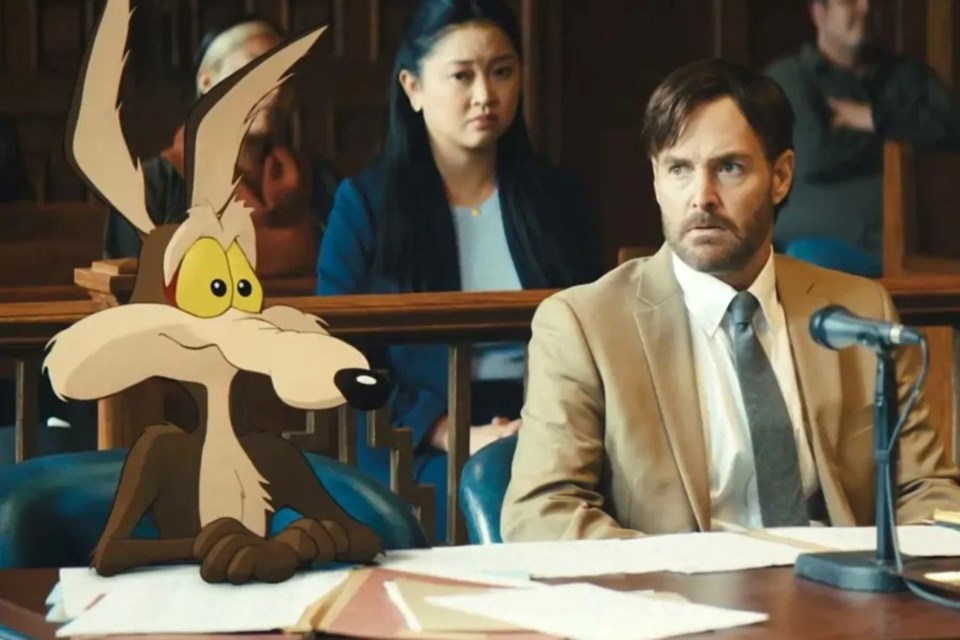
Coyote vs. Acme is a movie about a hero who always keeps going, no matter what is thrown in his path. Or on his head. It is also a film made by a team of filmmakers with a matching appetite for persistence.
The movie audiences are about to see is a love letter to animation, to facing failure and never giving up, and to the power of the human and animal spirit.
As the movie’s title makes clear, its story is that of the legendary Wile E. Coyote finally taking his case to court. “The message of this movie, like the character at its center, is to never give up,” says director Dave Green.

For all its pioneering techniques, Coyote vs. Acme is a story that began in good old-fashioned print, back in 1990
Its source was the satirical article, published in The New Yorker and written by acclaimed humorist Ian Frazier, that imagined the legal briefings of a case brought by one Wile E. Coyote against the ACME Corporation. A suit alleging corporate malfeasance and liability, born of the string of disastrous products, everything from ACME’s patented Rocket Sleds to Spring-Powered Shoes, that had, over the years, argued the plaintiff, caused him no end of “personal injury, loss of business income, and mental suffering”.
Frazier’s piece was a slice of sublimely articulated lunacy. But, if you were in the world of Hollywood, it also had a concept you couldn’t quite shake. “It was such a wonderful article and everybody who read it laughed and loved it,” says Coyote vs. Acme producer Chris deFaria. “But what was fantastic about it was that it presented a terrific access point into a movie about Wile E. Coyote. A movie that wasn’t going to be restricted by what is both wonderful and tough to adapt about the original Coyote/Road Runner shorts, which is that they had always been a very simple, straightforward chase. This idea gave them a whole new dimension.”
So exciting was this possibility that over the 30 years since the piece’s publication, its eventual adaptation has passed from filmmaker to filmmaker. Over time, the mantle was eventually picked up by Green, his expertise in movies that mix live-action and animation (Teenage Mutant Ninja Turtles: Out of the Shadows and Earth to Echo) making him the perfect visionary to tell this unique tale of a cartoon character taking on the big boys.
His movie begins with a triumphant sequence in which the eternally frazzled Wile E. Coyote is once again outsmarted by his ultimate nemesis: the Road Runner. “Realizing this is probably his unsuccessful attempt number 1,150 in the last year alone to get him, Wile E. decides that enough is enough. That he needs a new approach,” laughs deFaria of the premise.
“On the television he sees a commercial for an ambulance-chasing lawyer named Kevin Avery [played by comedy superstar Will Forte], who says, ‘If you have a problem, we can fix it.’ Kevin’s catchphrase is: ‘There’s always someone to blame!’ At that moment, Wile E. looks around his cave and realizes that all these failed products that he has always used to try and catch the Road Runner are made by one company – ACME. So, Coyote hatches his new plan: to go to town and find this TV lawyer, so together they can sue the ACME Corporation. That’s when things get messy…”
The set-up for Coyote vs. Acme is, as Dave Green admits with a grin, an absurd idea. And that’s precisely why he knew it would work, with one major caveat.
“We had to play it straight. I was instantly convinced of that,” the director says. “Because I knew that’s not just where the comedy would come from, but the emotion too.”
His key cast and crew couldn’t agree more. “For me, in movies, every character should be a total being, should have the full range of emotions. That is the fun of storytelling – being able to take something or someone we view as only one thing then taking that veil away, so you realize they have other sides to them. That’s what makes us connect with characters and root for them,” John Cena adds.
“That’s what makes this movie so strong. Until now, you have only viewed Wile E. as one thing. But by the end, you will see that Wile E. Coyote, although he is animated, is a total being. That he has all the emotions that we all have. And that’s what made me shed a tear or two when I watched it.”
When he was first created – in 1949 – by animator Chuck Jones and writer Michael Maltese, Wile E. Coyote was famously based on a line in a book by Mark Twain – his semi-autobiographical slice of travel literature from 1872 titled Roughing It, that described the desert coyote as a “long, slim, sick, and sorry-looking skeleton” always looking for its next meal.
But what Green found most interesting about the character of Wile E. Coyote specifically, and the heightened world in which he exists, was something more existential. A question that, once it first popped into his head, the director simply couldn’t shake loose.
“The thing that unlocked the whole movie for me was this idea that we watch cartoons and we laugh at the cartoon characters in them, and we laugh at their cartoon pain. We always have! So, in some ways, the idea of this movie was of us saying, ‘We’re sorry!’ This idea that Wile E. Coyote has been through 75 years of mistreatment and is totally sick and tired of it!” Green says.
“That then became, ‘Well, what if we treated his problem seriously? What if this whole thing wasn’t just a lark but went deeper and explored themes that we haven’t gotten to explore before?’ That was what excited me. This question: ‘What if we created real, actual empathy for Wile E. Coyote?’”
The questions kept on coming. “I asked myself, ‘How does it feel when people laugh at Wile E.’s pain? Why is it okay for people to laugh at cartoon injuries?’ Once I started putting all that stuff into the thought-blender, I realized this movie could get into a bigger thematic idea of what makes a person a person, and what makes a cartoon a cartoon?”
Green’s inspirations became as pioneering as his thinking throughout the development process, his pitches to the studio provocatively pushing the limits of the movie’s possibilities, stretching its edges, challenging established preconceptions of what a Looney Tunes movie could really be.
“When I first started pitching to make this movie, I pitched some truly crazy things, like, ‘Can it be a true crime documentary?’” Green laughs. “I was testing boundaries. And I was given permission to dream up whatever I thought the ideal version of this story could be. I started looking at classic courtroom dramas, thrillers and procedurals, pulling from Michael Clayton, The Verdict, A Few Good Men…”
But one movie above all others spoke to Green. A movie he’d long loved and that somehow felt perfectly suited. “That movie was The Insider,” Green says of Michael Mann’s seminal 1999 thriller in which Russell Crowe’s research chemist Jeffrey Wigand makes the brave decision to turn whistleblower on the tobacco industry.
“My take was, ‘What if we put Wile E. into the world of The Insider?’ Because the thing that I love about that movie, every time I watch it, is that you just feel so angry for Jeffrey Wigand and so mad at Big Tobacco and what they’ve done. As an audience, you have this simmering feeling of injustice.”
Green chuckles, acutely aware that a seven-time Oscar-nominated, decidedly grown-up examination of corporate corruption and one-man’s near psychological collapse might not at first glance seem like the most obvious parallel for a movie about an angry coyote arguing about faulty jet-propelled pogo sticks.
“Look, I do know that Coyote vs. Acme is a movie for kids and families!” Green laughs. “But The Insider was my north star. I knew that if we could give the audience a fraction of that feeling, of how unfair this all is, that it would work. Because Wile E. Coyote really does deserve a good case against the ACME Corporation!”
When the director had officially boarded the project, not long before the Christmas of 2019, one of his first tasks was building on the screen story that had been developed previously. It wasn’t, as Green is quick to point out, that that version of the script didn’t have its own merits, but that Green saw this story decidedly differently. For its emotion to land, he argued, it would need a specific kind of screenwriter.

The Screenplay
Green and deFaria would track down their quarry in an unlikely place. Both men had read an unproduced sample screenplay that was being passed around Hollywood by multiple executives excited by the new voice behind it.
That voice was Samy Burch. Her script, May December, was an arch dark comedy that would later be directed by Todd Haynes and star Natalie Portman and Julianne Moore, for which Burch would be nominated for an Oscar. On paper, she was a left field choice to pen a story featuring legendary Looney Tunes characters. “I give Chris the credit,” Green says. “He just said, ‘Her script is funny, clever, and dark. You should really meet with her.’ So, I did.”
This was the January of 2020, Burch remembers. She was still unrepresented as a writer but had been recommended by another producer to meet with Green. “I thought it was a general coffee meeting, not one about a movie about a coyote. I had no expectations at all!” Burch laughs. But the pair hit it off. And that’s when Green dropped the bombshell, asking her if she might be interested in taking a look at the existing draft for Coyote vs. Acme.
“I was like, ‘Sure!’ I read it and sent some ideas over in an email, and Dave called me the next morning: ‘Hey, can you get down to Warner Bros to talk to me and Chris about these thoughts?’ I ran there,” Burch says. “And I found myself in what they call a ‘bake off’ [the audition process for writers, in which multiple candidates pitch their takes on a project].”
Burch remembers the process as being “an intense battle” but emerged victorious thanks to two key factors, according to deFaria. “One was Dave’s obvious enthusiasm for her, and the connection I could instantly see between them,” deFaria says. The second was the Post-It Notes they plastered all over the whiteboard in his office.
As the screenwriter remembers, “We put about a hundred cards on the wall, working out the conspiracy, the legal case, the character arcs but also establishing a tone that mixed the straight-faced comedy of Ian Frazier’s article and an emotional core that hopefully would take the audience off guard.”
For deFaria, the process was as enjoyable as it was valuable. “The first thing we did – Dave, Samy and me – even before we really knew each other’s take on the story, was to grab a stack of Post-Its and write down adjectives that we wanted the audience to feel when watching the movie – specifically about Coyote. And since he never speaks in our film, we then had to imagine scenes that could deliver what was on those cards. It was kind of backwards, but it worked,” the producer says.
“You can’t go into a movie, especially one that involves characters that have such a history and so much material about them already out there, without figuring out what emotions you’re going to try to pursue, and where. The plot is important, clearly. But it’s what people are feeling as that plot plays out that really matters.”
As for the words that were written on the cards on that whiteboard that day, there were many. But the three that stood out then and ring so true in the final movie, deFaria says, were these: ‘Surprise,’ ‘Heart’ and ‘Smart/Silly.’
“We all believe that we’re Road Runner,” says deFaria, “but deep down inside, we know we are actually Wile E. Coyote. Once you understand that – and Samy definitely did – you realize what this movie is, and how it will touch people.”
What made the screenplay Burch turned in so strong was as much down to her abilities as a screenwriter as her previous experience. “What I love about Samy is that she is allergic to generic choices and obsessed with specificity, so was always making sure we were telling a courtroom drama through a Looney Tunes lens,” Green says.
“The thing with her is that she comes from that casting background, so was looking at the lineage of these characters, even the deep cut ones, and approaching them as an ensemble who were basically ready to slot into roles in a courtroom thriller. You could see her casting mind at work: ‘It’d be super funny if we counter-programmed characters who we think are sweet and lovable, like, what if the sweetest character in the roster turned out to be a villain?’ Her casting choices in her script were brilliant.”

The Ultimate Silent Movie Star
Looney Tunes have never gone out of style, says producer Chris deFaria. Nor has their poster-boy for mayhem: Wile E. Coyote. “The reason these cartoons have endured is because their core perspective has always been so subversive and iconoclastic. Looney Tunes in fact began as a method to sell music for Warner Bros. – that’s why it’s called Looney Tunes,” he says. “Those animations more than 90 years ago were subversive themselves and immediately became their own entity. That upstart nature is the key to these characters and always has been.”
Having worked with these characters and in this world for so many years, deFaria knows them inside and out. And says it’s impossible not to love his irrepressible star. “It’s easy to write this coyote off as a fanatical freak, but Wile E. is the most positive character in all of Looney Tunes. He wakes up every morning, sets the table for Road Runner stew, and goes out. And every day he fails, comes home and puts away those things on the table. But he never wavers. The next day he gets up and does it all over,” the producer says.
“He has this wonderful quality of staying the course and hoping that one day his dreams will come true.” There is more than a little of Sisyphus in him – the Greek King of Ephyra condemned to roll an immense boulder up a hill, only for it to roll back down each time it neared the top.
Wile E. Coyote has starred in many of the most memorable Looney Tunes shorts. He arrived in 1949 in Fast and Furry-ous, created by Chuck Jones and writer Michael Maltese alongside the Road Runner, the nemesis who would define him; his speaking appearances opposite Bugs Bunny followed a few years later, beginning with Operation: Rabbit in 1952.
“Wile E. Coyote has his flaws. He’s foolhardy, has an ego, is prideful and devious. But the thing that is so admirable about him is that he’s so persistent,” says director Dave Green. “As a kid, I loved him. The shorts I always gravitated towards were the Road Runner and Wile E. Coyote ones. I responded to them so strongly because the conflict in them is very simple, incredibly visual, and entirely nonverbal.”
The fact that his movie’s leading man doesn’t speak, Green maintains, was one of the aspects that particularly appealed. “It’s a great challenge,” he says, “because it means you have to rely on the purity of his expression and his physicality to get across very complex, really human ideas. In the tradition of Charlie Chaplin or Buster Keaton, Wile E. Coyote is one of the best silent film actors of all time.”
He has his famous signs, of course, that he holds up in moments of frustration, for comedy effect, or both. “But we have been very choosy with when and where Wile E. uses his signs because not only is he incredibly expressive in his face, but his body language is hilarious. We studied all these classic Chuck Jones poses from the original cartoons because he has always been such a malleable character,” says Green.
But while some aspects of Wile E. Coyote will always remain the same, in Coyote vs. Acme the filmmakers have had the chance to evolve him, too. By taking the character from his typical five-minute shorts and into the realm of a full-length feature, audiences will now have the chance to see and appreciate him more than ever before.
“People will now understand what he is actually thinking and really feeling, rather than just the fact that he is making them laugh,” says Will Forte. “That doesn’t mean we are reinventing the wheel of who Wile E. is. He is still a living, breathing example of pure want. That core stays the same. But now we get to play within those parameters in a way no-one has ever gotten to. What he can say without saying anything says so much.”
DAVE GREEN (Director)
Dave Green is obsessed with making cinematic comedy. He has an unbridled passion for finding absurdity in the ordinary world and for delivering ridiculous ideas with a straight face. Green most recently directed Coyote vs. Acme, starring Will Forte, John Cena, Lana Condor, and Martha Kelly, amidst a hybrid cast of 2D animated Looney Tunes characters. Green also directed Earth to Echo and Teenage Mutant Ninja Turtles: Out of the Shadows, for producer Michael Bay.
Green created the video series Toothpix, an anthology of 12-second shorts parodying the L.A. food scene. The series was dedicated to food critic Jonathan Gold’s writing and was adapted into a series for TBS with Tim and Eric’s AbsoLutely and David Gelb’s Supper Club.
He’s directed a series of viral shorts, music videos, and commercials detailing his unique talent for mashing up genres and turning them upside down, including the Sam Raimi-produced Zombie Roadkill and Meltdown, a short film starring David Cross.Upcoming, Green will direct Hex, with BenDavid Grabinski writing.
He’s interested in puppets, food, sight gags, and spaghetti. He takes himself extremely seriously.
SAMY BURCH (Screenplay by and Screen Story by)
Samy Burch is the Academy Award-nominated screenwriter of May December, directed by Todd Haynes, starring Natalie Portman, Julianne Moore, and Charles Melton. The film premiered in competition at the Cannes Film Festival and was the Opening Night Film of the New York Film Festival. May December won Best First Screenplay at the Independent Spirit Awards, Best Screenplay at the New York Film Critics Circle, and Best Screenplay at the National Society of Film Critics.
Samy’s upcoming films include Coyote vs. Acme, which is being released later this summer, and Late Fame, which will be released by Magnolia, starring Willem Dafoe and Greta Lee. The film was directed by Kent Jones after premiering at Venice and NYFF.
JEREMY SLATER (Screen Story by)
Jeremy Slater wrote Godzilla x Kong: The New Empire, which opened at #1 at the box office, and Mortal Kombat 2 for New Line/Warner Bros., which was released in theaters this May.
In television, Jeremy created The Umbrella Academy for Netflix/UCP/Dark Horse, Moon Knight for Marvel and Disney+, and is the creator and co-showrunner of The Exorcist on Fox.
Jeremy is currently in Ireland shooting his directorial debut, Sommoner, for Amazon, with Nocturna producing and Kevin Bacon starring.
Visit Our YouTube Channel
