
Visit our YouTube Channel
Good Boy (2026), also known as Heel, marks a striking and unexpected turn in the career of Polish filmmaker Jan Komasa, whose previous works — Corpus Christi, Suicide Room, Warsaw 44 — established him as a director fascinated by identity, moral fracture, and the psychological architecture of modern life.
In Good Boy, Komasa pushes these concerns into darker, more intimate territory, crafting a psychological thriller that examines obedience, power, and the human longing to be shaped by another.
‘We live in a world where people are terrified of being themselves,’ says Komasa, who wrote the screenplay with Bartek Bartosik and Naqqash Khalid
‘I wanted to show that goodness can come from the most unexpected places. Cinema is a place where we confront the things we are afraid to say out loud. We grew up in a country that changed every few years. You learn to adapt, but you also learn to question everything.’

The screenplay grew out of Komasa’s research into behavioural conditioning, parasocial attachment, and the ways individuals surrender autonomy when confronted with charismatic authority.
The inspiration reportedly came from Komasa’s fascination with extreme relationship dynamics and the psychological mechanisms that make submission feel like safety, a theme he had touched on in Suicide Room but never explored with such raw, behavioural precision. Pacewicz approached the writing process with his characteristic blend of sociological insight and emotional acuity, crafting a script that unfolds not through exposition but through gesture, silence, and the incremental erosion of personal boundaries. Together, Komasa and Pacewicz built a narrative that feels both theatrical and disturbingly plausible, a story in which the protagonist’s transformation is not a sudden collapse but a slow, almost tender surrender to someone who promises clarity in a chaotic world.
Anson Boon’s portrayal of Tommy in Good Boy (Heel) became a defining emotional experience for the actor, both professionally and personally.
Known for his intensity and precision, Boon approached Tommy as a man caught between devotion and self‑destruction, a character whose obedience masks a desperate need for love. The role demanded a level of vulnerability that stripped away performance and left only raw instinct; Boon immersed himself in the psychological tension Komasa built into the screenplay, studying behavioural conditioning and isolation to understand Tommy’s surrender. The process left a lasting mark on him — he described feeling “haunted” by the character’s quiet implosion and the moral ambiguity of his choices. The film’s impact on Boon was transformative: it deepened his understanding of emotional control and the fragility of identity, pushing him toward a more introspective approach to acting. In interviews following the release, he reflected that Good Boy taught him how silence can be more revealing than dialogue, and how the act of submission, when portrayed truthfully, can expose the most human kind of courage.
Stephen Graham added a volatile emotional charge to the film
Known for his ferocious authenticity and his ability to inhabit characters with bruised humanity, Graham approached his part in Komasa’s psychological drama with a raw, almost dangerous vulnerability. He spoke about the challenge of entering a world where power is expressed through silence rather than violence, noting that the film forced him to “play tension in the spaces between words,” a mode of performance that demanded restraint rather than eruption. Graham has often gravitated toward characters who fight their way through life, yet Good Boy required him to portray a man who watches someone else unravel and is powerless to intervene. That helplessness, he admitted, stayed with him long after filming ended. The emotional architecture of the story — the slow erosion of identity, the seduction of control, the quiet devastation of surrender — pushed him into unfamiliar territory, sharpening his sensitivity to psychological nuance. Graham reflected that the film taught him how stillness can be as explosive as rage, and how witnessing another character’s collapse can be more harrowing than experiencing one. The experience expanded his range, revealing a quieter, more introspective dimension to his craft, and left him with a renewed respect for the fragile, ambiguous spaces Komasa builds into his work.
Andrea Riseborough brought a distinct, unsettling electricity to the film, and the role left a deep imprint on her as an actor.
Known for her fearless immersion into psychologically complex characters, Riseborough approached the film’s power‑dynamic narrative with a forensic emotional intelligence, crafting a performance that is both hypnotic and quietly devastating. She spoke about the challenge of playing a woman whose influence operates through stillness rather than force, noting that the role required her to “hold an emotional temperature that never breaks, even when everything inside the character is shifting.” The experience pushed her into new territory, demanding a balance between empathy and manipulation that she found both exhilarating and disorienting. Riseborough has said that the film forced her to confront how intimacy can become a form of control, and how portraying such dynamics truthfully requires an actor to sit inside discomfort rather than perform around it. The impact on her was profound: Good Boy sharpened her understanding of psychological storytelling, expanded her range into a more behaviour‑driven mode of performance, and left her with a lingering sense of the emotional ambiguity that defines Komasa’s work.
The narrative unfolds with Komasa’s signature blend of realism and stylised tension.
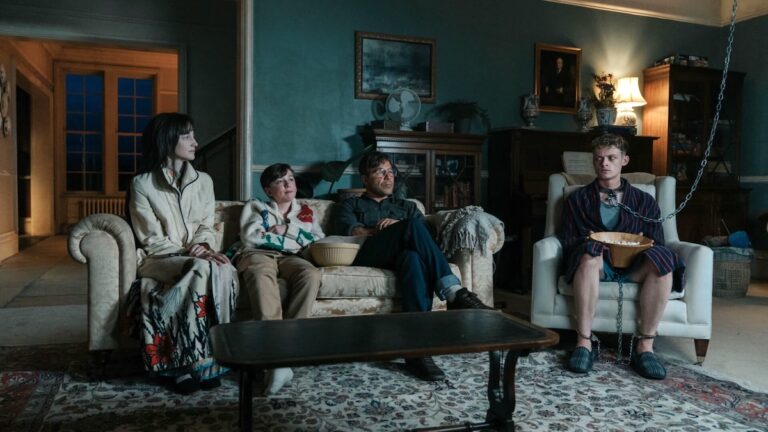
The protagonist, adrift and emotionally fractured, meets the woman at a moment when he is most susceptible to influence; she offers him structure, purpose, and a sense of belonging he has never known, and he responds with increasing devotion. What begins as consensual emotional intimacy soon becomes a labyrinth of manipulation, with the woman pushing him toward acts that test his loyalty, reshape his identity, and sever his ties to the outside world.
Komasa’s direction emphasises the protagonist’s internal conflict: he is both terrified and exhilarated by the intensity of the relationship, drawn to the clarity it provides even as it erodes his sense of self. The film’s title, Good Boy, reflects the protagonist’s gradual acceptance of a role defined by obedience, while the alternate title, Heel, underscores the metaphor of training, conditioning, and behavioural reinforcement.
Komasa uses these motifs not as shock value but as a lens through which to examine the human desire to be guided, valued, and relieved of responsibility. The film’s visual language reinforces its themes of domination and submission: Komasa and cinematographer Michał Sobociński employ tight framing, muted palettes, and stark lighting to create a world that feels both intimate and suffocating, with the camera often lingering on the protagonist’s face to capture the subtle shifts in his emotional state as he navigates the woman’s increasingly demanding expectations. Sound design plays a crucial role, with quiet, rhythmic cues that mimic the cadence of training, conditioning the audience to anticipate moments of tension and reinforcing the film’s behavioural motif.
The significance of Good Boy lies in its unflinching exploration of psychological vulnerability and the human need for connection.
Komasa refuses to frame the protagonist as weak or foolish; instead, he presents him as someone whose emotional wounds make him susceptible to manipulation, someone who longs for structure and belonging in a world that has repeatedly denied him both.
The film challenges viewers to consider how easily devotion can become dependence, how quickly admiration can become submission, and how profoundly a charismatic figure can reshape another person’s identity.
Critics praised the film for its bold thematic focus, its intense performances, and its willingness to confront uncomfortable truths about power, desire, and the emotional architecture of obedience. Some noted that its subject matter may be polarising, yet its emotional honesty and behavioural precision make it one of Komasa’s most compelling works.
Good Boy stands as a testament to Komasa’s ability to craft narratives that provoke, unsettle, and illuminate, offering a portrait of control that is as disturbing as it is tragically recognisable, a film that reminds us that the desire to be guided can become a trap, and that the most dangerous cages are the ones we willingly step into.
Where to watch: Good Boy (Heel) is not yet available on major global streaming platforms, and its distribution remains limited. Viewers must rely on festival screenings, European speciality releases, or region‑specific VOD services. After its 2026 premiere, the film circulated mainly through Polish and European festivals before receiving a modest digital rollout on Player.pl and Canal+ Premium, where Komasa’s work typically appears first. The film is absent from Netflix, Hulu, Disney+, and HBO Max, and has not yet received a broad international streaming release. For viewers outside Europe — including South Africa — the most reliable access is through Apple TV’s international catalogue or Amazon’s global rental options, where the film occasionally appears depending on licensing windows. In short, Good Boy (Heel) can be watched, but only through limited digital rental platforms or European VOD services, with wider global availability still forthcoming.

