
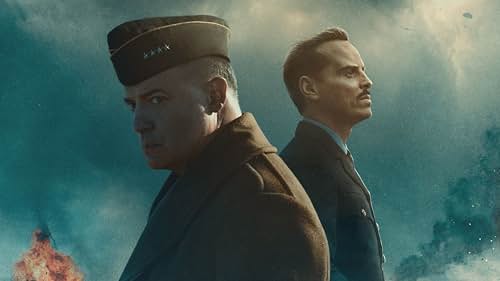
The extraordinary true story that would become the WWII thriller Pressure, began its journey to the screen via the stage. In 2012, actor and playwright David Haig set out to tell the story of an unsung Scottish hero in a new play for the Lyceum Theatre in Edinburgh. He chose as his subject Dr James Stagg, the eminent meteorologist, not widely known outside his field, whose weather forecast would decide the fate of the largest seaborne invasion in history: D-DAY.
With millions of lives and the fate of the War at stake, Stagg went head-to-head with General Eisenhower and Allied leadership in the days immediately before the attack, becoming the key factor in the final, momentous decision, to go…or not go. Stagg had told his own story after the war, but it had never been fully examined or adapted, and Haig saw a jaw-dropping corner of history that needed to be explored.
In the tense 72 hours before D-Day, and with the fate of the free world hanging in the balance, Pressure follows General Dwight D. Eisenhower and Captain James Stagg as they face an impossible choice—launch the largest and most dangerous seaborne invasion in history or risk losing the war altogether.
After a period of deep research and consultation with Stagg’s family, Haig wrote Pressure.
It played to enthusiastic audiences in Edinburgh and London, with the playwright in the central role for over 300 performances. The play was a commercial and critical success. Michael Billington, reviewing for The Guardian, praised Haig for finding “rich drama in the interaction of war and weather” and admired how the play “transcends its context” to feel relevant to the modern day. Scenes from the play were performed at the 75th anniversary celebrations of D-Day in Portsmouth in 2019, with Queen Elizabeth II, President Trump, Prime Minister Justin Trudeau and President Macron in attendance. When it played in Toronto, the Globe and Mail called it an “intense but frequently entertaining history lesson” and praised its intensity and suspense.
During its London run, two key figures were watching. Joe Naftalin, senior VP of global production and head of UK film production at Studiocanal, and Lucas Webb, producer at Working Title, both went along to see it, and were fascinated by the story and the tightly-focused angle that Haig took on it.
“It was recognising the play and its potential,” says Webb. “I’m always compelled by character stories, and this was very much a human story, an underdog story, about an individual who had to find the courage to do his job to the best of his abilities when everybody was saying one thing and he was a lone voice saying, “But we have to do another.”
“Everyone knows about D-Day,” Naftalin observes. “But no one seemed to know the extraordinary story of those crucial days leading up to the invasion, and especially the very last-minute decision making that would change the course of history.”
Naftalin discussed the play, and the idea of adapting it for the screen, with Ron Halpern, executive vice president at Studiocanal. Halpern felt an intense connection to the material. As it happened, he had written his senior thesis on Eisenhower’s leadership style as a general and later President, as well as having worked for CBS News at the 50th anniversary of D-Day in Normandy, and was instantly keen to explore this pivotal moment in history.
“Immediately this was an incredibly interesting story,” says Halpern. “So often people just tell leaders what they want to hear, and here was Stagg telling the great General Eisenhower and Monty (Field Marshal Bernard Montgomery), what they did not want to hear. That takes real guts.”
Studiocanal and Working Title had partnered very successfully over the years on other films such as Tinker Tailor Soldier Spy – and producer Eric Fellner and Working Title always had a keen interest in this particular period of history, having produced Darkest Hour – another World War II story with a little-known, personal angle – and with such enthusiastic support in both camps, they quickly made a deal to work together on a film version.
Playwright David Haig had always believed that his story could be more.
“I’ve been fascinated by James Stagg, his family and his achievements for the last twelve years,” says Haig. “I was so convinced that it would also be a good film that I wrote the first draft of the screenplay in parallel with the stage play.” David slowly developed the screenplay over many drafts, but it wasn’t until one more ingredient was added that the project began to take shape in cinematic form.
That key addition came when the 2019 thriller Hotel Mumbai brought filmmaker Anthony Maras into focus who would go on to co-write, direct and edit the film.
“We’d seen The Palace, Anthony’s short film many years ago, which was absolutely brilliant,” remembers Naftalin. “Then, when we were getting started with David and Working Title, Anthony was over from Australia to promote Hotel Mumbai, which was a film we had all been blown away by – by its emotion, its tension, and the ambition and the intention of its filmmaking.”
“At Working Title they have a great history of matching interesting international filmmakers with quite British material,” agrees Webb. “Applying that logic to something like Pressure, to find an Australian filmmaker with roots in action and really visceral, dynamic filmmaking, felt like a really unusual move that could create magic.”
When they showed the script to the Maras, the power of the story sank its claws into him. “David had unearthed such a powerful, poignant story in Pressure, that I felt could not be more relevant today. I could not stop thinking about it – about it’s themes of people speaking truth to power, of having the courage to stand by your convictions, of the importance of rational thought in times of extreme pressure. It may be set during wartime, but at heart it’s about how we make the toughest decisions of our lives. No matter how big or small.”
“I was utterly captivated by this unknown story of unsung heroes whose work was pivotal in pulling off the largest seaborne invasion in history,” says the Australian filmmaker. “A lot of people came together to defeat Nazi Germany on D-Day, and the deciding factor, of all things, was their ability to decipher the hidden patterns governing nature itself. They had to second guess the British weather.”
While the director instantly connected with the story, as a writer he wanted to drill further down into it’s underlying themes and characters, and reimagine the story for the big screen – something that Haig actively welcomed after spending so long with the material.
“Once Anthony came on board, I bow to his extraordinary filmic awareness,” says Haig. “His knowledge is encyclopaedic. He has such a clear vision, and a filmic structure that, as a stage playwright, I would admit wholeheartedly I don’t instinctively have. That element was crucial, and I take my hat off to him.”
The development of the screenplay extended through the pandemic, when Covid-19 and then industry strikes delayed the film’s schedule. “Years went by but no time was wasted,” is how Naftalin remembers it now. The pause gave Maras time to drill down into the work, and craft the script exactly as he saw it in his head, while his production partners figured out the logistics of making that film come to life.
“Many of the same tensions and questions that emerged during the pandemic were echoed in this story that took place eighty years earlier. The importance of facts and data, of speaking truth to power, of having the courage to take a stand, however unpopular. This is a story exploring a different type of heroism. Exploring what real leadership looks like during a time of crisis. I felt it was a story we needed,” says Maras.
“It needed to be told with a real sense of immediacy and intimacy. It needed to feel visceral to its core – and therein was our challenge. In Hotel Mumbai, the threat was palpable – predators were stalking the hallways of the Taj in a killing spree. It’s something that we’re biologically, evolutionarily designed to fear, whereas what attracted me to this story was it’s focus on the more existential threats that we collectively face, and that we don’t instinctively fear in the same way. How do you make a slow-moving weather system terrifying? How do you truly capture the unspeakable pressure these individuals were facing over those 72 hours? With millions of lives on the line, how can you bring yourself to the right decision? Is a ‘right’ decision even possible with so many unknowns?”
By 2024, it was ready to go.
The Casting Of Pressure
For the lead role of James Stagg, one name quickly came into focus: Andrew Scott. Maras needed an actor with the intelligence and poise to embody the supremely gifted meteorologist, the grit to withstand the pressure of the war’s most revered, and feared, military leadership, and the vulnerability of a man isolated, friendless, and ordered to leave his heavily pregnant wife behind.
“He’s stubborn and, at times, very difficult. But there’s a sense that Stagg is solid as a rock. A man who deeply understands the natural world, and who comes to feel like a force of nature himself. I couldn’t dream of anyone more fitting than Andrew Scott.”
Scott, on a career high after critically acclaimed work in productions like All of Us Strangers and Ripley, was instantly drawn to the role. “James Stagg struck me as a singular character, quite different to any I’ve played before. He’s not particularly charming or likeable – but that doesn’t mean that he isn’t extraordinarily gifted. Our attitude towards him changes as the movie progresses, and we start to show interest in what he knows, rather than what he shows. He’s a great intellect, and deeply passionate and deeply humane, actually – but that’s not something that he shows people right from the beginning. I suppose it’s a film about what we reveal, and who we are at heart.”
Opposite Stagg, Maras and his team needed to find their Eisenhower, the final authority on Operation Overlord and a future American President. One recent Oscar winner immediately stood out as the number one choice. “Eisenhower was someone that America loved and trusted, and I think Brendan Fraser is someone that the world loves, and trusts,” says Maras. “
Fraser would spend weeks reading every biography he could find, and visited the Imperial War Museum to see in person the top-secret battle plans for D-Day that Eisenhower helped to create, rusted staple marks still visible in the corners. He shaved his head to play the leader, who was “follicularly-challenged,” as he puts it, and absorbed every scrap of information about Eisenhower that he could find to round out his portrayal of the man. Maras reports that, even on one of the final days of filming, Fraser was still referring back to Eisenhower biographies and suggesting character quirks that he could add to the portrait.
“Eisenhower cared about his troops,” Fraser explains. “They were all his sons, as far as he was concerned. He had the ability to hear everyone out, because he wanted to absolutely succeed, but he didn’t do it at any cost imaginable. That wasn’t a popular notion at that time!”
ANTHONY MARAS – DIRECTOR AND WRITER OF THE SCREENPLAY
Anthony Maras is an Australian filmmaker whose debut feature Hotel Mumbai, starring Dev Patel, premiered to international acclaim and marked him as one of Variety’s Top 10 Directors to Watch. The film redefined the 26/11 Mumbai attacks for global audiences, transforming a distant news event into a hyper-real, deeply emotional lived experience.

Prior to this, Maras directed numerous short films including The Palace, Spike Up and Azadi, winning multiple Australian Academy Awards along with honors at film festivals worldwide. Across his body of work, Maras has gravitated toward stories set within real-world pressure points, from contemporary conflict zones to moments of historical crisis. His films are distinguished by exceptional performances, high tension, and the interplay between spectacle and personal, character-driven storytelling.
With Pressure, Maras turns his attention to the war room behind the largest seaborne invasion in history, D-Day, and the clash between the military commanders and meteorologists that would determine the fate of World War II. As with all of his films, he served as a writer, director and editor.
DAVID HAIG – WRITER OF THE ORIGINAL PLAY AND OF THE SCREENPLAY
David Haig is an Olivier award-winning actor and FIPA award-winning writer.
His writing credits include: MY BOY JACK which opened at Hampstead Theatre in 1997 and subsequently toured in 2004; THE GOOD SAMARITAN (Hampstead Theatre, 2000) and PRESSURE (a co-production by Royal Lyceum Theatre Edinburgh and Chichester Festival Theatre) which was nominated for Best New Play at the 2014 UK Theatre Awards. The play was revived in 2018. It toured the country, ran at the Park Theatre in Finsbury Park for 2 months, and then transferred to the West End for a sold out run at the Ambassador’s Theatre.

In 2007, David adapted MY BOY JACK for screen, produced by Ecosse Films and ITV. The adaptation, which starred David alongside Daniel Radcliffe, Carey Mulligan and Kim Cattrall, won Best Screenplay at the International Festival of Audiovisual Programs (FIPA) in 2008.
David is currently working on a new play: MAGIC opening at Chichester Festival Theatre in April 2026.
