
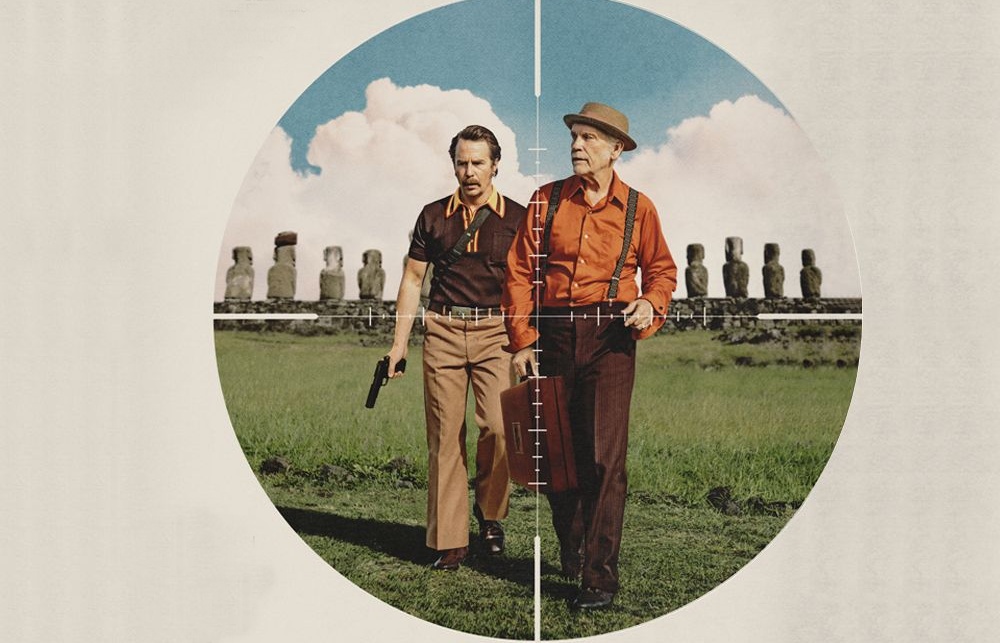
Writer-director Martin McDonagh’s Wild Horse Nine is centred on a friendship shaped by decades of secrecy, loyalty and moral compromise.
At the centre of Wild Horse Nine are two men whose lives have been defined by decades of shared work inside the CIA. Chris and Lee arrive on Easter Island not simply as colleagues, but as partners with years of dangerous assignments and the moral quandaries that accompany them.
In the film, Chris (John Malkovich) and Lee (Sam Rockwell) – veteran CIA operatives whose careers unfolded in the shadows of Cold War politics – arrive on Easter Island carrying the weight of a long-shared past and, though off-duty, ulterior motives they do not share even with each other.
Set in Chile in 1973, the story unfolds in the uneasy months leading up to the military coup that would overthrow the democratically elected President Salvador Allende. While political forces gather on the mainland, Chris and Lee are sent from Santiago to the remote isolation of Easter Island, a volcanic outpost more than 2,000 miles into the Pacific Ocean. While on Easter Island, the pair set off on different clandestine journeys, as Chris reflects on his life choices and career through a dictaphone and Super 8mm recordings by Lee, and Lee balances directives from MJ that places him squarely in the middle of Chris’ fate.
For McDonagh, the story and the character, Chris, offered an opportunity to explore the moral compass of a man who has spent decades operating within the hidden infrastructure of global politics.
“I thought it would be interesting to deal with a person’s guilt and attitude toward what he’s done,” McDonagh says. “He’s a Catholic guy, too, so guilt and sins and all that kind of stuff comes into play.”
A combination of ethical dilemma and tonal tightrope walk became the character’s defining feature, and immensely appealing for an actor like Malkovich. “He’s quite funny, quite childish,” Malkovich says. “But also, obviously given his history, he’s quite deadly, even though he’s at the end of his career.”
The emotional core of the film, however, rests on the relationship between Chris and Lee. Chris is nearing the end of his career after years spent carrying out covert operations around the world. Lee, meanwhile, remains deeply loyal to him as a friend, partner and sometimes reluctant caretaker.
“The love between these two men, that’s the heart of the story,” McDonagh says.
Rockwell describes the premise with characteristic blunt humor, calling it “a film about two white male idiots over the age of 50 who go to Easter Island to have one last hurrah and hijinks ensue.” But beneath the film’s dark humor lies a deeper emotional axis.
Actor Steve Buscemi, who stars as CIA chief MJ, says the story ultimately revolves around the complicated bonds between its characters rather than the politics surrounding them.
“The relationships are what I find really compelling,” Buscemi says. “It’s about friendship and what you’ll do for another person.”
“Martin takes you on a rollercoaster; it is really a love story between two men who have known each other a period of time, and over this trip really get to demonstrate their love to each other,” adds producer Graham Broadbent of Blueprint Pictures, who has produced 5 films with McDonagh. “He is telling this story from his position as a human being, not as a political activist.”
That balance between humor and emotional gravity has long defined McDonagh’s storytelling. As Malkovich describes the director’s voice, it often cuts emotionally close to the bone.
“It’s very funny – unusually darkly funny,” he says. “It reminds me of life.”
But the origins of Wild Horse Nine do not lie with its characters. The story itself grew out of a much earlier fascination with a place on Earth that had remained lodged in McDonagh’s imagination for more than a decade.
Developing the Screenplay
Long before Wild Horse Nine took shape on the page, McDonagh traveled to Easter Island with only a vague sense that the remote Pacific landscape might someday foretell a future project.
“I went about 12 or 13 years ago to see if a story could be set there,” he recalls, “not really knowing what that might be, but thinking that could be a pretty interesting, ‘out-there’ location.”
Known locally as Rapa Nui, Easter Island sits more than 2,000 miles off the coast of Chile. It’s one of the most isolated inhabited places on the planet. Though his first visit to the island was only a few days, the experience lingered in McDonagh’s imagination even as the story that would one day become Wild Horse Nine remained elusive. Over the years that followed, McDonagh returned periodically to the idea of setting a film there, experimenting with different narrative possibilities but struggling to settle on one that felt just right.
The breakthrough arrived when another long-standing interest resurfaced: the political upheaval that took place in Chile in the early 1970s. For McDonagh, that curiosity can be traced back to a punk song he first heard as an early adolescent.
“It all came from a song by The Clash on their Sandinista! album from 1980 called ‘Washington Bullets,’” he says. “It talks about America’s involvement in lots of places around the world. It talks about the Bay of Pigs and Cuba. I guess I heard that as a 10- or 12-year-old and that got me interested in questioning and reading about it, and those questions stayed with me.”
Eventually, those two ideas – the haunting isolation of Easter Island and the turbulent history of Chile – began to intersect. He finally collided them into a single story, and Wild Horse Nine really started to take shape.
“That trip to Easter Island, which is obviously a territory of Chile, it kind of freed me to use the island and use the history of Chile and America’s relationship with Chile all in one,” McDonagh says.
Continues Broadbent, “There’s something that Martin does, which is that he captures the sense of place in everything. The extraordinary thing Martin has done in this film is tie the events of Chile in 1973 to this unique location, in a way that I don’t know anyone else could have done.”
What had begun as a location search slowly evolved into a story about two long-timers navigating the moral consequences of a life spent inside the CIA set against a destination that has quietly observed centuries of human history.
A NEW ERA FOR McDONAGH
One constant throughout McDonagh’s filmography is the feeling that the place is a character – something McDonagh learned as far back as In Bruges.
“For Three Billboards, I remember we searched loads of states for an old school, small town with a single kind of road that you could throw a Molotov cocktail from one side to the other,” McDonagh recalls. “And with Banshees of Inisherin, we filmed in Inishmore and then found Achill Island and put those two together. For this, the characterization of the location evolved through different versions of the script. Rapa Nui is the furthest land mass from any other in the whole world; that sense of isolation and distance imbued the film as soon as we started shooting.”
Another consistency is the way in which McDonagh collaborates with his cast and crew, regardless of how many times he has worked with each member.
“Martin’s creative team is very special to him,” says Overland. “They’re very tightknit and work very closely together. He works with a lot of the same people all the time, like Graham, Pete Czernin, and Ben Davis. But Denis Schnegg was new to the team, and even so, Denis and Ben achieved the 1970s style beautifully with Martin.”
Many aspects of McDonagh’s work translate into this film, but more now than ever, McDonaghoffers a deeper introspection on human behavior, complicated political environments, and the lingering guilt of a life spent tiptoeing around God’s rules. Reflecting on his longtime partnership with the writer and director, Broadbent notes one thing that particularly separates Wild Horse Nine within McDonagh’s filmography.
“When looking at Martin’s emotional journey across all the films he’s made, you can see he’s in an emotionally rich and more vulnerable place more recently than he was at the start,” Broadbent says. “There’s a way Martin sits very comfortably in his film now. Wild Horse Nine is very funny and entertaining, but it’s also very sad, and he captures it beautifully. That’s not the same filmmaker who made In Bruges, I don’t think. It’s an evolution of a filmmaker.”
Martin McDonagh (Writer, Director, Producer)
Martin McDonagh is an award-winning, London-born filmmaker and playwright of Irish descent. He first gained attention behind the camera with his Academy Award–winning short Six Shooter, before going on to direct and write the critically acclaimed feature films – In Bruges, Seven Psychopaths, Three Billboards Outside Ebbing, Missouri, and The Banshees of Inisherin.
McDonagh has received widespread acclaim, including Academy Award nominations for Best Picture (Three Billboards Outside Ebbing, Missouri and The Banshees of Inisherin), Best Director (The Banshees of Inisherin), and Best Original Screenplay (In Bruges, Three Billboards Outside Ebbing, Missouri, and The Banshees of Inisherin). He has won six BAFTA Awards from twelve nominations, including Best Film and Best British Film (Three Billboards Outside Ebbing, Missouri), Best British Film (The Banshees of Inisherin), and three for Best Original Screenplay. He is also a three-time Golden Globe winner for Best Motion Picture – Drama (Three Billboards Outside Ebbing, Missouri) and Best Screenplay (Three Billboards Outside Ebbing, Missouri and The Banshees of Inisherin), and has received two Best Director nominations (Three Billboards Outside Ebbing, Missouri and The Banshees of Inisherin).

McDonagh is also an accomplished playwright. His works include The Beauty Queen of Leenane, The Lonesome West, The Lieutenant of Inishmore, The Cripple of Inishmaan, The Pillowman, and Hangmen, all of which have been staged in both the West End and on Broadway, and performed in over 40 countries in more than 30 languages. His honors include an Olivier Award for Best New Comedy (The Lieutenant of Inishmore) and two Olivier Awards for Best New Play (The Pillowman and Hangmen).
