
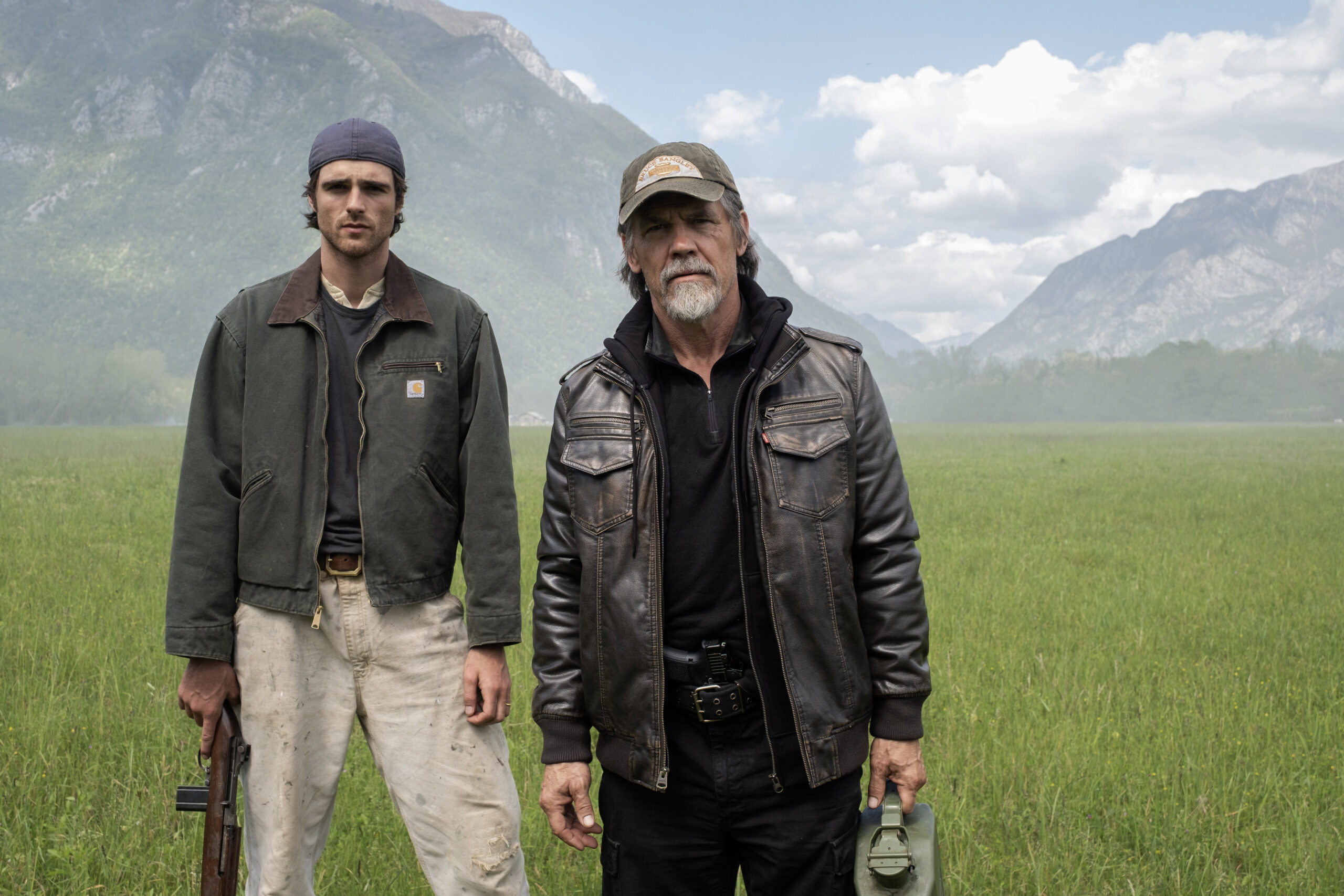
The year: 2035. The location: Eerie Colo., near the Front Mountain Range on the south side of Denver. A deadly flu outbreak has decimated the majority of the Earth’s population, and many of those who managed to survive are crippled by debilitating blood disease, resulting in an unstable dystopian world. In this brutal, post-apocalyptic landscape, the few remaining survivors are forced to confront the harsh realities of a bleak future, as they struggle to make sense of their new reality, reinvent their lives, and preserve what remains of humanity.
The journey from page to screen
Producer Mark L. Smith have a professional relationship that began years ago when they worked together on “The Midnight Sky” for director George Clooney at Netflix. “Lily, who wrote the book Good Morning, Midnight, on which the film was based, became friends with two of Mark’s children, and his son, Brandon, in particular, and loved the process of working with Mark,” says producer Cliff Roberts. “She said, ‘There’s this other book that I’ve always loved that would make a great movie.”
That book was Peter Heller’s The Dog Stars, published in August 2012, which was a hit with critics and readers alike, and went on to become a national bestseller. Executive producer Brandon Scott Smith read it and gave it to his dad, with his full endorsement, who then called Cliff Roberts and said, “Let’s go option this book together.” Smith then went on to write the screenplay on spec.
“Ridley Scott was looking for a new project once ‘Gladiator II’ had wrapped, and, being familiar with Mark’s past work (“The Revenant,” “The Boys in the Boat”), asked if he had written anything new he could read,” says Roberts, “and Michael Pruss, who works with Ridley at Scott Free Productions, suggested ‘The Dog Stars,’ which he read, and immediately agreed should be his next film.”
Roberts continues, “A good adaptation has to have faithfulness and has to be willing to kind of move off of things even if you really like them, and Mark did that in several key places, and quite effectively.”
“Mark’s script perfectly encapsulates the spirit of what Peter was getting at in the book, and what he was saying philosophically about society and the world,” says producer Michael Pruss. “He brought his own visual language and vocabulary to it.”
“Peter decided early on that he wanted to respect Mark’s space, but he was a great partner in that way, where he was always an enthusiastic cheerleader, but he didn’t ever step on his toes,” Roberts says. “When Peter visited the set, we talked about this metaphor that is in The Fountainhead: when they first started building steel bridges, they just built wood bridges out of steel until they realized that steel does totally different things than wood does. And I think that adaptations are like that as well: you have a tendency when you love a book to say, ‘let’s take everything from the book, but movies are different than books, because books can be much more internal…you can be omniscient, because they are not visual by definition.”
Adds Pruss, “Peter was a great partner, and was the first author of this remarkable story.
He is more than just an author…he is an outdoorsman who lives in Colorado. He was delighted that the film was being made, and he delighted in the fact that Mark brought his own brilliant craft and creativity to it. He is one of those authors who understands that as much as everyone loved the novel, sometimes there is a level of interpretation needed as it moves from the page to the screen.”
“The film is such a different change of pace for Ridley, especially on the heels of ‘Napoleon’ and ‘Gladiator II,’” Pruss continues. “One of the films that has always inspired him is ‘The Sound Barrier,’ directed by David Lean, a 1952 British aviation drama, which takes the notion of a plane as both a character and partner in the story, which is exactly what Hig’s Cessna is in the film. It’s not just Hig and Jasper’s mode of transportation…it’s an essential and deep-rooted part of their life.”

While director/producer Ridley Scott was originally under the impression that this was just another end-of-the-world story, he was pleasantly surprised when he read the initial draft.
“When you read the first page of a screenplay by a good writer, your fate is already sealed,” Scott says. “And what Mark managed to do – and what most zombie movies do not do – is inject the characters with real heart. Jacob and Josh’s characters live their lives with a degree of humor, even comedy. It’s like an odd couple having to live together and tolerate each other indefinitely. And then you have Pops and his daughter Cima, who, when you’re living that close to someone for that length of time with no neighbors and nowhere to go, start to get irritating.”
Scott continues, “I wanted to avoid doing something that has been done and overdone, because this is a story about the end of the world, and the time has come for it to disintegrate into nomadic behavior. I will do anything to avoid a cliché, which is my mantra whenever I do anything.”
“This story is about so many things, whether it’s drama, fear, terror, or comedy,” Scott continues. “It’s really about self-sufficiency. You’ve got to look after yourself. There are two words I love: “grace” and “frugal,” and frugal doesn’t mean that you are mean. Frugal means that you are sensible, and we are so not sensible. And thank God I read page one, otherwise I wouldn’t have made it.”
According to Pruss, “Ridley saw the story as a type of parable, and enjoyed the fact that the story is different from many of these types of end-of-the-world stories. This is more about how desolation leads to loneliness, and how you reconnect with the natural world around you. He liked the fact that while the story was not inherently optimistic, it also wasn’t pessimistic, and that’s what really appealed to him.”
“It’s about a group of people who are going to try, one community at a time, to rebuild a society that’s worth fighting for…something that feels human again, something that feels civilized,” says Roberts.
On Set With Ridley Scott
A visionary filmmaker celebrated for his distinct visual flair and cinematic eye, Ridley Scott is known for his spectacular 360 filmmaking, employing multiple cameras for each scene. And actors savor the experience of working with the four-time Oscar® nominee (“The Martian,” “Black Hawk Down,” “Gladiator,” “Thelma & Louise”).
“Ridley is a pioneer of cinema, and I would argue that he’s on everyone’s list of cinematic heroes,” says Jacob Elordi. “So as soon as he sent me the script, I said, ‘Yeah, I’ll work with you in a heartbeat,’ and the draw was entirely Ridley Scott.”

Elordi continues, “Ridley is, primarily, a visual storyteller. The medium of film is based on visuals, and that’s what makes him so unique: the way he creates a frame, whether he’s using 10 or 11 cameras to catch one scene, or a single cam or maybe two cameras…that’s a huge point of difference. When Ridley is on his way to the set in the morning, he’s sitting in the back of a Maybach, and he’s storyboarding the day with Posca pens and colors, and he’ll come into your trailer and put this piece of paper that he’s been drawing, and it is exactly what you’re shooting for the day in detail, drawn in this beautiful style.”
“Everything about Ridley is unique,” says Josh Brolin. “He doesn’t beat to the Hollywood drum. He is his own creative organism, and he’s dangerous. There’s a kind of papa bear safety about him, but it feels dangerous at the same time. The thing that I was reminded of, when we first started rehearsals, was what an anomaly his process is. It’s not typical, and it’s not what anyone is used to, except for him.”
Brolin continues, “When working with Ridley, you let go of the patterns that you’re attached to, and I’ll admit, I did freak out some at the beginning. Ridley is a master at manipulation, but in the best way possible, because by the time we got to the end of production, I felt so creatively elevated. I felt like I had gone back to something that I had not been playing with for a long time.”

Brolin explains, “With Ridley, you never know where a camera is. He might have six cameras, four cameras, seven cameras running, and there is not a lot of time for rehearsing. And we changed dialogue in every take, which actually ended up helping improve the relationship between Hig and Bangley. Jacob and I had to rely on each other, and it was fun, but I still did not completely trust the process. Then one day Ridley said, ‘Why don’t you trust me?’ He must have sensed it from my face, so one day he said, ‘Come here.’ And I heard that he doesn’t ever do this, but he took me into his trailer where they were cutting as they were shooting, and he showed me a scene that we had just finished, and it was a rough cut of that scene. We had literally just finished it, and it was good. It was really good. And that was when something in me just said, ‘breathe.’ And then, by the time –and I say this in all seriousness—by the time I got to the end, I was addicted to it. I just wanted to stay and keep going.”
“My multi-camera approach is to give the actor freedom to do what they want, because we’ll shoot the scene in one take, and Jacob hadn’t experienced that before, and he loved it,” says Scott. “So if we had an accident – a happy accident, that works – another director would say, ‘Cut, let’s go again…you didn’t do that right,” but I will just let the cameras run, and as they run, it evolves.”
The Story
A young pilot Hig (Jacob Elordi), and a military survivalist Bangley (Josh Brolin), have carved out an efficient but isolated homestead on a deserted airstrip. While Bangley has no intentions of leaving, Hig is eager to track down other survivors and frequently takes his beloved dog Jasper on scouting missions in his plane, delivering supplies to a nearby Mennonite community and searching for anyone who remains uninfected. When Hig receives a mysterious radio transmission, he ventures into the unknown in search of the hope and humanity he still believes exist. But when he is unexpectedly forced to land his plane, he stumbles upon an isolated canyon home belonging to Pops (Guy Pearce), who harbours a deep distrust of outsiders and guards his property with military precision. Pops embodies the survival instinct stripped to its core: wary, watchful, and unyielding. His daughter Cima (Margaret Qualley), on the other hand, carries the wisdom of survival without having lost her gentleness, offering Hig not just kindness, but the first genuine connection he’s felt in years. Together, they help Hig to repair his plane, but when their semi-idyllic existence is discovered, they are forced to flee and are given a terrifying glimpse at the evil that still exists in the world.
The Creative Team
RIDLEY SCOTT (Director/Producer) is a globally renowned Academy Award®-nominated filmmaker who has been honored with best director Oscar® nominations for his work on “Black Hawk Down” (2001), “Gladiator” (2000), and “Thelma & Louise” (1991).
Scott most recently directed the global box office successes ”Gladiator II” (2024), starring Paul Mescal and Denzel Washington, which generated more than $460 million worldwide, and ”Napoleon” (2023), starring Oscar®-winner Joaquin Phoenix.
In 1977, Scott made his feature-film directorial debut with ”The Duellists,” for which he won the best first film award at the Cannes Film Festival. He followed with the iconic science-fiction thriller ”Alien” (1979), and the landmark film ”Blade Runner” (1982), which was added to the U.S. Library of Congress’ National Film Registry in 1993.
Additional film credits as director include ”The Martian” (2015), which received 7 Academy Award® nominations, including best picture, a DGA Award nomination, and 6 BAFTA nominations, including best director; ”House of Gucci” (2021); ”The LastDuel” (2021); ”Alien: Covenant” (2017); ”All the Money in the World” (2017); ”Exodus:Gods and Kings” (2014); “The Counselor” (2013); “Prometheus” (2012); “Robin Hood” (2010); “Body of Lies” (2008); “American Gangster” (2007); “A Good Year” (2006); “Kingdom of Heaven” (2005); “Matchstick Men” (2003); “Hannibal” (2001); “G.I. Jane” (1997); “1492: Conquest of Paradise” (1992); “Black Rain” (1989); “Someone to Watch Over Me” (1987); and “Legend” (1985).
Scott and his late brother Tony formed the commercial and advertising production company RSA in 1967. In 1995, the Scott brothers formed the film and television production company Scott Free Productions. Recent Scott Free projects include ”Alien:Romulus” (2024), ”Boston Strangler” (2023), “A Haunting in Venice” (2023), and ”Death on the Nile” (2022).
On television, Scott executive produced the Emmy®, Peabody and Golden Globe® winning hit ”The Good Wife,” for CBS and its critically acclaimed CBS All Access spin-off ”The Good Fight.” Recent credits include Apple TV’s ”Dope Thief,” “Surviving Black Hawk Down” for Netflix, ”At Witt’s End: The Hunt for a Killer” for Hulu, ”Prime Target” for Apple TV, ”Great Expectations” for FX/BBC1; AMC’s ”The Terror”; and ”The Man in the High Castle” for Amazon.
In 2024, Scott was awarded a Knight Grand Cross in honor of his services to the UK film industry. In 2003, Scott was awarded a knighthood from the Order of the British Empire in recognition of his contributions to the arts. He received the 30th American Cinematheque Award at the organization’s annual gala in 2016, the Lifetime Achievement Award in Motion Picture Direction at the 2017 Directors Guild of America Awards, and the Academy Fellowship honor at the 2018 BAFTA Awards.
MARK L. SMITH (Screenwriter/Producer) has written a number of films, including Alejandro González Iñárritu’s Academy Award®-winning film, “The Revenant,” Universal Studios’ “Twisters,” JJ Abrams’ “Overlord,” and the George Clooney features, “Boys in the Boat” and “Midnight Sky.”
He also has the upcoming Ridley Scott-directed “The Dog Stars,” and Peter Berg’s “The Mosquito Bowl.” For television, he created the Netflix limited series, “American Primeval” and “Untamed.”
PETER HELLER (Based on the Novel by/Executive Producer) is an award- winning fiction writer and the author of acclaimed novels The Dog Stars, The River, Celine, and The Last Ranger, among others. He is a longtime contributor to NPR and a former contributing editor at Outside Magazine, Men’s Journal, and National Geographic Adventure.
An award-winning adventure writer, he is the author of four books of literary nonfiction. Heller was born and raised in New York. He attended high school in Vermont and Dartmouth College in New Hampshire. At the Iowa Writers Workshop, he earned an MFA in both fiction and poetry, and was awarded the prestigious Michener Fellowship for his narrative poem The Psalms of Malvine.
Visit our YouTube Channel

