
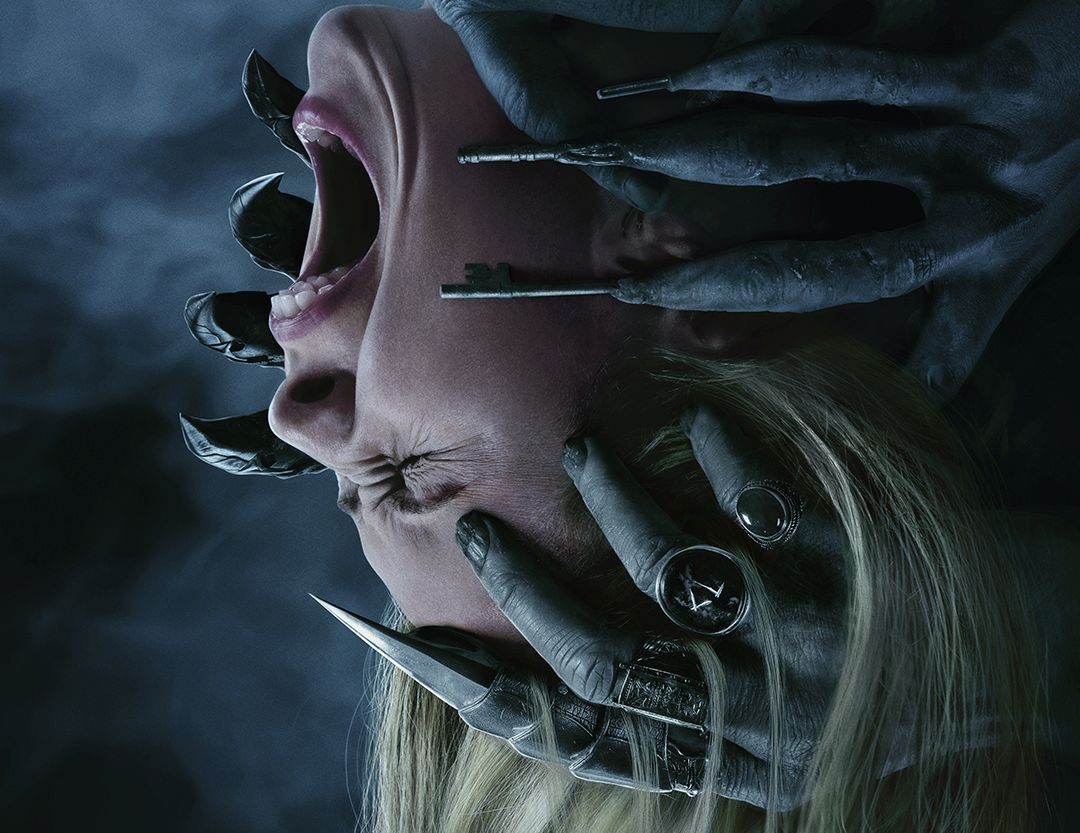
Insidious: Out of the Further is the sixth entry in the long‑running Insidious franchise, continuing the saga of psychic hauntings and interdimensional terror, promising a new chapter of terror that expands the Insidious universe into even more dangerous territory.
After five films and nearly three quarters of a billion dollars in box office, horror audiences know the dangers of the Further—the astral plane between our world and the next, where the tortured spirits of the dead dwell, haunted by demons, and where a few souls from our material plane can project themselves to their terror.
In the new film, Insidious: Out of the Further, Gemma, a young mother haunted by her history, finds she can bring objects from our world into the Further and back. For the first time in the franchise, the boundary between the two worlds runs both ways. As demons and entities hitch a ride to the material world, their power is unleashed.
Producer James Wan, who directed the first two films in the franchise, says Insidious: Out of the Further takes the ideas, um, further than ever before. “The Further is now leaking—escaping into our real world,” he explains. “That’s something we’ve never seen to this extent. We’ve seen premonitions or glimpses of the Further bleeding into our world, but never to the extent where they take physical form.”
For Leigh Whannell, who wrote the original Insidious and wrote and directed Insidious: Chapter 3, that leap is the boldest the series has taken. “When James and I built the Further, the one rule was that you went there in spirit, never in body. What Jacob found was the scariest question we’d never asked: what if something could actually make the trip both ways? That cracks the whole world open.”
“Gemma is a single mom with a traumatic past, trying to be the best mom she can be. But unfortunately, she discovers she has access to the Further,” says executive producer Ryan Turek. “Because that door is open, things are starting to bleed into our world, including ghostly visions of her mother.”
Of course, once the door to the Further is open, it’s hard to shut. And just on the other side of the door are the entities and demons, including one particularly powerful one named Cyrus, who sees Gemma as his ticket back to the world of the living. “They’re monstrous, they’re evil, they want to take life, and they want to live again,” says Wan.
With Insidious: Out of the Further taking the franchise in previously unexplored directions, Wan loves the idea that new directors can bring those fresh ideas. He enjoys the process of producing: in creating a franchise—as he’s done multiple times with Saw, The Conjuring, Insidious, and other stories—he can set the ground rules for the way a world works, then open things up for other artists to add to that world. “I say to all my directors that come and play in these franchises, ‘Here is the sandbox. Stay within the sandbox, but within it, do whatever you want,’” he explains.
For Jason Blum, whose Blumhouse has shepherded every chapter, that approach is exactly why the series has lasted. “Insidious keeps going because every few years a filmmaker walks in with a reason to make it personal, not just a reason to make it scary,” Blum says. “Jacob had that from the first meeting. Once I heard his take, the only job left was to get out of his way and let him build it.”

For Insidious: Out of the Further, the sandbox belongs to writer-director Jacob Chase.
Jacob Chase (Director/Screenplay) previously wrote and directed Come Play for Amblin and Focus Features, based on his short film Larry, and he directed and produced The Girl in the Woods for Peacock. Chase’s short film Mr. Blur won the International Jury Award for Best Director at Fantasia 2023. Chase is currently in development on his next features at Blumhouse and Atomic Monster. He has sold projects to Disney, ABC, HBO, New Line, Paramount, and Sony. He is an alum of the Sundance Labs. Chase’s love of horror began in the world of immersive theater with Sherwood Scare, the live haunted house attraction he created in Northridge, CA.
Chase had been working with Wan and Jason Blum for many years, developing several possible projects and exploring his point of view as a horror director. When the opportunity to helm Insidious: Out of the Further arose, Chase jumped. “It came from the years of working together,” he says. The film became an opportunity for Chase to express his vision within the guardrails of the Insidious franchise, as Wan, Blum, and Whannell, guiding him as producers. “Once I had a take on the material and how I wanted to expand on this world and introduce these new characters, it became a group effort of all my favorite filmmakers, coming together to support me,” Chase explains.
Chase’s love for the horror genre spans many years—and many modes. “I have a love of theater, and that translated into making haunted house attractions for years,” he recalls. “I’d do it with my friends, starting in high school and going into my early 20s, for a charity event, and it became a huge success. A haunted house has everything—it’s filmmaking, it’s storytelling, it’s great characters—most importantly, it’s the communal experience. There’s no better feeling than seeing someone screaming and laughing, whether they’re running out of a haunted house or in a movie theater.”
To create the significant creep factor for Insidious: Out of the Further, Chase also drew on his own life and his own fears, especially when he saw the way to juxtapose those fears with the everyday, normal, safe activity of human life. One example: the pillow fort that becomes an endless, inescapable labyrinth, with the dead closing in from two directions. “I find claustrophobic spaces absolutely terrifying. Even if I just have to reach under my bed, I feel closed in,” he says. “And the idea of a pillow fort becoming a nightmare… what’s the worst possible thing that could happen with that very normal, innocuous thing?
“The same with the dentist. It’s terrifying to ever sit in that chair,” he says. “So, it was important to me to put Gemma, the hygienist, into the dentist’s chair herself. To have the drill coming toward her is a terrifying moment for me to watch as a filmmaker.”
But for a horror film to be truly scary, it can’t just have audiences watching through their fingers. It has to have characters who go through the truly scary and terrifying experience of just being alive. And for Chase, Insidious is a franchise that has done that so effectively from its beginnings, because the stakes have been so high for its characters. “They have these amazing scares, obviously, great tension—but at the heart of these movies are warm, family-focused films,” he says. “With the Lambert family, Elise, and the new characters that have been introduced, there are wonderful characters that I felt a relationship with. And then, when those you love are put into peril—that’s when you really feel it in your stomach.”
That’s what makes Insidious, as a franchise, personal for Chase. “When I was writing Insidious: Out of the Further, my wife was pregnant, and I had a deep fear about becoming a dad,” he says. Tapping into that, he says, “was a great opportunity to start an Insidious movie from a real, personal place.”
For Wan, that idea fits right in with everything he loves about the horror genre. “The reason a lot of filmmakers really love playing in this particular playground is that horror allows us to say a lot of things we can’t otherwise say with other films,” says Wan. “We can make social commentary on the world, talk about the political climate. We can disguise it as a metaphor, an analogy. But people aren’t offended by it because at the end of the day it’s a scary movie—it’s supposed to confront you and offend you.”
Into the Further: The Look Of The Film
With five films’ worth of demons, ghosts, creatures, and other ghouls to draw from, it was important to Chase to deliver all the favorite baddies that Insidious fans know and love, while at the same time creating all new ones. With a vision for a climax that would have over 100 nasties, the opportunity was there. “It was really fun, as a fan, to see some of our favorites,” Chase says. He also brought back some deep cuts, “some of the demons or entities we’d seen in other movies but maybe didn’t get highlighted as much. I thought, ‘Let’s give them a moment here.’ And then, we created a whole bunch of new, amazing characters, some brand-new demons.”
For Whannell, who conceived the franchise’s first nightmares, that growing roster is the surest sign the world is still alive. “The demons in Insidious were never just scares to me, they were the furniture of a world,” Whannell says. “Watching Jacob bring back the ones we love and build a whole new generation around them, that’s the moment you realize the Further has outgrown any single movie.”
DAVID LESLIE JOHNSON-MCGOLDRICK (Screenplay) has been instrumental in launching several film franchises. His first produced writing credit was the 2009 thriller Orphan for Leonardo DiCaprio’s Appian Way, which spawned the 2022 prequel Orphan: First Kill (2022) and the upcoming Orphan 3. He was also a key creative voice involved with New Line’s THE CONJURING franchise, having written The Conjuring 2 (2016) and The Conjuring: The Devil Made Me Do It (2021). He also executive produced and co-wrote the franchise’s finale, The Conjuring: Last Rites (2025), which earned New Line nearly $500M worldwide and became the highest grossing installment in the franchise. He has also worked extensively with DC/Warner Bros., writing both Aquaman (2018) and Aquaman And The Lost Kingdom (2023) for director James Wan, which earned the studio a combined $1.5B worldwide. His other notable credits include Red Riding Hood (2011) and Wrath of the Titans (2012). In television, he reunited with mentor Frank Darabont to write two episodes of TNT’s noir crime drama miniseries, Mob City (2013) and 14 episodes of AMC’s ground-breaking series, The Walking Dead. Most recently, he co-wrote an adaptation of Behaviour Interactive’s hit video game Dead By Daylight with Alex Aja for Blumhouse/Atomic Monster.
Visit our YouTube Channel

