THE ART OF WRITING AND MAKING FILMS / COURSES FOR WRITERS / 2025 FILM RELEASES / 2026


Subscribe to our YouTube Channel


Writer-director Paul Greengrass wasn’t interested in making a by-the-numbers historical reenactment with The Uprising. He wanted to tell the story in a way only he knows how to do — as an epic action film that felt immediate, raw and spectacular. “It sounds like distant history, but it really is not,” the filmmaker says. “In that story, you can see all the colors of today.That’s what I want this film to be about. It’s an action-adventure story. It’s got romance, it’s got politics, but most of all it’s the turbulent story of what happens when one farmer moves from the marshlands of East England into the streets of London in search of a better life.

“I was born into a cinema family who held a strong belief that films could change the world, or at least your perception of it. My Greek father read me myths; Walt Disney wasn’t allowed in our home. I grew up on tales of heroes making grand gestures, throwing themselves into fire, and Hephaestus forging weapons in a volcano,” says writer-, who co-wrote the screenplay of Sacrifice with  Will Arbery.

Director David Ayer believes that no great story should remain untold and once he read the script for Heart of the Beast, he knew that he wanted to be the person to tell this one. “It was simply one of the best pieces of writing I’d ever seen,” he says. “It didn’t just make me cry; it made me ugly cry. I’d have to stop and process a little bit, then start reading a few more pages.”

My friends and I filmed Idiots says writer-director Macon Blair. It’s a labour of love. Short money, long hours, sweat equity, cussed determination- you know the drill. It was always designed to be a broad, scatological, slapstick-y kind of a comedy but as time went on, and especially after the first version fell apart, it began to resemble more of a film about desperate people trying to do their not-great best, which is always going to be a soft spot for me; and in spite of the characters’ undercurrent of bitterness, I think of it as a fundamentally warm-hearted story about found friendships.

For Spider Island screenwriter Christopher Jolley, the answer lay in a lifelong fascination with survival stories and the primal fear of creatures we think we understand. “I’ve always been intrigued by the way fear works—how something as small as a spider can completely disarm us. The idea of an entire ecosystem tipping out of balance, of humans suddenly becoming the outsiders, felt like a powerful starting point for a story. What began as a contained thriller quickly evolved into something more expansive—an emotional, character-driven story set against an overwhelming natural force.

To create the significant creep factor for Insidious: Out of the Further, Chase also drew on his own life and his own fears, especially when he saw the way to juxtapose those fears with the everyday, normal, safe activity of human life. One example: the pillow fort that becomes an endless, inescapable labyrinth, with the dead closing in from two directions. “I find claustrophobic spaces absolutely terrifying. Even if I just have to reach under my bed, I feel closed in,” says writer-director Jacob Chase. “And the idea of a pillow fort becoming a nightmare … what’s the worst possible thing that could happen with that very normal, innocuous thing?” 
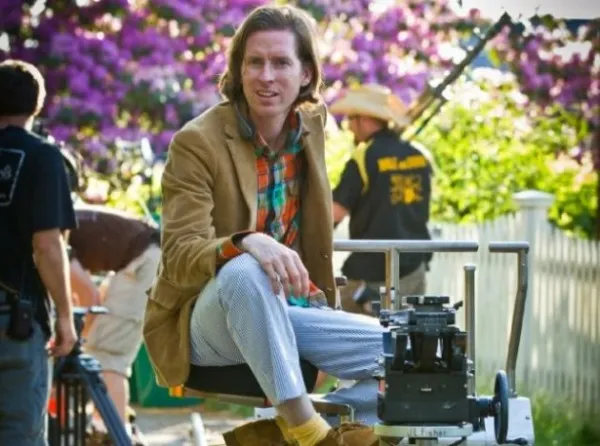
‘I had the idea of this story of these alpha dog characters and the setting of this garbage dump,” says writer-director Wes Anderson about the stop-animation Isle of Dogs. It sounds like a very odd thing to have to wait in the wings: a pack of dogs who lived in a garbage dump, but that was what I had. The story really could have been set anywhere but our big inspiration with the movie was to make it about what we loved in Japanese cinema and it grew into something more to do with all kinds of Japanese culture and our enthusiasm for it.’

‘I’d always wanted to make a dinosaur movie, since I was a kid,’ says Writer / Director / Producer David Robert Mitchell. “When I was walking through my neighbourhood, I passed an alleyway, and I imagined that there was a dinosaur there digging through the trash. And I thought, I want to write something that feels like this.  I want to make a movie that feels like this image in my mind… it was important to me that The End of Oak Street have all of the spectacle, the suspense, the action, and the personal stakes, all the things that you want from a popcorn movie.’

“I wanted to make a film that was a love letter to America on the 250th anniversary of America,” says writer-director Jon Erwin about Young Washington. “We talk about it at Wonder, telling stories that restore faith in things worth believing in, and America is one of those things. It’s not perfect, but it’s something that we can perfect together and we should celebrate together.”

Written and directed by Adrian Chiarella, Leviticus is an Australian coming‑of‑age romantic supernatural horror. “I wanted to make a movie where we explored homophobia, and homophobia is a type of fear, and horror is the genre of fear. That’s what it always does; it doesn’t matter if it’s a supernatural film or a slasher movie or some sort of psychological study. It’s about digging into the deep fears of the characters and expressing them in this genre that is a little larger than life. ”

Directed by Destin Daniel Cretton, from a script written by Chris McKenna & Erik Sommers and Justin Kuritzkes, Spider‑Man: Brand New Day is based on the Marvel comic book by Stan Lee and Steve Ditko. “It’s the first time that Peter is operating alone,” Cretton explains. “Peter has always had a wonderful community around him, but now, because of the world-changing events at the end of No Way Home, he must do everything by himself. A huge part of the story is watching Peter undergo an emotional and physical transformation. The two are linked.”

Director Derrick Borte with Russel Crowe

Director Derrick Borte and his writing collaborator Daniel Forte approached The Get Out with respect. “We adapted The Get Out from Strip by Thomas Perry, and it’s this dark, kind of neo-noir world,” Forte says. During development, Borte and Forte revisited many LA noir benchmarks, layering the screenplay with nods for sharp-eyed cinephiles. Forte explains, “We talked about movies like Sexy Beast, Go, To Live and Die in LA… You speak the language of the world you’re in. I think we’re playing into all those pieces.”

Director Rod Lurie co‑wrote the screenplay for Lucky Strike with Marc Frydman. “I wanted to write a story about a man who is absolutely alone in war,”  says Frydman. “I wasn’t interested in glorifying war. The screenplay had to celebrate heroism without celebrating the war itself,” says Lurie. “Castle is not a superhero. He’s a guy who keeps going because stopping means dying. That’s the psychology I wrote.”

Written, directed, and produced by visionary South African filmmaker Robert Benjamin, Angels: They Are Amongst Us is a deeply personal project shaped by his 21‑year spiritual odyssey and his insistence on portraying divine encounters as lived, disruptive truth rather than symbolic uplift. “To see a project that took two decades to bring to life finally reach audiences across the continent is beyond humbling. It proves that independent filmmakers can retain their creative voice, maintain ownership of their IP, and still achieve massive, unprecedented theatrical distribution.”

“Whether it’s the narrative through-line of Odysseus or the singular episodes that make the entirety of the epic, The Odyssey underpins almost all of cinema,” Nolan says. “It’s certainly there in every movie I’ve ever made, to a degree I never before realised. It was a fun thing to discover as I got into the work of adaptation,” says Christopher Nolan of The Odyssey. “What I’ve been doing in my films over the years, whether you look at The Dark Knight or Interstellar or Inception, is taking fanciful ideas and grounding them in reality,” Nolan says. “If the films have worked, I think some of their power and appeal come from that they earned their worlds with an audience, so the audience could believe in exciting, outlandish things.”

With Evil Dead Burn, writer-director Sébastien Vaniček and co-writer Florent Bernard deliver a bold new chapter that deepens the mythology while quite literally setting the franchise ablaze. “Florent and I wanted to primarily focus on characters—fear and action would come later. So, we started with our homework and watched all of the early Evil Dead movies. We realised that they were obviously talking about death, but also about love. So, we thought that the death of love would be an interesting idea, and the impact on the in-laws would be kind of universal for an audience.”

“It’s my hope in retelling the Robin Hood story that we become more aware of the stories we tell ourselves and often come to take for granted in terms of what they mean and why people told them in the first place,” says writer-director Michael Sarnoski of The Death of Robin Hood. ” For those who might claim this isn’t their Robin Hood because he doesn’t conform to their worldview, I hope they can ask themselves, well, why not?”

“Disclosure Day plays to what people know because the whole idea is that powerful forces have been covering it up and trying to convince people that what we have heard over the years is not true,” says screenwriter David Koepp. “So it was important to Steven to not deviate wildly from the stories we have been told. That said, we also wanted to bring our own imaginations to it, so we have a lot of original ideas that riff on established tropes.”

Steven Spielberg began to write a story for Disclosure Day in the Notes app on his phone. “I began at the end,” Spielberg says. “Ironically, that’s how I started writing Close Encounters, too: I started with the last scene, then backed up and figured how to earn that ending, with characters that can take us on a very identifiable journey through all the mystery toward a final act of communion.

Power Ballad marks another major creative milestone for filmmaker John Carney, who both directed and co‑wrote the film with Peter McDonald. For John Carney, the story became an opportunity to explore what a love story looks like later in life, when youthful ambition has collided with adulthood, marriage, and responsibility. “It strikes me as interesting to go okay, take a musician and see where that musician is at in their life and go, what’s the love story now? He’s a 48-year-old guy who’s married with a grown-up kid. He lives in Dublin. Who does he love? What does he love? What excited him?”

“For me, Backrooms is the cumulative result of a societal exhaustion with this industrialised monoculture we’re slipping into,” says visionary YouTube creator, writer and director Kane Parsons. “Repetition and patterns in society become like sensory deprivation — eventually the brain tries to find meaning and construct from all the incoherent noise. When people are isolated from society, they become disconnected and conspiratorial thinking arises. How terrifying would it be if that was your existence forever, and all you could do is experience it over and over again?”

American screenwriter Zachary Donohue and British horror writer T.W. Burgess decided to combine efforts and create one together, Passenger! “We both had an affinity for films like The Hitcher.  But we began to wonder, why has no one done something which was supernatural-based?”  says Donohue. “We wanted to do something totally different,” Burgess says.  “It’s not just a ghost of a road, but something more malevolent and more all-encompassing.  So what does that look like?” 

“It’s a comedy, a coming-of-age story, a murder mystery, and a detective story where sheep have to solve the murder of their shepherd,” says screenwriter Craig Mazin of The Sheep Detectives. “The comedy comes from how sweet and confused they are. The beauty comes from how wise they are. And the heart of the mystery comes from how much they love their shepherd—and each other—even when they frustrate one another. As long as you stay true to the characters and the emotions that inspired Leonie Swann’s novel, you won’t go wrong.”

“With Obsession, I wanted to tell a story about how far someone’s fixation on another person can go. At what point does something we call love stop being love? And beyond that, what does the word “love” even mean? I wanted to take a story we’ve all seen before – a wish story – and ground it in the real world, flipping it on its head to make something completely new.”

“While our film is fictional, it’s based on lived experiences,” says screenwriter Devon Delmar of Variations on a Theme. “In many ways, these are variations on a theme. This community is still waiting, hoping and persevering, just as they have been since 1945. In this way, the film asks a difficult question. What does justice look like when generations have been made to wait?”

When Russell Crowe approached screenwriter David Frigerio with the story for Beast, he didn’t blink. “When the best actor in the world asks when you can come to see him, you don’t wait.” That night, he booked a one-way flight from Los Angeles. Fifteen hours later, I was in Sydney, ready to work. For two relentless weeks, we lived in the screenplay.”

“What was behind all of that was the beating heart of a man who wanted to bring joy,” Michael screenwriter John Logan questions. “When I started looking at Michael’s life, I did the due diligence that you do as a dramatist dealing with historical material. I went in and I read everything. And I looked at so much material on Michael, just hundreds of pages of notes he had written to himself, inspirational notes, song lyrics.”

“I wanted to make a movie that was nothing but dialogue, that would be two great actors and a great script and nothing else. I honestly thought it would be fast and simple,” says Mother Mary screenwriter and visionary director David Lowery. “Mother Mary is about how art can take something terrible and turn it into something beautiful.”

“This is a movie that plays several different horror chords, and I’ve got history and renown for being someone who creates some pretty gory set pieces and some quite shocking imagery,” says writer-director Lee Cronin of Lee Cronin’s The Mummy. “this movie is no different in many ways, but it also plays with psychology, dread and chills as well. I think when it comes to gore and to imagery that is really arresting and sticks in your mind, it has to be earned. It has to be based on context. I think for me, the simple equation is to find characters that people fall in love with, and then maybe you can start to turn the screw and do horrible things to them.”

“In your closest relationships, you should be able to share everything, from how you actually feel to who you actually are,” says screenwriter Kristoffer Borgli. “The Drama is about that idea getting stress-tested between two people who are head over heels in love, and who maybe never considered there could be more to the other person. It’s about the power of love — an emotional state you don’t get to control, and how complicated that becomes when your feelings are at odds with your rationale. When that balance slips, you find yourself inside a crucial dilemma.”

“When you adapt a first-person story, you lose that direct access to a character’s thoughts,” says screenwriter Lauren Levine. “The letters in Reminders Of Him gave us a way to bring that interiority back without it feeling heavy-handed. We also explored her notebooks as a way to show her guilt and her attempt to move forward.”

“This is the story of two disparate individuals from opposite ends of the galaxy, and through science, teaching, empathy and compassion, they work together to save the universe,” says screenwriter Drew Goddard of Project Hail Mary. “We were terrified we would have to simplify it for a general audience, but what we found was the opposite. The audience loved that the science was complicated and
challenging.”

“I’ve wanted to make Giant for many years, for many reasons. The most important being: one, because Naseem’s story, and his journey and relationship with life-long mentor Brendan Ingle, is as moving and heartbreaking as it is exhilarating,” says writer-director Rowan Dinar Athale. “I want the film to inspire those who still crave it, and still need it. And I want the world to once again celebrate one of the few British-Asian-Muslims in our history.

“The Testament of Ann Lee is a retelling of the life of the extraordinary true legend Ann Lee, one of the few female religious leaders of the 18th century,” says writer-director Mona Fastvold. “I was raised in a secular household, and yet Ann Lee’s prophecies—however implausible—moved me deeply. Not because I share her faith, but because I recognise in her a yearning for justice, transcendence, and communal grace. Her radical pursuit of a self-fashioned utopia speaks to the creative impulse at the heart of all artistic endeavour: the urgent need to shape the world anew.”

“I’m interested in the monstrousness I see outside of myself that I think is really kind of alive and everywhere right now. I’m also interested in the monstrousness I see inside myself. And at the time, I was particularly interested in that. I was like, “What is this terrifying stuff that I personally believe is in all of us?” And Frankenstein is a way to think about and understand that,” says writer, director and producer Maggie Gyllenhaal of The Bride!, a bold, gothic, and psychologically charged reimagining of Bride of Frankenstein.

“We’ve played it so many different ways,” says writer-director Kevin Williamson of Scream 7. “Ghostface is always a trickster. You never know what you’re going to get. “The goal is to constantly surprise the audience. I don’t want Ghostface to just show up and kill somebody. I love a good chase scene. I want the victims to fight for their lives. I want to see Ghostface go at it with someone audiences love.”

“At the heart of Die My Love is the complexity of love and how it can change and transform over time. I aimed to keep it grounded, human, spontaneous and funny at times, capturing the moments that feel small but carry a lot of weight. This film is for anyone who’s ever been in a relationship – there’s heartbreak and beauty in vulnerability,” says writer-director Lynne Ramsay.

“The central question of crime fiction for me is how does one try to live decently in an indecent world?,” says Crime 101 screenwriter Don Winslow. “So I often have characters with good intentions that they’re not always able to carry out. I like characters that have internal conflict. I like characters who are morally flawed. I’m not trying to write white knights. At the same time, I’m not trying to write totally dark villains. I like those ambiguities. I think that that is reality, and I tend to write realistic fiction”.

“Our Wuthering Heights is a period romance but it’s not niche,” says writer-director Emerald Fennell. “It’s a grand, epic, multi-plex movie based on what I believe is the greatest love story ever written. The cinema is a place to connect, and we’re giving audiences a way to feel something, to unleash any emotions they’ve been stifling. To reclaim romance via a devastatingly sexy film from a sexy book—as sexy a book as could’ve been at that time, and it still is today. Emily Brontë’s story gets under your skin. No matter how many times I’ve read it I find things that are new, or remember something that I can no longer find, and that destabilises me as much as it did when I first read it.” 

Veteran writer of short stories and screenplays, screenwriter Owen Egerton’s inspiration for Whistle is rooted in exploring what
frightens him most. And what scares him most is death. “Not just death in the vague sort of sense but my particular death, my personal death. So I came up with a story about people being pursued by their own particular death. Their own particular future ghost coming to get them.”

“I wrote this script faster than I’ve written anything,” writer-director Bradley Cooper says of Is This Thing On? “And then the filming, I was much more at ease than I’ve ever been. Because you get into a hole on the day sometimes, and maybe things aren’t working. But I just breathed through it, like, ‘It’s going to come. It’s going to come. Stay relaxed.’ The moment you crink up, you’re fucked. It’s like that in anything – stand-up comedy, a fight, sports. You’ve got to stay loose, and I was very loose through this whole movie.” 

“I don’t often have words to describe why I choose a project,” says writer-director Chloé Zhao. “I’m often guided by instinct, a tight pull on my heart center. Stories appear in my life as if they have chosen me and I have no choice but to surrender to them. Hamnet came into my life like a whisper that grew into a hurricane. By the end of the journey, I was tenderized. I had truly experienced what it feels like to live with an open heart in the eye of a storm – the beauty, the pain, the thrill at the edge of annihilation and the silence.

Send Help screenwriters Damian Shannon and Mark Swift, like director Sam Raimi, have a deep-rooted appreciation for mixed-genre storytelling. “One of the reasons our taste is what it is, is because in our formative years we watched a lot of Sam Raimi movies,” Shannon says. “You know a Sam Raimi movie when you see it.” “We heard that Sam wanted to do an elevated thriller-horror,” Swift continues. “We looked in our bag, found our Linda Liddle concept, and put the pitch and screenplay together.”

Acclaimed filmmaker Johannes Roberts, the director and co-writer of Primate calls the movie his love letter to the first horror film he ever saw: Cujo. “For me, it opened up a whole new kind of horror based in real situations, not vampires and monsters,” he explains. “I instinctively understood the way that the director Lewis Teague and the cinematographer Jan de Bont were manipulating the audience — I knew right then that I wanted to direct films like that.”

Mercy screenwriter Marco van Belle explains that he melded old and new ideas for his forward-thinking script — and then watched as real life caught up with this kinetic mystery thriller. “When I found a news report about an AI judge being created in Estonia to handle decision-making in civil cases, I saw the incredible potential to reinvigorate the legal thriller/courtroom drama genre by framing a trial within an AI court.”

“Evil isn’t always going to put on a scary uniform,” writer-director James Vanderbilt says of Nuremberg. “It’s not always going to announce itself. It can be insidious. It can be – as Göring was – the nicest guy at the dinner party. That’s a much scarier thought than good guys versus bad guys.”

 “When I initially discussed 28 Years Later: The Bone Temple with Danny Boyle and Alex Garland, I told them, ‘I’m going to make it my own. I’m not going to try to make ‘a Danny Boyle movie.’ Because that’s impossible to make,” says director Nia DaCosta. “I could really put my imprint on it – to let my freak flag fly – and be visually adventurous and matching that with more classical filmmaking.”

“The American Dream is such a powerful story, and after the war, dreaming big became an international sensation alongside this new idea that individuals make history and play a crucial role in shaping and reshaping the world,” says writer-director Josh Safdie of Marty Supreme. “Marty represents the confidence, cockiness, and ambition that America expressed in the postwar years.”


“Sharing a brutal prison existence allows the two characters in this film to strip away all the markers and classifications society imposes on them – class, ideology, sexuality, gender – and see each other purely as individuals. It’s still a revolutionary idea, and I’m proud that people are responding to it,” says writer-director Bill Condon of Kiss Of The Spider Woman

“We want to push the boundaries of storytelling and captivate audiences,” says James Cameron of Avatar: The Way Of The Water. “The broader audience only cares about a story, the characters, and how the film makes them feel. I keep that in mind first and foremost every single day.”

“We root for underdogs because their struggle is our song. We need to see real people triumph over adversity — not just superheroes in capes. I need to believe, with all the problems we face in this country, that the American Dream is still possible,” says writer director Craig Brewer of Song Sung Blue

In Knives Out and Glass Onion: A Knives Out Mystery, Rian Johnson wrote mysteries so complicated that only Benoit Blanc could solve them. Johnson’s latest chapter, Wake Up Dead Man: A Knives Out Mystery, gives Blanc a run for his money, presenting him with his most layered and unexpected case to date. “This was the hardest script I have ever had to write,” says the twice Oscar–nominated filmmaker.

 “I think, for all of us, there’s a gap between who we are deep down and who we present ourselves to be, and this varies in terms of all the different roles we play in our lives. And as we get older and gain more experience, and maybe wisdom, how do we re-meet and redefine the person that we are?” says writer-director Noah Baumbach Jay Kelly, co-writing the screenplay with Emily Mortimer (in her screenwriting debut).

“Greg and I have been working together now for about 15 years, and we’ve written many scripts together. Train Dreams was unique because we had never adapted a work of fiction before. We try to bring a deep level of research to what we do, and this film was no different, but it’s hard to research something that’s about a time gone by, and also based on a work of fiction,” says Clint Bentley, who co-wrote the film with Greg Kwedar

“My dad really started to inhabit the characters, especially Ray, speaking as him during the writing process. That was when I realised this was going to be its own kind of special beast. Working with him taught me so much as a writer and storyteller; by the time we got to set, we had a shorthand for everything,” says screenwriter Ronan Day-Lewis, who co-wrote Anemone with Daniel Day-Lewis, inspired by the lingering scars of the Troubles in Northern Ireland. 

“Blue Moon is a chamber piece on the brutal architecture of artistic mourning… it deals with a trauma that is, in a way, two‑fold: not just a business split, but an artistic divorce between two men who defined an era together,” says writer-director Richard Linklater

“I’ve dreamed all my life of making rom coms in the vein of Lubitsch, Wilder, and Sturges,” says director David Freyne. “I adore that era when people believed rom coms could say everything, could be the deepest films, no matter how feathery their touch. And here was my chance. Eternity might be set in the afterlife, but what mattered to me is the characters are caught up in conflicts that feel very human and very true to our experienc­es.”

“My goal in expanding on Mason Deaver’s novel into a cinematic universe was to examine how acts of love, compassion, and service towards family—chosen and blood—could either endanger a child or embolden them to flourish, to offer audiences a contained and simple character study on becoming. It was important for me to tell this story authentically and not fall into the trap of dramatising Ben’s gender or coming out too much. Viewing anybody solely through the lens of their gender or sexuality diminishes their vast and complex humanity,” says writer-director Tommy Dorfman of I Wish You The Best

Guillermo del Toro’s Frankenstein is inspired by Mary Shelley’s seminal 1818 novel of the same name. “I’ve lived with Mary Shelley’s creation all my life,” says del Toro. “For me, it’s the Bible. But I wanted to make it my own, to sing it back in a different key with a different emotion. Mary Shelley’s masterpiece is rife with questions that burn brightly in my soul: existential, tender, savage, doomed questions that only burn in a young mind and only adults and institutions believe they can answer,” del Toro explains. “For me, only monsters hold the secrets I long for.” 

 “Once I read the script, I jumped in. Regretting You is a coming-of-age story about relationships between parents and children growing up, like my previous films Stuck in Love and The Fault in Our Stars. I have always been, and always will be, attracted to movies about families, specifically kids discovering that their parents are fallible. That’s an important moment in anybody’s life,” says director Josh Boone.

“In the world that we live in now, people live in certain bubbles that have been enhanced by technology,” visionary director Yorgos Lanthimos says. “Having certain ideas about people is reinforced depending on which bubble you live in, creating this big chasm between people. I wanted to challenge the viewer about the things that we’re very certain about, the judgment calls that you make about certain kinds of people. Bugonia is a very interesting reflection of our society and the conflict in our contemporary world.” 

“Beginning production on Springsteen: Deliver Me from Nowhere is an incredibly humbling and thrilling journey,” says writer-director Scott Cooper. “Bruce Springsteen’s ‘Nebraska’ has profoundly shaped my artistic vision. The album’s raw, unvarnished portrayal of life’s trials and resilience resonates deeply with me. Our film aims to capture that same spirit, bringing Warren Zanes’ compelling narrative of Bruce’s life to the screen with authenticity and hope, honouring Bruce’s legacy in a transformative cinematic experience.”

“From 1985 to 1994, my mother worked for the British Board of Film Classification. Each day, she would watch a film to determine its appropriate level of censorship and then, at night, for my bedtime story, recite the plot to the movie she had seen that day. I would fall asleep, visualising these narratives, dreaming about the T-1000 or Nakatomi Plaza and then later I would get to see these characters
and locations realised on celluloid. This practice spawned an inevitable life-long obsession with cinema,” says director Max Minghella, whose film Shell is a love letter to those bedtime stories.

Scott Derrickson and C. Robert Cargill

“With Black Phone 2, we were able to keep building on characters rooted in our own childhoods and what it was like growing up in the ’70s and ‘80s,” says writer-producer C. Robert Cargill. “We have been through a lot together and are as close personally as we are professionally. What keeps it creatively fulfilling is the material, of course. It is always about telling a good story. That drives everything,” says writer-producer-director Scott Derrickson.

“I wanted to design something new, but familiar,” says Norwegian-born director Joachim Rønning about TRON Ares. “What drew me to the project was the mix of the digital and real worlds. Having a Program exist in the real world was interesting for me – I hadn’t seen that before. And the idea of Ares finding out what it means to be human, what it takes to be human, was fascinating.”

There was something really complicated about Mark Kerr that I wanted to explore,” says writer-director / editor Benny Safdie of The Smashing Game. “And there was something about Dwayne, too. He has this image of himself out in the public, but as he spoke to me about Mark, and as he talked about this movie, oh my God! I realised there was a whole other side to him that we could explore together.”

“I believe that the strongest case of the theatrical experience can be made with horror films. We all seek the therapeutic experience of facing our worst, darkest, most secret terrors in the safe environment of a movie theatre,” says director Renny Harlin of The Strangers – Chapter 2. “We can scream, cry, hide our eyes, or even laugh at the uncontrollable and life-threatening scenes that unfold in front of us. In a movie theatre, it is all a communal experience.”

“Our past absolutely defines everything we do in the present. We can’t help it. We’re made by the events of our past, so there’s no escaping it,” says writer-director Andrew Haig of All Of Us Strangers. “I am fascinated by that person who is trying to live authentically, but they are on the outside of society—so how do they manage in the world around them?”

“I started working on One Battle After Another 20 years ago to write an action car-chase movie, and I returned to it every two or three years. At the same time, this was in the early 2000s, I had the notion to adapt Thomas Pynchon’s Vineland, a book about the 1960s, which he wrote in the `80s. So, I was trying to decide what the story meant another 20 years later. So really for 20 years I had been pulling on all these different threads. Vineland was going to be hard to adapt. Instead, I stole the parts that really resonated with me and started putting all these ideas together.  With his blessing,” says writer-director-producer Paul Thomas Anderson.

“As a kid growing up in the 80s and 90s, the buddy cop genre and road movies were more popular than ever before, and they had a major influence on me when it came to the kind of films I wanted to make. Like a lot of people, I was charmed by the idea of taking two individuals from different walks of life and forcing them together. As soon as my agents sent me the script of London Calling, I was all in. It took the best elements of the buddy genre, stuffed it into a road movie, and encompassed themes of family, aging, and identity,” says director Allan Ungar

“Over the course of my career, I’ve tried to bounce around different genres and stories, but they always seem to retain one common denominator – characters that are simply trying their best to do the right thing. I find there to be such a beautiful dignity to it. I felt like I had an idea of what I was going to be getting from a movie called The Threesome and then was given something much more sophisticated, tender and nuanced,” says director Chad Hartigan.

“I’m one of those guys who usually loves the book and hates the movie—so with The Long Walk we had to find a way to be really, really loyal to the DNA of the story,” says screenwriter JT Mollner. “What makes it special is this hint of nihilism, but then a tiny bit of hope—this weird amalgamation of things that Stephen King was obviously feeling as a young man. This disillusionment with America, and him creating this sort of hyperbolic version of it.”

“The real challenge is in structure,” says writer Julian Fellowes about writing Downton Abbey. “When you have a series, you don’t have to give every character a story every week. You can have different emphases. Whereas in a film, everyone has to have their crack at the whip. Everyone has to have an active part in the story.” 

“In my movies, if there’s a real case, I’m going to do a deep dive into it, and meet and talk to as many people involved as I can,” says Director / Executive Producer Michael Chaves of The Conjuring: Last Rites. “There’s also obviously research into the period—in The Nun II, I went through all kinds of great 1950s photography that we leaned into as we were making the film. So, we looked at the period, but I also did a lot of Zoom interviews with the four Smurl sisters. Talking to them about their experience was really powerful.”

“Together is a film about the potential horror of sharing a life with someone; the lingering anxieties of commitment writ large. It’s about co-dependency, monogamy, romances and resentments — and that at a certain point, can we truly tell where one life ends and our other half’s begins? What draws me into a project is finding a one-off, hooky premise, and squeezing that premise for all its juice. Despite the personally resonant and (hopefully) realistically observed characters at the centre of this story, I am so proud how we escalate the horror into things I’ve never seen before on screen, ” says writer-director Michael Shanks.

For Charlie Huston, Caught Stealing isn’t just a darkly humorous heist story— it’s a project that’s near and dear to their heart. “I wrote this book way back in 1998, the year the story is set in,” they say. “There’s a ton of my own lived experience in the story’s main character. When Darren Aronofsky reached out to me 18 years ago to say that he was interested in the book, it was super exciting. I loved the idea of Darren taking his visual sensibility and the dynamism of his storytelling and applying it to this story.” 

Tony McNamara believes one of the best things about being a screenwriter is seeing your words brought to life by the people playing the characters you have spent so long imagining in your head. When it came to The Roses, that first day on set was perhaps one of the best. “We wanted to make a very smart adult comedy that goes dark. And I feel like there haven’t been that many of those for a while,” says McNamara. “And we wanted to make a really good comedy about marriage that also had a good heart about how hard that is. We wanted to make something that people could relate to. I know we all did.”

“I’ve always liked Superman. I think as a kid I was really attracted to the Superman family comics, with Superman and Supergirl and Krypto and the whole gang. It was at a time when I was starting to become more aware of how important films were to me in my life, and that was different from how important films were to other people in their lives,” says writer/director/producer James Gunn.

“When I’m writing, I have a rule for myself—I don’t want to know what’s going to happen at all. I always just start. So, I sat down to write what would become this movie, and the first thing I type is this little girl telling a story and these kids who go running out of the house. And I’m thinking as I’m writing, “This is cool. I hope I figure this out.” And I didn’t really figure it out until it was time in the script to answer that question. Basically, I’m writing on a tightrope, hoping that it is revealed to me. Luckily, in this case, it was. But I was just writing to get this feeling out, and it ended up turning into Weapons. I think when I wrote Barbarian, it was kind of a similar thing. I sat down and started writing for the fun of it, without any idea of what it was going to be,” says writer-director Zach Cregger

Films listed alphabetically. Click on title to read more about how the films were written and made.

E

F

G

H

I

J

K

L

M

N

O

P

Q

R

S

T

U

V

W

X

Y

THE YOUNG MESSIAH

Z

SOUTH AFRICAN FILMS

TV SERIES /STREAMING


“There are many social ills that befall and challenge the Coloured community,” says Kopeledi. These themes are often explored in movies and rightly so, but they are not the only stories worth telling. 2 Thirds of a Man aims to show an alternative side to the Coloured experience, that is as valid and frankly more uplifting and hopeful. This story is my love letter to the Coloured community. Our stories are diverse, and we have an opportunity to tell them in ways not seen on screen before. I believe that when everything is said and done, the only thing that will shift this world is our ability to inspire through compelling stories.”

Having won acclaim on the international film festival circuit, including awards at the Amsterdam International Film Festival, Las Vegas Independent Film Festival, Los Angeles Film Awards, and the IndieFest Film Awards, Kopeledi’s uniquely South African film was co-produced by published fiction author Lester Walbrugh, with cinematography by renowned music video director Dale Fortune and scored by O’Ryan Winter.

In 2 Thirds of a Man Justin (Mario Ogle) returns to Cape Town as a first-year student at Rocklands University after spending most of his teenage years living in Beaufort West where his mom took up a teaching job after the untimely death of his father, a musician on the brink of success. Justin makes the transition from the small town to the city, leaving his mom and quirky friends behind. He moves in with his uncle (Van Lee Johnson), a 40+ Marketing Professor at Rocklands University, who lives a fun-filled existence as an eternal bachelor. Justin meets G (Ernest St Clair), a street-smart kid from the Cape Flats that might be able to help him transition back into city life and help him meet the girl of his dreams.


Daniel Dercksen shares a few thoughts with Earl Kopeledi about 2 Thirds of a Man

Tell me about what inspired you to write 2 Thirds Of A Man

It started out as just wanting to write something to challenge myself and to find a creative outlet. After exploring the how and the why, the consistent advice for novices was to write what you know. I felt I understood how a kid with a small-town upbringing feels and how overawed you can be by having to navigate a foreign space while still figuring out who you are. The second component was that I wanted to write something that I would want to see on the screen. It had to be entertaining as opposed to being preachy or hitting you over the head with some grand message. Having said that, being Coloured and growing up pre-democracy inevitably influenced my perceptions and created a perspective

In 2018, Earl Kopeledi wanted to explore his creativity beyond his actual day job. Even though his job in marketing had definite components of creativity and brand story telling he needed more. Without any formal training or a specific skillset lending itself to arts, he was looking for an outlet that he could do part-time and without any conflict to a high-stress environment of heading up a marketing department for a global player in fashion retail. Deciding that writing a book was not an exciting prospect he decided to have a crack at writing a screenplay with the sole purpose of satisfying his curiosity about being able to complete a script.

The film is a love letter to the Coloured community

I am a positive person that always errs on the side of optimism. I also subscribe to the idea that Believing is Seeing. This is a stubborn streak that I’ve developed over the years and smacks in the face of the Seeing is Believing theme that’s been the narrative that I’ve been exposed to throughout my life. I think we underestimate the power of stories and how they can influence people. If you can show people an authentic and believable narrative with positive themes, featuring people that look like them conquering dire situations through self-belief, it can be powerful.

Earl Kopeledi and his team

Was it a difficult process from page to screen

The short answer is yes. As an enneagram type 7 I am an extreme optimist with a glass half full mentality. As I matured, I realised I often lied to myself when I look back on how challenging certain endeavours were. Surely it can’t be that difficult if I was able to do it. The Coloured curse😊

You mentioned that amazing movies like Four Corners and Noem my Skollie were able to capture the impact of socio-economic challenges on the Coloured community. These movies are amazing stories and absolutely needed to be told. But it is also important to remind the world of the talent that comes out of these communities. That the Coloured experience is too rich and diverse to pigeonhole, and 2 Thirds of a Man sets out to balance the narrative around the Coloured experience.

It is very important for me to make this point because I really enjoyed those movies. As a Coloured person, you don’t often see yourself on a screen. When you come from a small town that also has a lot of social and economic challenges you can’t escape certain stories or images whether you lived through them or maybe know someone that could relate to it. I grew up in a household where my dad was a teacher and in a coloured community that was seen as a privileged upbringing. My opportunities to play sports, and go to school and university like some of my peers unlock different challenges and avenues and those stories matter.

Van Lee Johnson and Maxine Ceasar in 2 Thirds of a Man

In the film, Justin’s uncle talks about the Coloured curse – always needing to prove yourself?

I cannot effectively speak for the younger generation of coloured kids but certainly growing up we were confronted by the idea that you don’t have the same abilities or talent as a white kid. You would see that playing sports, you would see that at the start of your career in the opportunities available, but more importantly, it would echo amongst the people within your community. That belief or lack of belief seems to be the Achilles heel more so than the lack of opportunities. Lack of opportunity is not always controllable, but your belief that there is another way to get it done is a very powerful mindset.

I had long conversations with my Editor and fellow producer on where and how that scene fits into the movie. (The one thing I was adamant about was that it needed to be in the movie) When I wrote it, it was a longer scene and felt a bit preachy, but I was able to get it more concise with the assistance of Lester my co-producer. As a published writer, who had many a back and forth with his editors, he advised me to not patronize the audience.  “You don’t have to spell out everything.” That is my favourite scene in the movie and I was fortunate to use YoungstaCPT’s song Kleurling as that rallying cry to Coloured kids to believe in themselves.

He also mentions that “the lie that the Coloured community are less is more compelling than the truth they are more …“

This was written differently and speaks to the conversation I had with Lester. Uncle Mike had a long explanation when Justin asked “Why don’t we believe in ourselves” His answer basically popped into my head one morning contemplating that question.

The lie that we are less, speaks directly to the lack of belief in self. When you are told for years you are not good enough to be at this institution, be in that team, mingle with this group of people, that becomes your truth. But what happens when you stop looking for outside validation? Can you find a different truth internally?

It was important for me that Uncle Mike does not rush his answer. He also needed to discover that answer in its simplicity for the very first time.

Bronté Snell and Mario Ogle in 2 Thirds of a Man

You grew up in Beaufort West. The film must be a very personal story for you.

I always tell people that this movie is not a biography but very personal. I wanted to address feelings that I had about certain topics but also explore how certain themes could play out. I didn’t have a detailed story when I set out. I had a beginning and I had an end and I discovered the layers in between. I definitely borrowed some things and a few situations but fictional liberties abound.

How much do you think the South African Film Industry has changed in the last 10 years?

I must say this is a difficult question because I really don’t have any connection to the industry. When I started writing this script as a novice in 2019 the only thing I knew, was that I haven’t seen a movie that reflected a narrative close to my life experience. To be honest, as of today and barring 2 Thirds, I still haven’t seen anything.

Would you agree that the Covid pandemic has fostered the rebirth of the independent film industry?

I have no stats to back this up, but I do believe Covid gave people a lot of time to take stock. I think you had a lot of aspirant filmmakers develop an urgency to get their work into production. Tomorrow is not a guarantee. There is a quote that is used somewhere in the movie. (In fact, I have it as a tattoo in reverse so I can read it in the mirror) “ Don’t die with your music still inside of you” – Wayne Dyer

What tips do you have for screenwriters to get their stories produced

I think this is super hard. When I completed the screenplay, I sent it to a few producers and got crickets. I ended up funding and producing it myself.

I would suggest writing a character-driven short film and shooting it yourself.

Network, find an up-and-coming videographer, or director.

Watch a lot of Youtube. There are amazing channels like Indie Fim Hustle. You don’t have to reinvent the wheel. I wouldn’t have been able to make 2 Thirds without the internet.

Towards the end of 2018, he started researching all aspects of screenplay writing, including registering on Masterclass.com and watching hours of Youtube videos on the subject. Having always had an affinity for storytelling and his love for writing compositions at school level, the aim was to explore the structure and utilise The Hero’s Journey as a framework to write his first script. Four months later he had the first draft of 2 Thirds of a Man.

Ernest St Clair and Mario Ogle in 2 Thirds of a Man

What do you think producers are looking for in new screenplays?

Once again I don’t know because I produced my own screenplay. The one piece of advice I can give is to write something that only you can write. There are 7 billion people in the world, there is a niche audience for your story.

After sharing the screenplay with a few close friends including his co-producer and published author Lester Walbrugh, he decided to approach production companies. With zero success after a few attempts and having to do a stint in the UK as a secondment, Kopeledi was sure that the script will remain in a drawer and gather dust. While in London far from home and missing Cape Town, the local culture, and our unique way of doing things he realized that he needed to produce the movie or else it would never be made. Back at square 1 and in the same space as pre-script, he started a fact-finding and self-tutoring mission. Back on Masterclass, this time exploring classes by Spike Lee and Ron Howard, Earl was driven to learn as much as he could about producing and directing a film. Not knowing how to fund the project he signed up for a 2 -day course in Low budget filmmaking presented by Elliot Grove the founder of the Raindance film festival. Equipped with some much-needed insight and equal amounts of crazy and naivete, Kopeledi
felt the confidence to have a real crack at it.

Tell me about the importance of screening your film at multiple International film festivals

As a marketer by profession, I used this strategy to create marketing opportunities. It’s humbling that we did so well but the aim was to get into a festival, gain press exposure and have something to talk about on your social channels. Ster Kinekor reached out to me after hearing an interview I did on the radio that followed on press we received after winning a festival award.

2 Thirds Of A Man is a very gentle coming of age story that reflects on ordinary life .. your views on this?

I don’t know if it’s gentle and I don’t know if what we call ordinary is sometimes extraordinary. You often find people that have odds stacked against them and they go on to achieve amazing things despite certain traumas. Often these people don’t fit the traditional mould of what success looks like. So we end up saying things like….Yes, his talented but…..He is a bit rough around the edges….If only he was a bit more eloquent.

There is a beautiful poem by the late Tupac Shakur called the Rose that grew from the concrete. He explains the sentiment of that poem as follows:

“We wouldn’t ask why a rose that grew from the concrete had damaged petals, in turn, we would all celebrate its tenacity, we would all love its will to reach the sun, well, we are the roses, this is the concrete and these are my damaged petals, don’t ask me why, thank god, and ask me how”

What’s next?

I started writing an Afrikaans piece which I’m very excited about.


From her Sundance Award-winning first feature Down to the Bone to her Oscar-nominated feature Winter’s Bone and her documentary Stray Dog, writer and director Debra Granik has examined the lives of outsiders struggling to maintain their independence. Granik’s third narrative feature, Leave No Trace, set in the Pacific Northwest’s hidden byways and forgotten encampments, is based on Peter Rock’s novel My Abandonment, which is inspired by a true story.

“Who among us has the inner strength and autonomy to live outside the churning new cell phone cycle and the amplified social chatter of our digital consumer society?” Granik questions poignantly, who directed the film from a screenplay she crafted with Anne Rosellini, with whom she’d also collaborated on Winter’s Bone) adapted from Peter Rock’s novel My Abandonment.

The real-life story that Leave No Trace is inspired by has become something of a legend in Portland, and was reported on in The Oregonian and elsewhere: a girl and her father were discovered to have been living for four years in the nature preserve bordering the city’s downtown area.

They ventured into Portland only to collect his disability checks and shop for what they couldn’t grow. The girl was healthy, well cared-for, and tested academically above her age group. After being relocated to a horse farm where the father was able to find a job, the pair soon disappeared.

Peter Rock, intrigued by the mystery, created a fictionalized version of the tale that filled in the unknowable details.

The author notes, “There were other books inspired by the same story, some more investigative. I’m a fiction writer; the genesis of my book was reading the newspaper stories and wondering what happened to the two people — where they came from, who they were, and how they survived.”

Peter Rock

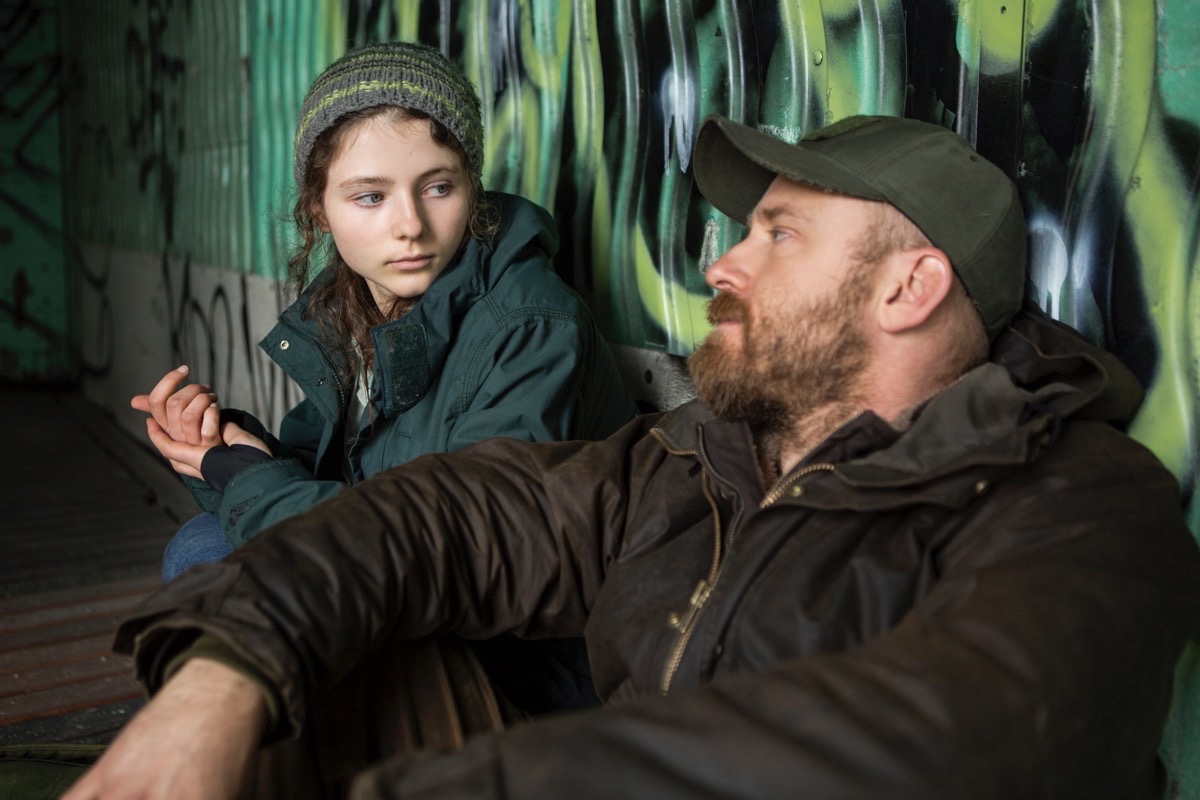
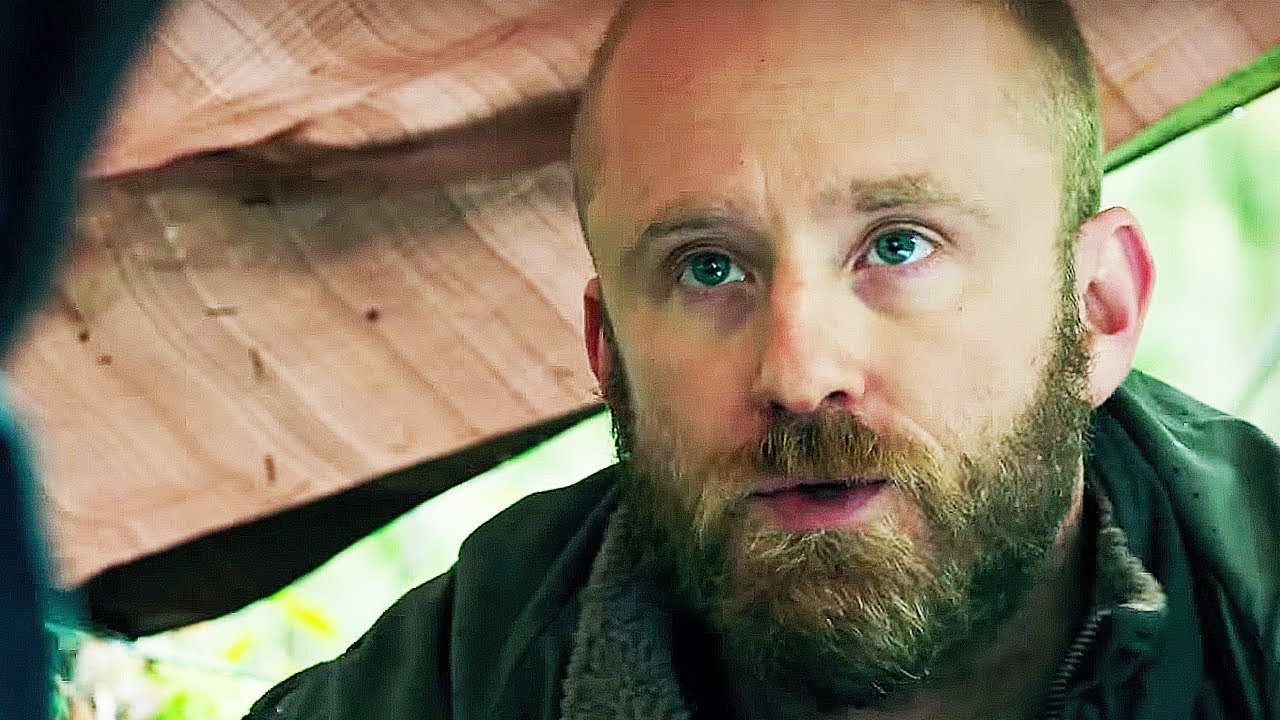
In the film Leave No Trace, A teenage girl, Tom (breakout newcomer Thomasin Harcourt McKenzie), and her veteran father Will (Ben Foster of Hell or High Water and The Messenger) have lived undetected for years in Forest Park, a vast woods on the edge of Portland, Oregon. A chance encounter leads to their discovery and removal from the park and into the charge of a social services agency. They try to adapt to their new surroundings, until a sudden decision sets them on a perilous journey into the wilderness seeking complete independence and forcing them to confront their conflicting desire to be part of a community and fierce need to live apart.

Rent Leave No Trace on Vudu, Apple TV, Amazon Prime Video, or buy it on Vudu, Apple TV, Amazon Prime Video.


The real-life story that inspired Leave No Trace  

Peter Rock’s book was brought to Granik and Rosellini’s attention via two other frequent moviemaking collaborators, producers Anne Harrison (the Oscar-winning The Danish Girl) and Linda Reisman (the Oscar-winning Affliction).

Anne Rosellini
Anne Rosellini and Debra Granik

They originally optioned the novel in 2007, attracted by the book’s distinctive voice and landscape, eventually bringing in Granik and longtime collaborator, Anne Rosellini.

The four then worked together four years developing the screenplay.

Debra Granik directed and co-wrote Winter’s Bone with Rosellini, which was adapted from Daniel Woodrell’s novel of the same name.
Her first feature was Down to the Bone, which she directed and co-wrote.

In 2014, Ms. Granik completed her documentary feature Stray Dog, which later aired on PBS and was nominated for an Independent Spirit Award. The film’s subject is Ron “Stray Dog” Hall.

In 2016, Harrison and Reisman approached Bron for financing; Bron then brought in First Look, now called Topic, as a financing partner.

Anne Rosellini is an independent filmmaker whose company, with Debra Granik, is Still Rolling Productions. Ms. Rosellini was nominated for an Academy Award twice in the same year, for producing (with Alix Madigan) and co-writing (with Ms. Granik) the Best Picture Oscar nominee Winter’s Bone.

Formerly a programmer for the Seattle International Film Festival, Ms. Rosellini founded the 1 Reel Film Festival in 1996 before moving into acquisitions for AtomFilms, an online platform for films that was way ahead of its time. She holds a BFA from The School of the Art Institute of Chicago.

The setting for the story is forests and isolated rural enclaves in Oregon and Washington State

Granik was attracted by this environment: “Films that take place in a specific region always speak to Anne and I, and this is a story inextricably tied to the Pacific Northwest. We could visualize a setting and a journey that would be very photogenic, and a story that would draw us in.”

When we meet the father and daughter, they have been living in a rudimentary encampment, using outdoor living skills to carve out a life almost entirely off the grid and invisible to the outside world.

Granik says, “Will and Tom have life experiences that are very different from anything I’ve known or done. Who can live on public land, and stay undetected for so long? And how did they do it? It became clear that to tell this story would require research and deep consultation with a range of Pacific Northwesterners to understand how to film this existence.”

Rock reports, “The plot of the film differs from my book in some ways, but in terms of the tone it’s pretty close. My book has elements of fantasy, and Debra’s movie grounds the characters in more realism.”

Debra Granik
Debra Granik

Although the screenplay does not use narration, Granik notes that “the teen narrator from Pete’s book led me to wonder about how a person could live happily and richly with few possessions. Tom and Will have a very disciplined lifestyle, and it necessitates a commitment to distinguish between want and need. Thinking about Tom and Will led me back to Henry David Thoreau’s Walden, and to environmentalist Bill McKibben’s reportage as well as One Man’s Wilderness: An Alaskan

Odyssey, from Richard Proenneke’s journals.

“Who among us has the inner strength and autonomy to live outside the churning new cell phone cycle and the amplified social chatter of our digital consumer society?”

In approaching the story, Granik also thought back to Shakespeare’s The Tempest, with its father-and daughter characters of Prospero and Miranda: “I’m drawn to the ways classic stories depict close relationships in which people complement and complete each other. Will and Tom look out for each other and also pollinate each other’s mind. Tom has learned to be the adult at times, because of her father’s psychiatric vulnerabilities. He, in turn, is trying to teach her every useful thing he knows.”

My Abandonment
Thomasin Harcourt McKenzie and Ben Foster with director Debra Granik during filming of Leave no Trace

Leave No Trace tells the story of two people who forge their own path, with no villain in the tale

Granik remarks, “There are a handful of core themes in literature and film that we learn. But right now it seems that stories which rely on direct threats of violent bodily harm, annihilation, and highstakes crimes are what get almost all the attention. I’m curious about our appetite for stories that don’t rely on violent actions but still have strong resonance. Several people, all of them strangers, help Will and Tom along the way, but the tension remains high because of how they choose to live. The antagonistic forces are not exerted by any malevolent character, but by something hard to see — the pressure of social conformity and business as usual.

LEAVE2

“In this story the stakes are physical and existential survival. When Tom and her father are evicted from public land and don’t have a safety net, those are high stakes. Where do people who don’t fit neatly into the mainstreams of our culture go, and how do they fare?”

The director adds, “The stakes are also tied to the intricate dynamic between Tom and her father. After they are evicted from the park, where they knew how to structure their lives and relate to one another, they are pushed to learn more about one another when forced into the wider world. Will senses that Tom’s curiosity pulls her in a different direction from him, which eventually leads to a fork in their path.

“That is something universal we all have to navigate, but which we do in our own ways. Since coming of age can require that a person cleave themselves from those they are closest to, it’s always high stakes in terms of how hard that can be.”

In the character of Will, Granik returns to a topic she explored in her documentary feature Stray Dog, developing it here in a fictional context. “I’m very interested in the lives of veterans, especially how their experiences affect them years after the war,” she explains. “And it’s getting to be long after our wars in Afghanistan and Iraq began, the time when civilians begin to forget, and veterans are left holding the bag.

“The father’s veteran identity was something that Pete had embedded in the book. When we got to Portland to research and scout the movie, I was able to go deeper into the issues that the father character wrestles with, through the help of several vets who advised on the film based on their personal experiences.” David J. Morris’ book The Evil Hours, about his experience as a Marine with post-traumatic stress (PTS), and Ron Hall, a Vietnam Era vet who was the subject of Stray Dog, also provided insight and inspiration.

The Cast

Ben Foster, who plays Will in Leave No Trace, is known for intense, tightly wound performances in such movies as Hell or High Water, Lone Survivor, and 3:10 to Yuma. “I have appreciated Ben’s work in an array of films, specifically in The Messenger,” says Granik. “This was a big, meaty, soulful role, and I thought he’d have room to put that layered intensity he has into it. He’s a very committed, indepth kind of actor.”

Foster also has an interest in veterans’ experiences. Granik was “touched that he had spent a considerable amount of his working life trying to learn about and understand the experiences of returning soldiers. In several films he’s been asked to delve into that on a very deep level. In discussions with Ben, I also learned that the subject of living off the grid, living with less, and questioning the ubiquity of social media, is very much on his mind. All of that was very helpful.”

The actor reflects, “Although dealing with difficult circumstances, this was a very hopeful script about trying to do the right thing — and I hadn’t been reading a lot of scripts that made me feel very hopeful.

LEAVE
Ben Foster

“When the script landed on my desk, my fiancée and I were expecting our first child. So, iterations of fatherhood were very present when I read it. And Debra’s films, particularly Down to the Bone and Stray Dog, had touched me deeply. Because of this combination, I really wanted the job!”

He and Granik “would take walks together and talk about how someone in Will’s position could make this life make sense for himself. Living with his daughter in a temperate rainforest is in many ways working for him, and it’s working for her. When social services comes, what the father and daughter created, and the world that they know, is turned upside down. What will they be gaining, and losing? They each have to grow in different ways, and this pierces the heart.”

Aware of the responsibility of portraying soldiers’ complexities on-screen, Foster notes, “We did not overly articulate what Will is struggling with; his scars are internal. I’ve had the privilege of talking to a lot of brave men and women about this; I have friends who served and survived and have done a lot of healing.

“What’s so inspiring about spending time with those in the service is that they are can-do people; they fix it, they figure it out. It isn’t about ‘Does it feel right’ or ‘Do you want to.’ It’s, you do it. I’ve tried to then understand how I myself could do that.”

For an independent filmmaker, Granik feels that an actor like Foster is a gift: “Ben is a defender of independent films. He puts his spirit into the research, gets immersed, and he stays true to it. He’s not afraid of getting muddy or emotionally entangled. He’s done profound work on films without frills, and he champions it.”


“The opportunity to take a script to some very emotional places is for a writer the most exciting thing, says screenwriter Luke Davis, who wrote the screenplay for Lion, the incredible true story of Indian-born Australian Saroo Brierley and his unwavering determination to find his lost family and finally return to his first home.

Luke Davies wrote the screenplay for Lion, based on the 2013 non-fiction book A Long Way Home by Saroo Brierley. He had read Saroo’s story online just days before Emile approached him and he too was riveted by it: “It’s such an incredibly moving story. And it’s a primal story – the loss of the mother and reunification with the mother.  At that mythic level it’s amazing, but at an actual human level of ‘this really happened to this kid’.  The opportunity to take a script to some very emotional places is for a writer the most exciting thing,” Luke says.

“Lion gives an insight into the lives of children who have been adopted and I hope will push more Western countries to recognize the need for and benefits of adoption. There are so many kids who never end up in a loving family and there are so many loving families who want a child.”

Director Garth Davis during the filming of Lion.

Five-year-old Saroo gets lost on a train travelling away from his home and family. Frightened and bewildered, he ends up thousands of miles away, in chaotic Kolkata. Somehow he survives living on the streets, escaping all sorts of terrors and close calls in the process, before ending up in an orphanage that is itself not exactly a safe haven. Eventually Saroo is adopted by an Australian couple, and finds love and security as he grows up in Hobart. Not wanting to hurt his adoptive parents’ feelings, he suppresses his past, his emotional need for reunification, and his hope of ever finding his lost mother and brother. But a chance meeting with some fellow Indians reawakens his buried yearning. With just a small store of memories, and the help of a new technology called Google Earth, Saroo embarks on one of the greatest needle-in-a-haystack quests of modern times.

  • You are able to stream Lion by renting or purchasing on Google Play, Vudu, and Amazon. You are able to stream Lion for free on Pluto or Tubi.

From Page To Screen

The Weinstein Company acquired Lion at script stage at the 2014 Cannes Film Festival, where they closed the deal for worldwide distribution excluding Australia and New Zealand. Transmission Films is the Australian and New Zealand distributor. The film was co-financed by Screen Australia and Fulcrum Media Finance.

When See-Saw Film’s Emile Sherman and Iain Canning first heard the true story of Saroo Brierley’s journey to find his childhood home and birth mother, they immediately sensed that it could make an extraordinarily powerful feature film.

A bidding war was soon underway for the film rights to Saroo’s story and book which See-Saw won based on the company’s track record for quality films and the producers’ commitment to making a film that was authentic and international in ambition.

“It’s one of those stories where it is virtually impossible not to move people when you talk to them about it. It’s an incredible story that gives everyone tingles up their spine. It taps into something primal in us as human beings – the need to find home and the need to know who you are,” Producer Emile Sherman says.

Producer Iain Canning says:  “It is an incredible true story. As soon as we heard it we felt that we had to go after it. Emile and I read an early manuscript of Saroo’s memoir and it has, without question, one of the most incredible endings in Saroo finally finding home.”

Iain and Emile approached Garth Davis to direct the film while at the  Sundance Film Festival in 2013 for the world premiere of their television series Top of the Lake, co-directed by Garth, with Jane Campion, who also co-wrote the series. Both directors were nominated for an Emmy Award for their work on Top of the Lake.

Impressed by Garth’s stunning work on the series, Emile and Iain didn’t hesitate to offer him the opportunity to direct Lion.


“We followed our instincts. We felt Garth – although he hadn’t yet made a feature film – was exactly the right director for the film.  He’s incredibly cinematic and can create real visual scope. At the same time he’s just brilliant with actors.  He creates such intimacy in his work and we wanted to make sure this felt raw and real.” Emile says.

“This is a film about family, about those deep bonds that never go away, that underpin our lives. Garth feels those bonds. He is a director who is not afraid of emotions. He embraces the emotion but does it in a way that is real and fresh and edgy. He also has a spiritual side – there is a sense of fate in this film. It’s about destiny and hope and we knew that Garth would bring out those resonances in a way that another director might not have been so finely tuned to do.”

Lion 2

Determined to honor the truth of the story, Garth travelled to India while developing the film where he spent time in Kolkata (Calcutta) and also in Saroo’s childhood home village,.  Garth was there in the village when Saroo’s birth mother Kamla and adoptive mother Sue met for the very first time.  Some of the filming of LION took place in the village and Saroo’s family were welcome visitors to set on several occasions.

“It was important for me to just walk in Saroo’s reality as much as possible and so I literally retraced his steps as best as I could. I walked around his village by myself and imagined being a little boy growing up in that area.  I sat on a bench at the Burhanpur train station where he woke up alone, and then on to Kolkata and the main train station, Howrah, where the full force of the story really hit me. I have my own kids and to imagine a five year old alone there, unable to speak the language…that’s when I knew this was going to be a really powerful film.”

LION

Director Garth Davis and Davies collaborated closely

Luke Davies wrote the screenplay for Lion, based on the 2013 non-fiction book A Long Way Home by Saroo Brierley.

Davies had read Saroo’s story online just days before Emile approached him and he too was riveted by it: “It’s such an incredibly moving story. And it’s a primal story – the loss of the mother and reunification with the mother.  At that mythic level it’s amazing, but at an actual human level of ‘this really happened to this kid’.  The opportunity to take a script to some very emotional places is for a writer the most exciting thing,” Luke says.

Director Garth Davis and Davies collaborated closely and intensely, experimenting with ideas, including the film’s structure. Would it be told in flashback or as a linear narrative? How do you honor the truth of the story but tell it in a way that is satisfying for a cinematic audience?

LION 1

“I had an emotional template for this character and, through the story, I could feel the spirit of this kid. So I knew who I was looking for but it was very sobering to think about what we had to achieve.  Children generally can be good actors from about the age of eight but it is difficult to find a five year old capable of acting.  But I knew it was important to have a small boy – it is visually very powerful having a tiny boy lost in the world – and a boy who had the resilience and the patience to cope with the demands of the lead role in a film.” Garth says.

“I just kept coming back to Sunny. I would put a camera lens on him and he just felt like the boy I had been feeling. I needed a boy who in his natural state could give me 80% of the performance, someone with a look behind his eyes, a history, a quality that’s beautiful to look at…and Sunny had that in spades.  He could just sit in a room with the cameras on him and those of us watching would get lost in his story, in his face. At the same time there was something darker, something interesting going on,” Garth continues.

“He was one of those special kids.  So then the question was ‘can we do a scene with him? Can he take direction? Can he cry? Can he scream? Does he have strength? Can he withstand direction?’ He did all of that and more.

“There was a certain point, maybe a week into the shoot, where he became an actor…where it was clear he was putting together different emotional ideas. It was absolutely extraordinary recognizing that he was bringing something to his performance that we weren’t asking him to do.”

Garth Davis says:  “Dev heard we were making the film very early on, when we were still writing. He pulled up one day at Luke Davies’ house in Los Angeles where we were working, walked in and introduced himself. He was very passionate about the role. Eventually we did a four and a half hour screen test in London – literally bare feet and a handheld camera – and I pushed and pushed Dev to see how far he could go with this character.  We needed a soul that shined and that is Dev!”

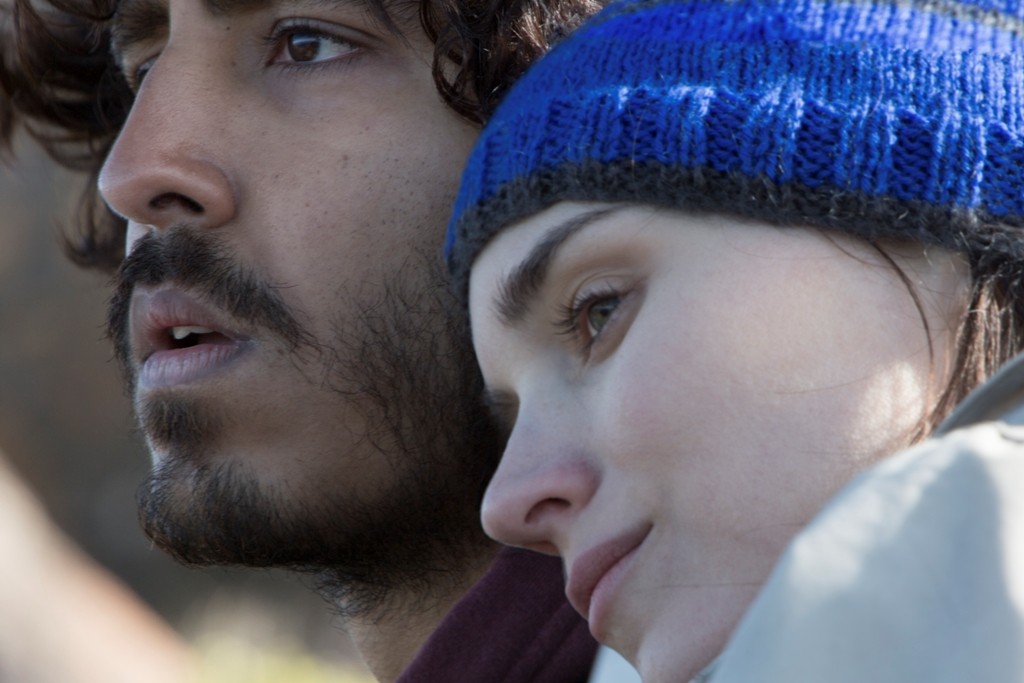
Dev Patel, who plays the adult Saroo, arrived early in the shoot to film the scenes of reunion with Saroo’s birth mother.  Dev campaigned hard to win the role, convincing Garth Davis and the producers that cinema audiences had yet to see the range he was capable of.

Dev confirms that he chased the role.  He says he’d never read a script so enchanting:  “It encapsulates triumph. It’s such a hopeful story about this kid’s will to survive and to find his family again.  What particularly drew me to the role was that it is a very contemporary character and also that the story has complex family dynamics – it’s a beautiful role.”

Iain Canning and Angie Fielder recall meeting Saroo Brierley and their first impressions of him.

Angie says: “When you meet Saroo you get a sense of how he managed to survive on the streets of Kolkata as a five year old. There is something about him as a person that is very resilient and industrious and confident.  At the same time he’s a quintessential Aussie guy with a larrikin sense of humor.”

Iain says:  “I was very taken by how family orientated he is, both with his Australian family and with his birth family in India. At the time he was genuinely surprised that his journey had captured the public’s imagination and had also captured the imagination of Google.”

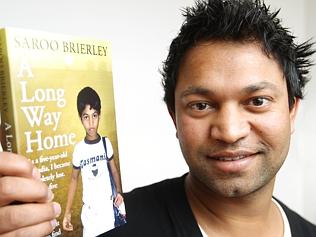
Saroo

Having heard the vital role Google Earth played in Saroo’s search for home, the company had invited him to speak at an international conference where he met the company’s Chairman, Eric Schmidt. Google assisted the producers throughout filming, ensuring authenticity of the scenes in which Saroo searches for his Indian birthplace using Google Earth.

To better look like the real Saroo Brierley who is tall and strong after a lifetime in the Australian outdoors, actor Dev Patel embarked on a punishing weight and food regime, to add bulk and muscle. He also worked with a dialect coach to perfect the notoriously difficult Australian accent.

Dev Patel and Saroo Brierley

Saroo’s Thoughts

The producers and Garth spent considerable time with Saroo and his Australian parents while preparing for the film.  Saroo spoke to Garth about a butterfly coming to him throughout life whenever he was under threat, for example while facing danger on the streets of Kolkata.  Saroo talks about the butterfly as being the spirit of his older brother, guiding him.

“I spoke to Emile while we were at Sundance and said ‘I think the butterfly is the spiritual totem of the film, but we don’t need to let anyone know that, it can just be a texture’.  We finished that conversation, went together to a private function and five minutes later a homeless Indian man walked into the room selling butterfly pins to raise money. I looked at Emile and said ‘it’s happening’.

There are motifs throughout the film, including the sea and butterflies.  Garth explains:  “In much of the film, it’s what’s not said that’s interesting. But how do I get that across in the camera, how do I get that working? So the second half of the movie – when Saroo arrives in Hobart, Australia, I decided to use the sea as an element. Tasmania is an island and Hobart is on a large harbor and river.  Our  characters all live by the water and it’s so totally different to where Saroo came from in India, which is a landlocked world. There’s something about the sea that’s feminine, and something whereby the ocean connects all of us.”

Garth talks about the ‘mapping’ of Saroo’s story for an audience: “A lot of thought went into how to get across clearly the steps Saroo needs to take to find home. What his memories are, how to represent them, what the audience knows at each point. All so that the audience can be with Saroo on his journey, discovering home with Saroo. That needed to be very carefully worked out.

“I hope to watch the film it looks effortless, but a lot of thought has gone into the engineering of how the visual storytelling helps the layers of the story.”

Emile Sherman believes the creative team has well and truly made a film that delivers on the promise of the story:  “This is a film I am very proud of. It’s an incredible story about mothers, and the primal urge to find home.  I hope audiences have the same spine tingling experience that Iain and I did when we first heard the story.”

Emile also believes the film will deliver a powerful message about adoption:  “The film gives an insight into the lives of children who have been adopted and I hope will push more Western countries to recognize the need for and benefits of adoption. There are so many kids who never end up in a loving family and there are so many loving families who want a child.”

Over 80,000 children go missing in India each year. See-Saw Films have been exploring opportunities to work with reputable organizations to support children in India and around the world. Using the profile and publicity that will surround the release of this moving film, See-Saw hope to shine a spotlight the need for global support to assist these organizations.  Audiences will be able to find out more information and an opportunity to make a donation via the film’s website, www.lionmovie.com.

Saroo Brierley and his adoptive parents Sue and John continue to live in Hobart, Tasmania, where Saroo works in the family business.  Saroo is a passionate supporter of the work of Mrs. Sood, who arranged his adoption to Australia and who runs orphanages in Kolkata, and he returns to India frequently to visit Mrs. Sood, his birth mother Kamla and his extended Indian family. Saroo is also a sought after motivational speaker in Australia and overseas.


Director Garth Davis  is an Australian television, advertising and film director, best known for directing the film Lion (2016), and the film Mary Magdalene, written by Helen Edmundson. He earlier directed episodes of the series Top of the Lake (2013) for See-Saw Films for which he received Emmy and BAFTA nominations. Garth is internationally renowned for some of the most memorable and awarded commercials. His recent work has won gold at the London International Award show, the prized Gold Lion at Cannes, and in 2010 he received a finalist nomination from the DGA (Directors Guild of America) for best commercials director. Originally a fine artist and designer, Garth has explored all forms of filmmaking. His dramatic work has included the festival hit documentary Pins, the Dendy Award winning short film Alice, and the highly acclaimed TV series Love My Way.

Screenwriter Luke Davies is an Australian writer of poetry, novels and screenplays. His best known works are Candy: A Novel of Love and Addiction (which was adapted for the screen in 2006) and the screenplay for the film Lion, which earned him a nomination for the Academy Award for Best Adapted Screenplay. Davies also co-wrote the screenplay for the film News of the World.

His four volumes of poetry (the latest, Interferon Psalms, won the inaugural Prime Minister’s Literary Award for Poetry, Australia’s largest and most prestigious literary prize). He co-wrote the screenplay adaptation of Candy with Neil Armfield. Davies’ screenplay Life, about the friendship between James Dean and Life magazine photographer Dennis Stock, produced by Oscar-winning The King’s Speech producers See-Saw Films, was directed by Anton Corbijn. Davies co-wrote the screenplay of Beautiful Boy, with director Felix van Groeningen, based  based on the memoirs Beautiful Boy: A Father’s Journey Through His Son’s Addiction by David Sheff and Tweak: Growing Up on Methamphetamines by Nic Sheff.  Davies also wrote a TV adaptation of the Joseph Heller novel Catch-22, for True Detective producers Anonymous Content and Paramount TV.


The inspiration for Talk To Me came from observing neighbourhood kids growing up and marks the debut feature film from Australian twins Danny and Michael Philippou, best known as online global sensations RACKARACKA, with more than 1.5 billion views on YouTube. “It’s is a sincere movie about not knowing how to cope with your feelings as a teenager and finding outlets that mess with your mind. We want this to be our first film because it’s the closest to our world as it is now and we want to capture that. We want our first movie to feel vivid and alive.”

“We are always interested in the age where you go from being a kid to being an adult, where you’re still taking risks but now the consequences are more brutal. Where you’re trying to just have fun, but now hidden emotions convince you of negativity that isn’t real. You are your own worst enemy.” says Danny and Michael Philippou.

Named one of Variety’s 2016 Fame Changers and ranked 5th on the Australian Financial Review’s Cultural Power List, the brothers are the creators of action comic horror online content, which has racked up more than 1.5 billion views and over 6.6 million subscribers on Youtube alone. Their numerous awards include Best Integrational Channel Streamy Award; Best Overall at the Online Video Awards; and AACTA Award for Best Web Show

“Given the huge popularity of the horror genre right now – and the appetite for more emotionally sophisticated horror that says something about the world we are in now – we are hopeful that the combination of a strong concept and rich real characters will not only connect with a large audience, but also evoke a response that will generate thought and conversation from international audiences of all ages.”

The real-world horror in the film stems from the consequences of reckless behaviour as an outlet; and the
supernatural horror stems from the fallout of repressed feelings breaking free.

“Our starting point is to create a completely believable world – teenagers can sniff out artifice and posturing. We have cast teenagers who speak and act like teenagers, and not adults acting young. We’re very inspired by smart psychological horror films in recent years that reflect current society but with a classic lens. These movies are not just entertaining, but evolve the form, by respecting the audience’s
intelligence. That is the contribution to the conversation of cinema we want this film to make.”

In Talk To Me, a group of friends discover how to conjure spirits using an embalmed hand, they become hooked on the new thrill, until one of them goes too far and opens the door to the spirit world, forcing them to choose who to trust: the dead or the living.

From Inspiration To Writing the Screenplay

“One of the kids was experimenting with drugs – their friends filmed the experience and they were having a really negative reaction to the drug, they were on the floor convulsing and having a really bad reaction. Everyone was filming him on the floor and laughing at him. I found the footage quite striking and
horrifying at the same time,” says Danny and Michael Philippou.

Daley Pearson, a friend of the brothers, shared a short film script he’d written about a group of teenagers
who used possession to get high. The concept sparked Danny’s imagination and he started discussing it with his co-writer Bill Hinzman.

“At the first drafting stage, the story just flowed out, the characters felt real and it evolved really naturally,” says Danny. “I wrote the initial 80 pages of scenes and ideas and characters, and from there Hinzman started throwing in his ideas to find the theme and the structure.”

The film is about a teenage girl who gets hooked on possessions as a new high. But on a deeper level it’s about young people dealing with addiction and mental illness, the way that what begins as an escape from suppressed pain, can actually become a terrifying eruption of that pain.

As the characters and story gained their own momentum, Danny and Michael agreed that Talk To Me felt right to be their first feature film.

Causeway Films’ Samantha Jennings and Kristina Ceyton had crossed paths with Danny and Michael years
before they worked together.

Kristina recalls “I originally met Michael when he was our production runner and Danny was lighting assistant on The Babadook,” Samantha adds. “Later they worked with us on Cargo and they were part of a Google and Screen Australia workshop I led for YouTubers developing longer form scripts.”

Kristina says “We kept in touch with them and their work, so when they reached out with a few feature film concepts we were intrigued. We had seen their shorts as well as their online content, and knew that they had a rare connection to audience and also had the talent to be taken seriously as international filmmakers.”

Samantha recalls “The concept for Talk To Me was the one that stood out for us, because it was infused with their infectious energy, we felt it would really deliver on its genre and at the same time express themes relevant to what young people are going through now. We all decided to collaborate on developing the script and it took off from there.”

Samantha explains, “One of the biggest priorities for us as producers is that we knew from the beginning we all wanted to make a really good film. Danny and Michael have always wanted to be filmmakers, and to be taken seriously as filmmakers. Their YouTube work as RACKARACKA is amazingly inventive, they worked out how to do incredible things, for real, and built up a huge following around the world. But that is one part of them.”

“In making Talk To Me, we set out to harness the huge talent, imagination and skill they’ve developed in their online work and at the same time elevate it. The whole team – directors, producers, Heads of Department, were constantly aware of their audience and alongside that a new potential audience too. We wanted to make a debut feature that was smart, cinematic and well crafted, that had layers and depth and was also exhilarating. Maintaining both sides of that equation throughout was key, and it meant that we all never stopped trying to push the material.”

The Transition From You Tube To Feature Film

For Danny and Michael, making the jump from their online content to a serious feature film was a challenge they enjoyed, bringing their energetic approach to the incredibly structured world of a feature film set.

Danny says “In the YouTube videos, we have no characters. We have no plot. We have no idea what we’re
doing, where we’re going, or what the hell we’re shooting or why we’re shooting it. That’s the YouTube thing. Nothing was really thought through very much. It was all just sort of made up on the spot and we just went with things.”

“With the film, there was more of a plan. But we still adopted the same energy that we have on our
RACKARACKA videos – we are really, you know, energetic,” explains Danny.

Michael continues “It was so good working with other creatives, and other talented people and they could
bring their specialty to the table as well. It was a massive collaborative experience. Even workshopping with the actors, playing through scenes, they added other dimensions to it, that we couldn’t have with the script and never have with YouTube, except for Danny in Nerf Battle Three.”

Causeway Films Samantha Jennings and Kristina Ceyton say “What has been a delightful surprise in making this film has been experiencing how fun the process can be. Making independent films is hard, it demands a huge amount from everyone involved, there is never enough time or money and you are asking everyone for an extreme level of commitment.”

“But working with these directors was a constant reminder to everyone that it can also be enormous fun. There can be wild exhilaration in a way that still encourages deep interrogation of every element and intense seriousness about the work. In fact, that little bit of crazy can make people work even harder, and it was a privilege to see that happen.

“Everything that we’ve ever done, everything we’ve ever made was in pursuit of this, of making our first
feature film. So it was literally a dream come true. It was the most incredible experience. Every single part of it. It was so overstimulating we couldn’t sleep at night. Every time that we’d shoot, we’d come home and we’d edit because it was just so… it was just the best experience ever. We loved every second of it. We felt like we were dreaming and we cannot wait to make another movie.”

“I was interested in telling a story about two men, about masculinity, I guess, or the way in which men communicate physically and emotionally..” says writer-director Francis Hill about his masterfully soaring queer love story God’s Own Country.

Francis Lee didn’t make the masterful God’s Own Country because he thought it would be a sure-fire hit or stoke enough controversy to get him recognized as a director.

The first time filmmaker wrote and directed the soaring queer love story, which revolves around the budding romance between Yorkshire sheep farmer Johnny (Josh O’Connor) and Romanian migrant worker Gheorghe (Alex Secareanu), because the story was burning inside of him and he needed to get it onto the page and onto the screen, regardless of who saw it.

A dig into the nature of humanity from a director already fluent in the language of brutality and tenderness. A stunning love story that in its finest moments is pure poetry.. 

Terry White, Empire

“God’s Own Country” is a quietly radical film that reimagines the rural romance through the lens of queer intimacy, emotional healing, and the redemptive power of connection.

Set against the rugged, windswept moors of Yorkshire, the film follows Johnny Saxby, a young sheep farmer numbed by isolation, grief, and the weight of familial duty. His world is one of silence, alcohol, and fleeting encounters—until Gheorghe, a Romanian migrant worker, arrives to help during lambing season. What begins as a volatile clash of masculinity and cultural tension slowly unfolds into a tender, transformative relationship. Their evolving bond—rooted in shared labor, mutual care, and unspoken longing—becomes a quiet rebellion against the emotional repression that defines Johnny’s life.

The film’s significance lies in its subversion of genre and geography. Where rural settings in British cinema often symbolize tradition and stoicism, here they become a crucible for vulnerability and change. Director Francis Lee crafts a narrative that is both viscerally physical and emotionally restrained, using the land not just as backdrop but as metaphor for Johnny’s inner thaw. The romance is not idealized—it’s muddy, bruised, and hard-won—but it offers a vision of queer love that is grounded, sustaining, and deeply human.


In the end, “God’s Own Country” is not just a love story; it’s a reclamation of place and self. It suggests that even in the most barren emotional landscapes, tenderness can take root. It’s a film about learning to stay, to care, and to build something lasting—one fence post, one lamb, one gesture at a time.

Bringing “God’s Own Country” to the big screen has been a 20-year-long journey for Lee

Before taking the plunge and moving behind the camera Lee was an actor. However, he insists he was never any good, as he was terrible at auditions, and was always just lucky enough to get work. Lee was never able to express himself as an actor, and after several years of boredom and frustration, he suddenly thought, ‘I’m going to have to stop acting. And I’m going to have to do this because ‘Either do it or shut up.”

Francis Lee
A keen photographer and lifelong storyteller, writer-director Francis Lee is used to viewing the world through a lens. A largely self-taught filmmaker who resisted the ‘rules’ of writing – though found truth in the subtext of Chekov’s plays – he has come to the job of writer/director via a handful of shorts following a modest acting career.

He wrote a script on spec and showed it to a friend,  who showed it to his agent.

The agent loved it and encouraged Lee to enter a funding scheme run by the British Film Institute and Creative England. While he was ultimately unsuccessful, he got down to the final three submissions and the BFI were so taken with God’s Own Country that they later offered to support the film anyway.

Lee’s original urge to make “God’s Own Country” came from the Yorkshire “landscape,” especially because he had such a “love-hate relationship” with his home.  “On the one hand I saw it as totally creative and expansive and it always felt like home. But on the other, it felt problematic and difficult and brutal and cold and wet and inaccessible and wet. And then it was just trying to work that out and find some peace within that.” All of which he then mixed together with “falling in love and making yourself vulnerable for somebody else….”Those kinds of things collided, and that’s what I wanted to explore.”

This approach clearly worked a treat, because audiences quickly connected with “God’s Own Country.” After premiering at Sundance, it screened at the Berlin International Film Festival and has been the “biggest selling film of the year” in parts of Northern England. In Lee’s home town Halifax it not only outsold “Dunkirk” but has become “the biggest selling film they have ever had,” with viewers going to see it five or six times.

God’s Own Country, with its story of two young men who fall for each while working on a Yorkshire farm, merges rootsy British realism with the thrill of romance, even if it’s to be found on a cold fell in lambing season. By turning tender and sexy, the film is also a significant addition to the queer cinematic canon and a part of the lineage of queer cinematic greats.


Interview with Francis Lee

Tell us about the 5 years it took to make the film.

In all, it took five years to make, but the bulk of that time was waiting around. The wheels of the film industry turn very slowly, but fortunately, I am very patient. That’s probably no bad thing since when we finally got the go-ahead in May 2016 we had just missed lambing season so we then had to wait another entire year.

I was determined that the action should be as authentic as possible and cast newcomers Josh O’Connor and Alec Secareanu as the central characters and brought them to Yorkshire where they experienced farming life first-hand. I knew that it was going to be a challenging shoot for the young actors and I wanted to give them all the support I could. Three months before filming began we started work on their characters and by the end, they knew every breath they had taken from birth to the point we see them on film. “We also got them to work placements on farms where they learnt everything from the lambing to the dry stone walling. They had to be so comfortable in that landscape that everything came as second nature and both of them developed really strong bonds with the farmers, so much so that Josh is still in touch with one of them.

How did you see Johnny’s sexuality in the film?

In terms of the character’s sexuality, I think he’s fine with who he has sex with. The difficulty comes in him moving forward and not just having sex but having an actual relationship and the journey he has to go on to achieve that because he is very closed emotionally for lots of reasons.

Why did you want to write a rural working-class story?

That’s my experience. In terms of the cinematic landscape, I’ve seen a lot of working-class stories but they are usually urban and they are usually about benefits or problems with drugs or gangs. I’d never seen the world I knew depicted in the way in which I saw it. That’s where I come from, that’s where I live.

GODS COUNTRY 2

How did that feed into the visual mood?

It was important to depict the landscape in a way which I’d not seen in a film before; that it was cold, wet, windy, that it’s hard work, that there’s mud. There’s only one landscape shot in the film and that’s because it’s the first time that Johnny sees the landscape. The rest of the time he doesn’t see it. That’s because of the way he has to live and work here and it becomes very oppressive.

The film has been compared to Brokeback Mountain. But aren’t there already references to Ang Lee’s film within yours?

Yeah, I love Brokeback Mountain I think it’s a wonderful film, I love the book. I’m not going to tell you where those references are but I was very aware that there would be comparisons and rather than shy away from that I wanted to celebrate that.

How did the character of Gheorghe come about?

When I gave up acting I got a job in a scrapyard and worked there to make money so I could make short films. One of the guys working there who is a friend of mine was from Romania. He’d come here to better and change his life. He spoke very eloquently about coming to this country, about the xenophobia he’d experienced. I was shocked and ashamed of our country and that kind of attitude towards people. I wanted to look at an outsider coming into this community, coming into it from a totally different perspective.

You filmed God’s Own Country before the EU referendum but the film carries a certain charge when viewed post-Brexit. Did politics come into play at any point?

We didn’t re-edit it or rethink the film after the referendum but it just made the story and the world and the characters more poignant. It just became apparent that what could potentially happen now is that two people could fall in love from two different countries in Europe and they can’t be together.

Tell us about the characters

I am very precise and the script was very detailed. Every look, every glance, every touch, every animal thing, those things can’t change, but then we have to discover how they got to this point, and that’s where Josh and Alec’s input came in. They were very creative about building these characters from the moment they were born until we first see them in the film.  Johnny and Gheorghe are men of little words, though the Romanian man is more emotionally open. It’s in this regard that God’s Own Country’s most beautiful moments land in the unspoken beats between them, especially a moment’s silence on a glowing hilltop.

GODS COUNTRY 3

One of the things that I was quite obsessed about, particularly now I’m living back in Yorkshire, is that idea of everything being part of the landscape, of nature, and of everything belonging in some way to each other,” Lee says. “The earth, the animals, the moon and the stars, everything kind of becomes that feeling of oneness my grandma used to talk about. And that was what I was trying to explore a little bit with the boys. I wanted them to feel so rooted here.

Their actions are a mirror not only of the landscape but also of their growing union. Gheorghe caring for an abandoned lamb echoes the crumbing of Johnny’s initial resistance.  I was trying to represent these people as very practical, but also as a filmmaker to be very visual and to constantly layer it with meaning or significance. Even if no one else knew, I knew.

Filming more or less in chronological order, O’Connor stayed up at the farm while Secareanu was lodging in a hotel down in the local village. I knew that if the first time really they met was onscreen, there would be that extra frisson, that extra anticipation or excitement or nervousness about how they were going to work together, and that did translate.

I wanted to build an almost paternal bond of trust with each of them that has continued long after filming wrapped, and that relationship became a triangle when finally filming together.

When British screenwriter Steven Knight and Chilean director Pablo Larraín started working on the idea of the film Spencer, an imagining of what might have happened during those few fateful days when Princess Diana decided to leave Prince Charles, Larraín was relieved Knight did not intend to write another biopic.

“I didn’t want to write a biopic, there were too many traps and pitfalls. Instead, I wanted to take a snapshot of her, as so many photographers did. I wanted to isolate a couple of days which illustrated her life,” says Knight, recalling watching Diana’s funeral in the early hours of the morning in Canada, where he was based for work in 1997.

“What I saw was something very un-British. An outpouring of extreme grief expressed openly and without hesitation for form or propriety,’ Knight explains. ‘In the years since, I have wondered often about the effect she had on the British people and the people of the world. I have not been preoccupied with it, it was just a question in my mind. Who was this woman who had this effect?”

‘We decided to set it at Christmas in Sandringham and tell the story about her leaving the family. Once we had the time, the place and reason, we had the starting point for our film,’ Larraín explains.

“Many of the personal, internal struggles which we depict in the film are imagined or guessed. Most of all, I wanted the story to be, at its heart, the story of a family driven together by Christmas where all of the tensions and grievances get magnified. I wanted to imagine that, beyond all the trappings, the Royal Family is just a family,” Knight explains.

For this research, Knight spoke to the people who were in Sandringham where the events take place at the
the time they happened.

“I deliberately didn’t read any background material because I didn’t want known history affecting the narrative,’ he explains. ‘I hope the film goes to places that the intrusive paparazzi cameras never reached and that we can begin to imagine ourselves in her situation.”

Making Jackie (2016) has made Larraín even more interested in discovering and revealing the intimate personalities of women who changed the face of the 20th century

“Both Diana and Jackie built their identities by themselves, not necessarily connected with the men they were married to. Both understood how to use the media of their times to convey certain versions of themselves to the outside world, though they did so in very different ways,” says Larraín.

“We all grew up understanding what a fairytale is, but Diana Spencer changed the paradigm, and the idealised icons that pop culture creates, forever,'” says Larraín. “This is the story of a Princess who decided not to become a Queen, but chose to build her identity by herself. It’s an upside-down fairytale. I’ve always been very surprised by her decision and thought it must have been very hard. That is the heart of the movie. I wanted to explore Diana’s process, as she oscillates between doubt and determination, finally making a bid for freedom, not just for herself but for her children too. It was a decision that would define her legacy: one of honesty and humanity that remains unparalleled”

Jack Farthing | ‘Prince Charles’ and Kristen Stewart | ‘Princess Diana’, in Spencer. Photo credit: Frederic Batier / Courtesy of FilmNation Entertainment.

“When Diana decides to leave Charles, the family, and the life that comes with it, it is a decision she takes for herself, realizing that her own identity matters more to her than that of the Royal family or the nation. But there is no idleness about that – she does it because she needs to. She is living in an environment that is crushing her, diminishing her, so she must protect herself and her children. Diana’s process, between doubt and determination, over the very condensed time of the Christmas holidays in Sandringham may just be a small glimpse at her life, yet it can say so much more than that. It is a life reflected in a few days.”

“A lot has been written about Diana, in newspapers, books and magazines. The stories are endless – some can be proven, some cannot. We did extensive research about Diana, Royal Christmas traditions, and the anecdotes of ghosts at Sandringham House. Yet the Royal family is notoriously discrete. They may appear publicly on some occasions, but at some point, the doors close, and once they are, you don’t know what is happening behind them. That gives a lot to fiction; that was our work. “

“We didn’t aim to make a docudrama, we wanted to create something by taking elements of the real, and then using imagination, to tell the life of a woman with the tools of cinema. That is why cinema is so fantastic: there is always space for imagination.”

Courtesy of FilmNation Entertainment.

Approaching UK producer Paul Webster at Shoebox Films with the idea for a film on a very British subject matter

Pablo Larraín and his brother Juan de Dios run Fabula, a highly successful production company in Chile. Fabula has always worked on an international scale and had been working with Jonas Dornbach at Komplizen in Germany, producing the Oscar-winning ‘A Fantastic Woman’ together. Juan and Pablo turned to UK producer Paul Webster at Shoebox Films with the idea for a film on a very British subject matter, Princess Diana. The three producers decided to team up and work together.

“Knowing Pablo’s work, I knew in the hands of a master like him, we were going to get an entirely different look at an institution that we’re so familiar with,’ producer Paul Webster recalls. ‘I loved the idea of a Chilean director coming in and looking at our British society and presenting it in a way that we perhaps could never see.”

Setting up the financing of the film independently was a challenge. There were several studios interested in the project, but it was decided to keep control and stay in the driving seat to best steer the film in the desired direction. This meant a trilateral production between Komplizen Film (Germany), Fabula Films (Chile) and Shoebox Productions (United Kingdom). FilmNation boarded the film as world sales and managed to secure important sales in Cannes 2020 ahead of the shooting.

Getting production financing from the UK, however, proved to be difficult due to concerns over media attention. That is why it was decided to shoot most of the film in Germany, where it was possible to find suitable locations and finance a substantial part of the budget. Shooting then took place between January and March 2021 in Germany, before moving to Norfolk in the UK for the final stretch.

“German producer Jonas Dornbach: ‘We are extremely grateful for the support of our distributors worldwide, our partners and funders who have shown tremendous commitment to us in these extraordinary times. Over the last year, we have had to deal not just with the consequences of Brexit, but also a worldwide pandemic. But still, here we are, with an independently produced film made for the big screen about an iconic woman’s own declaration of independence. We couldn’t be more excited! “

With a concern that filming in the UK would get a lot of scrutiny and unwanted media attention, production chose to shoot in Germany instead. Production chose the two main locations of Schlosshotel Kronberg for most of the interiors of Sandringham and Schloss Nordkirchen for the exteriors and few remaining interiors.

Courtesy of FilmNation Entertainment.

Casting Diana

“Of course, for a character-driven film like this, actors are of the utmost importance. A good relationship between the main actress, the camera, and myself was key to building a character everybody thinks they already know.”

“Building the character of Diana, we didn’t just want to create a replicated image of her, but use cinema and its tools, like time, space, and silence, to create an internal world that struck the right balance between the mystery and fragility of her character. Both these sides of her are very visible in the scenes that have supernatural elements,” says Larraín.

“My idea was not to drift towards the paranormal or absurd, but rather reflect an inner life. Everything Diana sees is a reflection of her memories, her fears and desires, and maybe even her illusions. These elements take something that is happening inside her and shows a vulnerability that is very beautiful.”

Photo credit Pablo Larraín / Courtesy of FilmNation Entertainment.

For Larraín, he knew Kristen Stewart would make a perfect Diana.

Kristen was introduced to worldwide audiences in 2002 with her gripping performance in Panic Room. Her star took a huge rise when she starred as Bella Swan in the hit franchise The Twilight Saga. In 2015, she became the first American actress to be awarded a Cesar Award in the Best Supporting Actress category for her role in Olivier Assayas’ Clouds of Sils Maria. Most recently, Kristen can be seen as the title character, Jean Seberg, in Amazon Studios Seberg and starred in Hulu’s romantic comedy Happiest Season. Other recent projects include Charlie’s Angels and Underwater. Coming up, Kristen will begin production for David Cronenberg’s Crimes of the Future.

“Kristen Stewart is one of the great actors around today. She is where she is now because she has something very important in film, which is mystery,” says Larraín. “Kristen can be many things; she can be very mysterious, very fragile, and ultimately very strong as well, which is what we needed. The combination of those elements made me think of her. The way she responded to the script and how she approached the character is very beautiful to see. She has created something stunning and intriguing at the same time. As a filmmaker, when you have someone who can hold such a dramatic and narrative weight just with her eyes, then you have the strong lead who can deliver what we were hoping for. She is a force of nature.”

“It was crazy how confident Pablo was in my casting,” says Stewart, who was up for the challenge “Without even having a conversation with me or making me read anything, he knew I could do it.”

“I’ve worked for a long time as an actor and I wanted to see if I could go to the very top of the mountain so to speak. I just thought as an actor, if you’re not trying to do that, then why are you even an actor?”

Courtesy of FilmNation Entertainment.

“For Stewart, she felt like she got to know Diana through her research and found some similarities to her life that she could relate to. ‘I’ve felt extremely out of control in certain periods of my life, and that is a defining factor of her life.

She must have been aware that people were always staring at her, and I’ve tasted that, I know what that feels like,’ Stewart explains. “As soon as I got to understand her and build a relationship with her through my research, I couldn’t believe how easy it was to love her.”

“Kristen journeyed deeply into Diana’s soul, adopting not only her voice and mannerism but also her flaws and virtues. Her research was meticulous and the result speaks for itself,” Knight explains.

Stewart worked with dialect coach William Conacher to perfect Diana’s accent, a vital part of the process of becoming Diana.

“There are instructions that William has developed over his career that make it possible to create sounds that are totally new to your muscularity,” Stewart explains. “

As someone who doesn’t take a long time to prepare for her roles, for this one Stewart knew she needed the time to research and study Diana’s accent.

‘I watched and listened to her a lot and I remember certain things she has said that have really affected me and gave me goosebumps,’ Stewart explains. ‘She had this casual but incredibly intense way of speaking that was so disarming and really attractive.’

When it came to working with Larraín, Stewart felt her performance was safe in his hands.

Photo credit Pablo Larraín/ Courtesy of FilmNation Entertainment.

“As an actor working with a director, you hate to think they’re missing what you’re doing,” Stewart explains. “Pablo didn’t have to say much because he felt so unbelievably present and watchful. I knew that I was being seen from all sides. If there was ever anything that felt untrue or wasn’t in keeping with the momentum of the piece he was putting together, he would put me right on track.”

“I had to create this intimacy with Kristen, to breath with her and live the film with her. The camera and I were very close to her, sometimes it felt like I was her in the scene,” says cinematographer Claire Mathon.

Mathon is a French cinematographer. Graduated from French Cinema School Louis Lumière in Paris, she has practiced both fiction and documentary. She is known for her collaboration with Alain Guiraudie (Stranger by the Lake, Staying Vertical), Céline Sciamma (Portrait of a Lady on Fire) and Mati Diop (Atlantics). She has also worked with Thierry de Peretti, Maïwenn, Bruno Podalydes, Catherine Corsini and Louis Garrel. In 2020 she won a Cesar for best cinematography for her work on Portrait of a Lady on Fire and The Los Angeles Critics Award for both Portrait of a Lady on Fire and Atlantics.

“For me, what film does is puts everything together so beautifully and makes it look more organic,” Larraín explains. “With the direction that Claire took with using very little contrast, it made the film look like a watercolour which I don’t think we would have achieved digitally.”

Filming with Larraín and Mathon gave Stewart a great sense of security in some of the more intense scenes.

“I was really lucky, in the moments I felt were most difficult, I felt Pablo and Claire’s presence as a huge support system,” says Stewart.” I lent myself to the process knowing they would catch me if something went wrong. I was almost driven by that knowing that Diana didn’t have that feeling.”

“It didn’t feel like a huge theatrical experience, it felt intimate,” Stewart adds. “I never felt like I had an audience outside of Pablo and Claire. I never felt like I was on display.”

Claire Mathon
Kristen Stewart with director Pablo Larraín during the filming of Spencer. Photo credit Pablo Larraín / Courtesy of FilmNation Entertainment.

“Pablo created a reality around Diana which was heightened to exactly the right degree,’ Knight continues. ‘A world in which paranoia, fear and self-doubt turn a family Christmas into a terrifying ordeal.”

For Larraín, working with Stewart was a rewarding experience that the whole crew felt.

“Kristen inspired all the crew to believe in the film. It’s good to feel inspired by an actor who is carrying that role with such complexity. Working with her was beautiful, I learned so much from her.”

For Stewart, being surrounded by a predominantly international crew came as a relief to her.

“Shooting in Germany was great for me,” Stewart explains. “I felt lucky not to be surrounded by an English crew who would assess my accent. It took a certain level of self-consciousness away.”

For Stewart, she believes from the moment the film begins, the expectations people might have for a film based on such a salacious topic such as Diana’s decision to leave the Royal family, will be immediately suspended

‘It’s a survival story. It’s a woman who is drowning and thrashing around and then finally coming up to shore and taking that successful first gasp of air,’ Stewart describes. ‘Then the film finishes, and you don’t really know any more about her as a woman; the film has such an unbelievable loss by the end of it.”

For Stewart, the experience of making Spencer is one she will never forget and credits Larraín for putting together the perfect team to bring this film to life.

“This experience cracked me open every single day, I wasn’t anything other than a raw nerve and it filled me with a new confidence,’ Stewart explains. ‘I wanted everyone to feel that too, that they could do anything. We got to set every day and I wanted to take care of everyone, I wanted everyone to really be connected and happy and mutually endeavouring to protect Diana.’

Courtesy of FilmNation Entertainment.

Director Pablo Larraín | Director

Along with his brother Juan de Dios, Pablo Larraín is a founding partner of Fabula, a production company
dedicated to film, television, advertising, and production services. Fabula has produced over 40 films, more
than 15 TV Shows, and 500 commercials.

In 2006, Pablo directed his first feature film Fuga, followed by Tony Manero (2007), which premiered in the
Directors’ Fortnight at Cannes 2008. Post Mortem (2010), premiered in the Official Competition of Venice Film Festival. No (2012), won Best Film in the Directors’ Fortnight of Cannes Film Festival and Academy Award nomination for Best Foreign Language Film. The Club (2015) premiered in the Official Competition of Berlinale in 2015 and went onto win the Silver Bear for the Special Jury Prize and a Golden Globe nomination for Best Foreign Language Film. Neruda (2016), was nominated for a Golden Globe for Best Foreign Language Film. Jackie (2016) won the Golden Lion for Best Screenplay. Ema, his latest film, premiered at the Venice Film Festival 2019. In 2019/20, Larraín directed the eight-episode limited series Lisey’s Story, written by Stephen King.

Pablo Larraín

Steven Knight | Writer

Steven Knight

Steven Knight CBE is a Writer and Director. Steven’s first screenplay, Dirty Pretty Things, directed by Stephen Frears, premiered at the 2002 Venice Film Festival and won a host of prestigious awards including four BIFAs, Best Film & Best Actor at the Evening Standard British Film Awards, the 2004 Humanitas Award, the Edgar Award for Best Motion Picture Screenplay, Best British Screenwriter at the London Film Critics’ Circle Awards and an Academy Award nomination for Best Original Screenplay at the 76th Annual Academy Awards. Steven went on to write Amazing Grace, about the life of the British anti-slavery politician William Wilberforce, Eastern Promises, The Hundred-Foot Journey, Pawn Sacrifice, Seventh Son, Burnt, Allied, The November Criminals, Walks Ahead, and co-wrote The Girl In The Spider’s Web. Most recently, Steven penned Locked Down, shot entirely in lockdown. Steven has also directed and written three films: Hummingbird (US title Redemption), Locke and Serenity. Steven is the creator and Executive Producer/writer on the BAFTA Award-winning Peaky Blinders, executive producer/creator/writer on BBC series Taboo and writer and executive producer on SEE. Steven wrote and executive produced A Christmas Carol. Coming up he will adapt Great Expectations for the BBC and FX. Steven has had four novels published: The Movie House, Alphabet City, Out of the Blue and The Last Words of Will Wolfkin, which was released in 2011 which was his first children’s novel. Steven’s first stage play was The President of an Empty Room, which opened at the National Theatre in London.


The genre-bending, cult style South African film Fried Barry marks the feature-length directing debut of Ryan Kruger and has been distributed internationally in over 50 countries and garnered 23 awards from the festival run.

Cape Town-based actor/director and writer Ryan Kruger has been making movies since he was 14 years old. As a winner of SAMA (South African Music Awards), MTV and GOEMA awards, Ryan is widely celebrated for his outstanding work as a music video director, having directed over 100 music videos.

As a director of dozens short films, Ryan is known for his distinct visual style and character-driven stories.

Fried Barry marks Kruger’s first independent feature film, and will premiere on DStv Box Office on 26 October.

Daniel Dercksen shares a few thoughts with writer-director Ryan Kruger about Fried Barry.

Fried Barry is described as a first in the history of South African cinema: a bizarre tale told in a genre-bending onslaught of sex, drugs, and violence. A spectacle that pulls you in and won’t let go as every expectation is subverted in this boundary-pushing tale of alien abduction. Tell me more about this?

In South Africa we don’t make these type of cult films. We are known for our dramas, comedy and historical movies. Over the past few years there’s been more genre movies coming out of South Africa, which is great. Even the past 2 years there’s been a major difference. It is exciting to finally see South Africa stepping out of their comfort zone. The great thing about Fried Barry is that it’s a genre bending film. It has elements of horror, sci-fi and a lot of dark humour. This film is defiantly not for everyone. It’s quite out there and a very bold film. You will either love it or hate. It’s designed to take you on a journey. It’s a road trip movie without the car. Barry is the car.

What inspired this story of an alien assumes control of a drug addict’s body and takes it on a bizarre joyride through Cape Town?

As a filmmaker you have to think out the box. We sadly live in a generation of remakes and reboots. Filmmakers try to change things we have seen before, just adding a different name, change the location from snow to space or desert, change guns to lasers and so on. It’s hard to find something new and unique. When I came up with the idea I realized we have never seen a drug addict being abducted by aliens in cinema. That really intrigued me. This film was born out of total frustration. I went through a lot before I made this film. In a nutshell I went through depression, had a operation on my kidney, got sepsis and nearly died, lost a girlfriend, my cat got cancer and I went deeper into depression. It was way too much for me at the time, Being at the bottom of the pit, I asked myself what the number one thing was that I’ve always wanted to do. That was to make a film. I came up with a 50 percent scene brief break down in 3 days. A month later I was shooting the movie. Fried Barry was my medicine and got me out of that dark place. Even though it was the worst time of my life going through depression, I am so grateful I went through it because it brought me here. Something always great will come out of darkness. I just used it.

Are you an avid horror fan? What films / filmmakers in this genre inspires you?

I am a big fan of 80s horror and overall 80s cinema. They just don’t make movies like they use to. I really like all types of genres. Tere’s a time a place and mood for everything, just like music. Filmmakers that inspired me were Spielberg, John Carpenter, Jerry Lewis, David Cronenberg and Shin’ya Tsukamoto.

Ryan Kruger with Garry Green and Sean Cameron Michael during filming of Fried Barry. Photos by Graham Bartholomew

The story of Fried Barry began with the 3-minute experimental short film of the same name, shot in 2017. Tell me more about this?

During my depression I decided to make 8 experimental films. Where I could do what I wanted to. And get really creative with no clients or producers telling me what I can or cannot do, and not worrying about getting it on TV. To be able to do my style 100 percent and have total freedom. It just happened that Fried Barry the short was the first one I made. And it’s the only one out of the collection that has been released. Its now 5 years later and I have the last 2 in post. It’s some of my best work I have ever done. After each one is complete it does the festival run overseas. But I will release them as a collection very soon.

The simple concept and stylized execution of the short was a success, earning the film 59 official selections and 13 awards at film festivals across the world. How did you go about reaching such a wide audience?

It was crazy. I sent it to a lot of festivals and more festivals reached out to me that they wanted to screen it. There just seemed to be a lot of interest and a lot of love for it. There was never a plan to make it into a feature. But it did plant a seed in my head am sure.

You never expected your first feature film to be Fried Barry but after positive responses the wheels began to turn. Tell me more about this?

As a director I think all directors think what is the right film to do first. It’s the most important question because it matters what you put out there. What will make a noise? What will be easily forgotten? I never thought it was going to be Fried Barry because I had so many other scripts and I couldn’t decide which one to launch. But as I soon as I got the idea I knew it was the right one straight away. At that time I needed something that was 100 percent my style and something that I could get super creative with.

You proved that it is indeed possible for a short, experimental concept piece with a loose plot to evolve into a fully-fledged feature film?

It all depends on the concept you have. When I looked at it there was nothing there really. It was just about a look and feeling and sticking to a subject you know. So when I looked at the success of the short I was like how the hell can I get this character out of this room? And how would it work with Gary Green.

Tell me more about the importance of breaking the concept into a scene outline over the course of three days.

Every film has its character go on a journey and have the arcs as they go along. Characters need to develop and the story has to move forward. So for me its like looking at any break down of a film where this happens and what the character goes through. From there I would fill in the gaps and write the main dialogue. It was great to be open and that nothing was set in stone. The film needed to breathe and be open to a unpredictable normal structure.

You decided to forgo a traditional script, and chose to workshop the scenes with the cast, work shopped each scene to figure out how we get there. Tell me more about the importance of working with actors to bring the story to life?

Because of the style and type of film I was making, I didn’t want anything set in stone. Most films get a green light and you can’t change anything. I feel that it needs to be organic, where anything could happen and that’s also what acting is… it’s feeling a moment and being real in the scene. As a director I wanted to explore that. We have all heard a actor say “I really don’t think my character would say this” and a lot of the times they are right. As a director my job is to get the best out of actors and make them understand where we are going and what they are feeling. But half of a good director’s job is done with great casting.

Ryan Kruger with Gareth Place – Director of Photography – during filming of Fried Barry. Photos by Graham Bartholomew

Your approach imbued the film with an improvisational energy and resulted in some of the biggest laughs and most affecting moments in the movie. Tell me more about his?

As a director its really just being in the moment of your characters and story and what we would expect to see or how I can make this different. If you know your characters well it opens you up to so many more ideas. If you get a better idea for a scene in a moment and it’s a 100 times better than what’s on the page, I will do it. Some of the best gems in the film came to me either one take in or a second before shooting a scene. And I said let’s try this.

You managed to secure funding from private financiers within a month and started shooting. This clearly highlights the importance of collaboration during the process from page to screen… Your views on this?

We actually didn’t get investor on board until half way through the film. Me and my co producer James C Williamson put up all the money from the start of filming. It was only later on where I showed a director some shots from the film that he wanted to give invest. So there wasn’t any collaboration on what I wanted to do. He just truly believed in me and wanted me to do my thing. Which I am truly grateful for.

You also have a collaborative and improvisational approach to directing, allowing the best ideas to rise to the surface through creative discussions with his cast and crew. 

As an actor myself I love to improvise and I like giving freedom to actors to add stuff and make it there own. Filmmaking is all about collaboration. The only person that didn’t improvise in the film was our lead Gary Green. He isn’t a trained actor and comes from a extra back ground. I cast Gary because I love characters and I knew I could get what I wanted out of him. I knew from the start for this whole film to work it had to be the right character and right story in every aspect as the movie relies on Barry. I needed a clean slate to work with him everyday and be in the moment with him. But Gary did an amazing job. He was always willing to do as many takes and never got frustrated with that. No one but Gary could have done this part. He trusted me and we both had so much fun.

During filming you would write dialogue on a piece of paper while driving from one location to the next. What fostered this?

Every good director should always carry a pen or paper when they get an idea and write it down. Those ideas are always good.

Your views on the importance of directing music videos for some of South Africa’s biggest artists as a step towards making your feature film debut.

I was always known for narrative music videos. I was still telling stories. It’s all about directing performance in a narrative and feeling those moments and hitting those beats. More so than commercials, which am sure a lot of producers in that world would disagree because they just use to look at me as a music video director in the past and maybe not for commercials. The great thing about music videos you can get really creative. There are many directors out there that can’t direct performance and get across what they want in commercials because they are more visual.

Fried Barry is a character-based film featuring over 100 actors, with dozens of bizarre and interesting characters – both major and minor – that bring the world to life. Tell me more about this monumental task?

I knew this drug trip road movie would be an experience. I knew Barry is going to come across a lot of characters. Every single person I cast in this movie did not audition I either worked with them before or wanted to work with them because I knew their work. I put them all in roles I knew they would be great at. And it all worked out perfectly. Every single character is great and interesting. It shows how much amazing talent we have in South Africa with actors.

In signature cult movie style, the movie has inspired artists around the world to create their own Fried Barry-inspired artwork. More about this?

It started with the short experimental which was weird because who wants makes fan art for a short. When the film came out it just went crazy. This has to be the first SA  film to get major fan art. Even people getting tattoos of Barry. Its just insane and incredibly honored that someone would do this.

Your views on the future of filmmaking in South Africa after the impact the Pandemic had on the industry?

I truly believe it gave people a chance to reset and think about what they want to do in life. I think the industry is going to boom again and be better than ever. The content coming out of SA has risen a incredible amount and the standard is higher than ever.

The success of your journey clearly shows that it is vital to remain pro-active.

Absolutely, I love to work and I love what I do. I am constantly at it and I want it just as much as I ever did. So there’s no change in staying pro-active.

I don’t really have a life if I could work everyday onset I would. That saying you have to love what you do and you really do have to eat shit breath movies to make stuff happen and that what divides people who want it.

Have you always wanted to be a filmmaker?  Where did it start for you?

It’s been a life time to get here. But working 23 years to get to this point working in film. I started young and never wasted time doing anything else but film. I first got into acting and then making short films with my friends in the UK during the holidays or weekends .My childhood was very much like that film “Super8” It’s all about sticking at something you know that you will never lose interest in. Every parent will say to you as an artist  “maybe get a back up just in case so you can always do something else if it doesn’t work out.” When they said that to me I said OK I will do directing as well. And they rolled their eyes. 😉 .

What tips do you have for aspirant writers and filmmakers to get their work out there.

Pick up a camera and start making content, you are nothing without this. Writers meet directors and get your short scripts made. You have to get out there, there’s a million other people thinking what your thinking work together. Don’t wait just do it!

What do you hope audience will get out of experiencing Fried Barry?

Have fun. Be open-minded. It was designed to take you on a trip and for you to have an experience that you will never forget, even if you love it or hate it, you will remember this film.

Tell me about the international success of Fried Barry?

So far, we have it distributed in over 50 countries and still hitting it hard. This month we have the SA release so it’s great to bring it back home. Getting AMC to buy the film really was a game changer.  The media overseas has been amazing. Getting it into the likes of The Guardian and Empire magazines and Fangoria and New York Times and constant interviews has focused attention on the film.

 I hope the film carries on and people have been asking for a follow up film, so lets see what happens.

Die Hard in a football stadium

An independently funded British action movie with the production value and spectacle to rival Hollywood’s behemoths, Final Score was the brainchild of producer Marc Goldberg, who, in late-2015, spied a unique opportunity.

“I’d made a few British movies and have a distribution company and my business partner is David Sullivan, who owns West Ham [United Football Club],” he explains. “During the final season at Upton Park [West Ham’s home since 1904 – for the 2016-17 season, they moved to the Olympic Stadium in Stratford], I asked him ‘What’s happening to the stadium once you leave?’ and he mentioned it was being reconfigured to be apartments. So I got in touch with Barratt Homes, the property company who had bought the land, to see if there was a way to use the stadium before they knocked it down.”

At this point, there was not even an idea for a story, just the sure knowledge that to be allowed access to such an arena – and to be allowed to blow parts of it up – was a once-in-a-lifetime opportunity.

“We had to start somewhere, and we felt that making a movie about sport or a movie about West Ham would not be widely appealing,” continues Goldberg. “So we thought, ‘How about making an action movie?’ We started with ‘Die Hard in a football stadium’. That was the nuts and bolts of the idea. I then got in touch with the guys at The Fyzz Facility, who obviously have been involved in the making and financing of lots of films [Silence, Wind River and 47 Meters Down are just three recent examples], and they came on board to produce it with me.”

“Marc text me as I was getting on a plane to LA,” says Wayne Marc Godfrey, CEO, co-founder and co-owner of The Fyzz Facility. “So we had dinner in LA the next night. He said, ‘We’re all Brits and we all know about football and that West Ham are leaving Upton Park; I can get the stadium for four to six weeks after the end of the season. Let’s make a movie there.’ I was like, ‘You are absolutely nuts! But we are in.’ The concept was ‘Die Hard in a football stadium’ – we’d figure the rest out later. It felt like an amazing challenge as this was November [2015] and we were talking about shooting the next May. We had no script, no writer, no director, no cast, and no money! But we had this unique opportunity.”

Believing his traitorous brother Dimitri (Pierce Brosnan) is somewhere in the stadium, Arkady (Ray Stevenson), the former leader of a revolution in the Russian state of Sukovia, locks down the Boleyn Ground during the European semi-final between West Ham United and Dynamo FCC. In the crowd with his niece, Danni (Lara Peake), is US-veteran Mike Knox (Dave Bautista), who stumbles upon the plot and goes about taking out Arkady’s heavily armed team. Can he get to Arkady before Arkady gets to Dimitri? The fate of 35,000 people inside the stadium – and many more in Russia – depends on it…

Final Score is directed by Scott Mann from a screenplay by Jonathan Frank, David T. Lynch and Keith Lynch

Action Stations

Given the movie had to shoot in the summer of 2016, between the football season ending in May and Barratt Homes beginning the demolition of the stadium in September, Goldberg and Fyzz were able to map out a clear timeline as to what needed to be done by when.

A brief was sent out to writers, attracting a flood of submissions that ranged from single-paragraph treatments to, as Godfrey puts it, “10-page epics”, and from these a shortlist of 10 was drawn up – it was like Pop Idol for film. Each participant was paid to develop their ideas over the next few days. This, in turn, resulted in a hot list of three, with the Lynch Brothers (David T. and Keith) winning out after various rounds of meetings and interviews. They were commissioned to write and deliver script by January 3.

Director Scott Man

“It was good; a great start,” says Godfrey, who pocketed the manuscript and flew to LA with Goldberg and fellow producer Robert Jones for a week of meetings. “People were very accepting that this was a unique project and the location was a one-off,” says Goldberg, while Godfrey notes, “Out of 10 meetings, we got nine offers.”

It was also during that week in LA that the producers netted their director, Scott Mann. “I had previously worked with Scott on a film called Heist, and he did a great job on it,” says Godfrey. “He was in LA at the time, so we had him read it and met him for breakfast that same week. He got engaged immediately. He had ideas on the story and script and wanted to put some of his magic into it. We all saw eye to eye and we had a director.”

Goldberg nods. “He was first choice. Heist wasn’t a wide theatrical film but seeing what he was able to achieve on a relatively low budget and a short amount of days, and the type of talent he was able to work with on that film… We needed someone who got action and could work in a relatively unconventional way, and we met and instantly got on. He loved the project and came on and, to his credit, he and his writing team made some changes to the script and it worked.”

“The script had me intrigued,” says Mann. “I read it and it was really good – far beyond my expectations [given the rushed time schedule]. Working closely with the producers, we went hell for leather to get it ready to go out to actors.”

Men Of Action

While the concept and the promise of unprecedented access to a major sporting arena had been enough to excite financiers in the LA meetings and to ensure a raft of distribution deals were secured at the Cannes Film Festival in May, it was essential that Scott and his producers find the right actors for the key roles.


Pierce Brosnan was the first to sign on as Dimitri, the Russian who, along with his brother Arkady (Ray Stevenson), once lead a revolution to overthrow the government. Long thought dead, it is Dimitri’s presence in the football stadium during the semi-final of the European Cup that has triggered Arkady’s terrorist plot.

“I’d done The Foreigner with Wayne [Marc Godfrey] and we’d become friends,” says Brosnan. “He sent me the script. I thought it was rather fascinating that they’d wrapped the whole story around the football stadium. I said, ‘Sure, let me see if I can fit in a week. I’m here in Texas shooting [TV series] The Son. And it just worked out. It was a lovely job to do. Playing a Russian felt like a bit of a hoot.”

Not that it was all fun and games for Brosnan. A committed professional, he was not about to cut any corners or be content with offering a cardboard cut-out characterisation. “You respect the material,” he insists. “You don’t walk through it. I gave it my full attention. I got my dialect coach, Brendan Gunn, who’ve I worked with many times now, and we talked about the Russian accent and I worked on the Russian accent, and you try to make it as believable as possible within the proscenium arch of the film.”

Casting an international star who had four times played James Bond was a smart move. But equally smart was securing the man-mountain ex-WWE wrestler Dave Bautista – at the time best-known for playing Drax in the Guardians Of The Galaxy movies and henchman Hinx in Bond film, Spectre – as the lead.

“I cast Dave in Heist and he surprised me by how good he was and how seriously he took the work,” says Mann. “Wrestling had instilled a sense of discipline [in him], and it is also about performance. So I had a lot of faith in Dave. But we originally talked about him playing Arkady because the lead was, at that time, a Brit. But Dave wanted to play Knox. I talked to the writers about changing the dynamic, making it an American at a ‘soccer’ match, and what you could do with that. The process was so alive.”

“I was looking for more leading roles,” says Bautista. “It’s easy for me to step into the role of villain, I wanted to play the hero for a change so people could see me in a different light; I’m still trying to prove myself as an actor.”

Neither Mann nor the producers were against the idea. Noting that Bautista is, in real life, a joyful, hugely likeable guy with a big personality, they saw an opportunity to show a different side of him on screen.

“We all worked very closely on the character of Michael Knox,” says Bautista. “We had to alter a lot. We had to make him American because me trying to pull off a Brit accent or any knowledge of football would just be insulting to our audience! And I didn’t want to make Mike a generic character, like the cold-blooded assassin, ex-Navy Seal type guy that we’ve seen a million times before. I wanted people to care about these characters.”

“When we cast Dave he was one of the Guardians but Blade Runner 2049 was yet to come out, Guardians 2 was yet to come out… he was still a bit of an unknown quantity,” notes Goldberg. “But he really delivered and we feel it couldn’t have been anyone else playing that character.”

Brosnan, who knows a star performance when he sees one, was certainly impressed: “He’s passionate, he’s got the commitment, he’s got the strength physically and emotionally, and he wants it,” he says. “I wish him every success. He’s a good bloke. A top man.”

While ‘Die Hard in a football stadium’ makes for a catchy pitch, it also captures exactly what Final Score set out to do: deliver a throwback action movie that recalls the genre’s halcyon days of the 1980s and ‘90s, when the likes of Bruce Willis and Nicolas Cage kicked ass and had fun doing it. Nowadays, action movies are dominated by superheroes overcoming inter-planetary threats. Final Score puts an ordinary (if highly skilled) guy in an extraordinary but believable position.

“It makes you think, ‘What would I do if I was in that position?’ rather than it being a global zombie outbreak or Armageddon-type movie,” says Goldberg. “Don’t get me wrong – those films are spectacle and people want to be entertained. But what I like about Final Score is that there aren’t movies like this. It happened more so in the ‘90s and early 2000s where you used to get real action heroes. There’s a gap in the market.”

It’s a sentiment echoed by Godfrey, who says, “Final Score is great fun and doesn’t take itself too seriously; there is definitely a world for action films that are set a bit more in reality” and by Mann: “I much prefer the kinds of movies that I grew up with, where you have a more relatable threat and it’s a more personal film,” he says. “I was really interested to do a British action movie, and not a low-rent one but a real one. Making the lead American just allowed us to explore the British sensibilities even more as you’ve got someone who can observe and reflect against them. You can have fun with those things.”

Bautista, who’s just finished shooting the biggest action movie ever made, as Drax and the Guardians team up with the Avengers and more in Infinity War, has no doubt that the market is hungry for movies like Final Score. “When I’m changing the channel and I see Die Hard is on, I stop and I watch it,” he says. “It’s fun and exciting and I feel connected to it. I really hope people get the same sense of feeling from this film. I’m sure they’ll have a great time watching it.”

A nuanced look at how well-meaning people often respond imperfectly to situations beyond their control.

Oscar-nominated writer and director Peter Hedges has made a career of telling compelling and complex stories about flawed families of all shapes and sizes and the unique struggles they face. In films including the 1993 cult classic What’s Eating Gilbert Grape, which he adapted from his own novel; his feature directorial debut, Pieces of April; and About a Boy, which he co-wrote based on Nick Hornby’s novel, Hedges has presented audiences with moving, often funny tales of imperfect families doing their best in an imperfect world.

Hedges’ latest film, Ben Is Back, opens on a family that seems at first glance to have little in common with the ones populating his previous films.

Nineteen-year-old Ben Burns (Lucas Hedges) unexpectedly returns home to his family’s suburban home on Christmas Eve morning. Ben’s mother, Holly (Julia Roberts), is relieved and welcoming but wary of her son staying clean. Over a turbulent 24 hours, new truths are revealed, and a mother’s undying love for her son is tested as she does everything in her power to keep him safe.

Affluent, attractive and loving, with their talented teenage daughter singing in the choir and their adorable younger children dressed up for a Christmas pageant, the Burnses evoke a modern version of a Norman Rockwell painting.

But the deeply conflicted look on Holly Burns’ face when she arrives home to find her oldest son Ben on her doorstep makes it instantly clear that this family faces a profound challenge of its own — one that cuts across economic and social strata. “I come from a family that has been deeply impacted by addiction, both alcohol and drugs,” says Hedges.

“Some in my family recovered, some did not make it, and some family members are still struggling. So after I suffered the loss of someone close to me and watched another person I knew in recovery, I wanted to make a film that explores how one broken, hurting person can impact all the members of his family.”

As he looked for a way to effectively dramatize this ripple effect within the time span of a feature film, Hedges decided to compress his story into a single 24-hour time frame.

“I got the idea of starting the movie on Christmas Eve morning. I wondered what could happen in one day if a young man in recovery comes home when it’s probably too early for him to return,” explains the filmmaker.

“The story became more compelling when I approached the issue from the point of view of one ordinary family on one extraordinary day.”

Hedges was excited at the opportunity to return to his indie filmmaking roots.

“I felt an ache to get back to making the kind of films I made early in my career, something urgent and raw,” he says. “I’d spent a number of years helping other people realize their ideas. Now I wanted to shift back to doing something original. I wanted to see what happened if I took that old fearlessness I had and married it with whatever wisdom I’ve accrued over 35 years of being a writer.”

After mulling over the idea for several years, Hedges sat down to write Ben Is Back in earnest in late May 2017.

He surprised himself by finishing a draft in less than six weeks. “It didn’t feel like I was telling this story,” he recalls. “It was more like the story was telling me. I wrote it in a white heat, and that rarely happens for me. I just tried to get out of the way.”

One of the aspects of the script Hedges was proudest of was the role of Holly Burns.

“I’ve written some pretty interesting mothers,” he says. “From Gilbert Grape to Pieces of April, but when Holly Burns emerged, I felt like she was the most complex, full and fierce mother I had ever imagined. That’s not to say that Holly does everything right. She makes a lot of questionable choices. But she never makes them with malicious intent. They always come from this aching hope to be a protector and a provider for her children.”

After a couple of revisions, Hedges sent the script to his friend, entertainment industry powerhouse Nina Jacobson.

Formerly the president of Walt Disney Motion Pictures Group, Jacobson has gone on to produce blockbusters including The Hunger Games and Crazy Rich Asians under her Color Force banner. “Nina is one of my favourite people in the film business,” Hedges says. “Although I felt Ben Is Back was too small for the kind of thing she does, I wanted her to see what I was up to before I went to other producers. Within 90 minutes of getting the script, Nina called me and said, ‘You wrote a real page-turner. I have to produce this.’”

Peter Hedges is a novelist, playwright, screenwriter and film director. A 1984 graduate of the University of North Carolina School of the Arts, Hedges founded the Edge Theatre in 1985, in collaboration with Mary-Louise Parker and Joe Mantello. Over a three-year period, he wrote 12 works for the company.

Julia Roberts, meet Holly Burns

Over the summer, Jacobson’s team sent Hedges’ script to Oscar winner Julia Roberts to gauge her interest in the role of Holly. Roberts responded immediately to the material.

“The story was very touching,” says the actress, who received her fourth Academy Award nomination in 2014 for her supporting role in the domestic drama August: Osage County. “Peter’s script really spoke to the myriad ways addiction can impact a family.”

Roberts took time out of a family vacation to meet with Hedges at her home in Malibu.

“We had a great meeting,” says the Brooklyn-based filmmaker. “Julia really connected with Holly as this mother who will not give up on her child no matter what. But it’s a big deal for Julia to be away from her kids, so she wanted to discuss the movie with her family before making a commitment.”

A few weeks later, Hedges received a text from Roberts saying she had accepted the role.

“My heart was pounding I was so excited,” Hedges recalls. “First of all, Julia Roberts has been my favorite movie star for my entire adult life. She’s incredibly smart and passionate, and as I would learn later, she’s also the most prepared actor I’ve ever worked with. One of my hopes is that this film reaches as many people as possible, and Julia Roberts is an actor whom so many people root for. And this part gives her an opportunity to go places emotionally, physically and dramatically as she tries to save her son. So it was an amazing day when she said yes.”

Hedges & Hedges

Roberts didn’t ask for any changes to the Ben Is Back screenplay, but she did have one request regarding the film’s casting: Impressed by Peter Hedges’ son Lucas’ Oscar-nominated performance as a newly orphaned teenager in Manchester by the Sea, she urged the writer-director to cast him in the title role.

There was just one problem: “For my entire life, I’ve always made it clear to my dad that I would never act in a movie of his,” says Lucas.

“The thought of doing it has always made me really uncomfortable because it just seemed awkward and weird. I knew my dad was making this movie but I didn’t even know there was a part for a person my age — although he later told me he wrote it for me.”

The actor’s reticence evaporated, however, once he learned that Roberts had championed him for the role.

“When I found out that Julia Roberts wanted me to play Ben in this movie, it was crazy,” says Lucas. “She seemed like somebody from a far-off land. The fact that she wanted me to act with her was incredibly flattering. Then I read the script and I was really blown away by it.”

In case Lucas needed further persuading, Roberts sent his father a photo of herself with her oldest son, a redhead.

“The note said something along the lines of, ‘I just want Lucas to know that handsome red-headed men feel comfortable around me,’” recalls the ginger-haired actor.

“Julia took the pressure off my fear that if I did this movie it would be all about me and my dad. While my relationship with any director is obviously important, an even bigger part of it for this movie was my character’s relationship with his mother.”

Once he agreed to take on the role, Lucas threw himself into learning about the affliction that drives his character.

“I tried to get as much information as I could about what it’s like to get to the point where you do these really harmful things to yourself just so you can get high,” he says. Lucas also found inspiration closer to home.

“Some of my best friends from high school have been living Ben’s life: going in and out of rehab, struggling” he says.

“When I was growing up, a lot of kids were being prescribed Adderall and other drugs that they had no business taking on a daily basis. So I already knew drug use among teenagers was a huge thing in Brooklyn. What I didn’t realize was that it is just as prevalent, if not more, in suburban and rural parts of America.”

Setting Ben Is Back on Christmas Eve provided the film with a rich metaphorical framework, but the wintry holiday backdrop also required cast and crew to endure bitter weather conditions.

“Exterior. Night. Winter. Those are three words I may never type again in succession,” Hedges laughs. “Honestly, it got very hard. The nights were long and very cold, which starts to do a number on your psyche. And it’s not like we were doing playful banter or comedy. Nearly every scene was very intense.”

Roberts, who lived in New York for 18 years, says she had never experienced an East Coast winter like the one that befell the Ben Is Back production. “This was like a whole new level — minus 30 degrees in January,” says the actress. “It was hilarious to find ourselves in the Arctic Circle — aka Westchester — because truly, there were times where I thought, ‘It’s so cold I can’t go on another second out here.’ But one does. And getting to spend time in all these quaint locations helped balance it out.”

A Mother and Son Bond

Despite the frigid conditions, Lucas Hedges and Roberts developed a warm rapport on set.

“Julia was just amazing,” says Lucas. “She’s so maternal and caring and humble. I was really shocked that somebody who has spent decades in superstardom could be so grounded and lovely. She was there for me in all of the off-camera moments as well as the on-camera moments. I’ve worked with some big actors who won’t do that.”

Roberts cherishes the professional and personal bond the pair formed on set. “Lucas is very special and we grew very close,” says the actress. “He’s just so talented, and such a beautiful available person. There were some challenging scenes, so it was our good fortune to have that true connection.”

Most of the daylight scenes in Ben Is Back were filmed before the production broke for the holidays. In January, filmmakers shot night scenes as the darkness sets in to the storyline, both literally and figuratively.

Peter Hedges observes that his stars exercised great sensitivity in portraying the increasingly intense mother-son conflict.

“There’s so much emotion in the movie, the question becomes, where’s the levity? Where’s the breath? Julia and Lucas can’t be sobbing and screaming in every scene. They both had really smart instincts about when to crack open and when to hold it together:”

So looking back, what did Lucas think about having his father as a director?

“Sometimes having him around really helped, and sometimes it was annoying,” says the actor, who turned 21 during the shoot. “But even when it was annoying that helped too, because there’s a lot of frustration in the characters’ circumstances. So whether he was giving me a great note or doing something that triggered me just because he’s my dad, it was always something I could use. Don’t get me wrong, he did an amazing job. It’s just natural that sometimes I still feel like a grumpy teenage boy around him.”

Don’t Give Up

Combining Hollywood star power with a tightly scripted and profoundly emotional drama, Ben Is Back forces audiences to put themselves in the position of a parent who would do anything to help their child, but doesn’t know how — or if — they can.

“There are a hundred different narratives for every family,” says Roberts. “But the one concept we’re trying to put across in this movie is just to not give up on each other.”

Her co-star Lucas Hedges sees Ben Is Back as a non-judgmental portrait of characters who are each suffering from a disease that’s often perceived as a moral failing.

“There is a stigma around people who struggle with addiction,” he says. “Hopefully we can create some sense of understanding around how hard it is to be dealt that hand. I hope people who see the film might walk away with a greater sense of compassion.”

Rather than offering simplistic answers, Ben Is Back aims for a nuanced look at how well-meaning people often respond imperfectly to situations beyond their control.

“I’m the son of a minister so I know the job of a sermon is to tell people how to live,” Peter Hedges says. “I don’t think that’s the job of the filmmaker. My favourite film experiences leave me feeling like I’ve gone on a great ride, that I’ve felt a whole series of emotions run through me, not because I was being manipulated but because I was told a story that felt true. The kind of movie where when you leave the theatre, you feel more alive and more open to other people’s experiences and you’re reminded of the fragility and beauty of life. That’s the kind of story we tried to tell in Ben Is Back.”

Sometime after Insidious, it became my goal to make a sci-fi film that had the creative freedom of an independent film whilst also making it feel like a big and expansive world.

Upgrade is a thrilling and hyper violent vision of the future from the producers of Get Out and The Purge, and writer-director Leigh Whannell,  the creator of Saw and Insidious.

After his wife is killed during a brutal mugging that also leaves him paralyzed, Grey Trace (Logan Marshall Green) is approached by a billionaire inventor with an experimental cure that will “upgrade” his body. The cure – an Artificial Intelligence implant called STEM – gives Grey physical abilities beyond anything experienced and the ability to relentlessly claim vengeance against those who murdered his wife and left him for dead.

Leigh Whannell has steadily gained recognition for his contributions to film through his writing, acting and now directing and was named one of Variety’s 10 Directors to Watch with his directorial debut Insidious: Chapter 3 (film three in the highly successful franchise he co-created).

Born in Melbourne, Australia, Whannell began his career as an actor appearing in acclaimed Australian series such as Neighbours and Blue Heelers. He was also a presenter and a film critic on the cult hit TV series Recovery, which he later went on to host in its last two seasons, interviewing names such as George Clooney, Jackie Chan and Tim Burton.

Whannell, the co-creator of Saw, studied film at the prestigious Royal Melbourne Institute of Technology, where he met filmmaker James Wan and where they started developing ideas together, including the 2004 Lionsgate release SAW, which Whannell wrote and starred in. In addition to his work on the screenplay for SAW II, Whannell wrote and starred in SAW III and is an Executive Producer on the SAW Franchise. He is also a creative consultant on the SAW video game. The franchise is recognized as one of the Most Successful Horror Movie Series and named so by the Guinness World Records in 2010. Lionsgate released the latest installment, JIGSAW, on October 27, 2017.

Whannell’s other produced writing credits include the Universal release Dead Silence and the Sony/FilmDistrict releases Insidious, and Insidious: Chapter 2, in which he starred.  Insidious: Chapter 3, which he wrote and directed, grossed over 112M worldwide. He wrote the screenplay for the latest chapter of the Insidious franchise, Insidious: The Last Key.

DIRECTOR’S STATEMENT

 Sometime after Insidious, it became my goal to make a sci-fi film that had the creative freedom of an independent film whilst also making it feel like a big and expansive world. Around this time, I had an idea about a quadriplegic man who was controlled by a computer. And that is when Upgrade was born, but I hadn’t planned to direct it. It was attached to another director but after I directed my  first film – Insidous: Chapter 3 and everyone asked “What is next?” I thought “What about Upgrade?”. I asked the director that it was attached to if I could take it back and he kindly said yes. It felt like it was all meant to happen.

Leigh-Whannell-Featured-ImageMy influences during the writing of Upgrade were films like The Terminator – a perfect example of a relatively low budget independent film that feels much bigger than it is. Besides being brilliantly written and directed by James Cameron, the film pulled off an amazing sleight of hand. Arnold Schwarzenegger played the murderous robot so well that you really believed he was a cyborg under that flesh. He IS the special effect in that movie. And this is something I wanted to do with Upgrade.

The 1980’s were, in my opinion, a great time for science fiction films because they were the height of practical effects. When the 90s arrived, and with them ground breaking CGI films like Jurassic Park and – ironically – Terminator 2, the era of practical, handmade effects became much more quiet. What I miss about that style though, is that the science and the fiction had to live within a box. You couldn’t conjure up anything the way a computer can, so you had to get creative. This made films like Robocop, The Thing, Scanners, Total Recall and many more of that era my inspirations for Upgrade. I didn’t want to simply pay homage to them – I wanted to write a story about thoroughly modern themes in the spirit of those movies. Something tactile and grimy.

Something audiences could see themselves in.

I knew I needed a lead actor who would dedicate himself completely to the physical aspect of the main character, because one of the big special effects is just the actor using his body. In this respect, I am thankful to the almighty Movie Gods for helping me find Logan Marshall-Green. He is not only a brilliant actor who captured the emotional turmoil of the character, but he trained for months on his own time to be able to pull of the robotic, computerized movement I wanted him to enact for the camera.

UPGRADE

The rest of the casting came from auditions. Betty Gabriel blew me away with her audition. She really reached through the screen. I instantly could tell that she could play the role of Cortez. She delivers all the time, on time. For the role of Stem, I only wanted to hear the audio from the auditions and Simon Maiden’s voice was exactly what I imagined when I was writing it. He had this really good interplay with Logan and I thought that they were great partners as actors.

Once we decided to shoot the film in Australia, I insisted on shooting in my hometown of Melbourne. Melbourne has a great gothic, urban feel to it that blends both old and new. It’s futuristic and forward looking whilst also housing imposing Victorian architecture. This mix is exactly what I wanted.

UPGRADE2With Kylie Du Fresne at Goalpost Films, we assembled a talented and dedicated crew in  Melbourne and couldn’t have realized this world without them. Including pre-production, the production took about 3-4 months. It wasn’t a long shoot due to the smaller budget, but the key to victory was a lot of planning.

Cinematographer, Stefan Duscio was a great partner. For the fight scenes, we really wanted that feeling of computer precision and so we actually locked the camera to the actors in the scenes. It gave us this really precise movement that added to the feeling of an artificial intelligence being in control.

I worked really closely with Felicity Abbott, the production designer. She never worked on a movie like this before – which was a huge bonus since I wanted it to feel new and different to the audience. Before production, we had a lot of conversations about the near-future – Alexa, Siri, self-driving cars. However, we wanted it to be touchable and real with nothing too slick or shiny. The film occurs in  the near-future, not 100-200 years in the future.

For the other things we did in the film, we did very practically. We had an amazing VFX company that gave us all the city scenes, and a prosthetics lead on-set that would create a head that we could just blow up!

After shooting the film, I relocated to Sydney and began editing with Andy Canny. His storysense, thoughtful opinions and total focus were a lifeline for me.

I am very thankful for the creation of this film.

– Leigh Whannell


“As I continue to work, and as I learn more, I have to keep looking for ways to be slightly outside of my comfort zone. So that’s what I’ll keep doing.”

Following last year’s Logan Lucky, filmmaker Steven Soderbergh’s latest self-financed feature Unsane was shot  on an iPhone and is the latest example of his desire to move beyond the studio arena for good.

Unsane is a psychological horror film shot, edited, and directed by Steven Soderbergh and written by Jonathan Bernstein and James Greer.

The ripped-from-the-headlines psycho-thriller traps unstable bank employee Sawyer Valentini (Claire Foy) in a mental care facility against her will, and to make matters worse, she’s pretty sure one of the orderlies is the man who has been relentlessly stalking her for years. But for whatever reason – perhaps because Soderbergh places his focus on the unsexy topic of the American healthcare-industrial complex’s myriad failings – he ended up working on a humble scale with a modest budget

In Unsane, Sawyer Valentini relocates from Boston to Pennsylvania to escape from the man who’s been stalking her for the last two years. While consulting with a therapist, Valentini unwittingly signs in for a voluntary 24-hour commitment to the Highland Creek Behavioral Center. Her stay at the facility soon gets extended when doctors and nurses begin to question her sanity. Sawyer now believes that one of the staffers is her stalker — and she’ll do whatever it takes to stay alive and fight her way out.

The film stars Claire Foy, Joshua Leonard, Jay Pharoah, Juno Temple, Aimee Mullins, and Amy Irving,

Soderbergh was never exclusive to bigger productions, but his studio history encompasses everything from “Ocean’s Eleven” and its two sequels to “Magic Mike.” With “Logan Lucky,” he raised the movie’s $29 million budget primarily by pre-selling foreign distribution rights, as well as ancillary rights, and partnered with Bleecker Street on a service deal for the theatrical release.

LOGAN POSTERLogan Lucky was the first attempt at this model through his Fingerprint Releasing, and although its domestic gross didn’t reach $28 million, Soderbergh tweaked his approach with Unsane, which stars “The Crown” breakout Claire Foy alongside Juno Temple and was produced in secret last year.

“I want to be careful to not to overreact to things that I felt didn’t work and end up not being sensitive to the fact that they’re very different films targeting very different audiences.”

He recognizes that experimental releases demand patience.

“I’m playing a long game here,” he said. “I’m trying to develop an approach to putting out a movie in wide release that makes some kind of economic sense for the filmmakers and the people that have a participation in the movie. It’s going to take a while.”

However, the biggest story around “Unsane” might not be its release strategy.

Taking a page from Sean Baker’s “Tangerine,” Soderbergh shot the whole movie on an iPhone. While Baker has said he used a phone instead of traditional cameras due to budgetary constraints, Soderbergh said he was so impressed with the quality of iPhone cinematography that he would likely continue to use phones to shoot his movies going forward.

Unsane-2018-movie-poster

The most conspicuous sign that he’s playing minor-league ball is the R1 Pro from Shoulderpod, a rudimentary camera rig that uses an iPhone to shoot footage. Soderbergh has insisted, however, that he appreciates the crispness of the 4K video quality and that he does not see this as any manner of concession. “I think this is the future,” he told Indiewire. “Anyone going to see this movie without any idea of the backstory to the production will have no idea this was shot on the phone.” It’s the skill of a great artist to turn a limitation into a strength, and indeed, Soderbergh has harnessed the potential of the gizmo in your pocket to create a striking and affecting new visual dialect. Bad news, fellow laypeople: we no longer have any excuse for not having completed a feature film.”

iPhone 7 Plus

Unsane was filmed using an iPhone 7 Plus

Don’t get it twisted, the iPhone’s no substitute for a 35mm camera; it’s its own thing, and all the better for it. For purists, the cinematic medium is synonymous with the warm, lived-in grain of the celluloid filmstrip. Digital video introduced a cleaner, more sanitized look that may have boasted a higher resolution, but still proved alienating to some traditional audiences. That unnatural feel has been a stumbling block to other productions, but here, that quality is precisely what makes the iPhone perfectly suited for Soderbergh’s purposes in this film. The iPhone flattens an image’s depth of focus without losing clarity, creating a disorienting effect in which something feels wrong even when the frame is all in order. At times, the amount of visual information that Soderbergh can force into the foreground is somewhat overwhelming, as the brain rushes to decide where the eyes should be drawn. How better to communicate the mental interiority of a woman losing her mind?

The iPhone is not a fully democratizing tool, instantly freeing the unknown auteurs-in-waiting from technical shackles; the film only works as well as it does because Soderbergh knows his stuff. (A lifelong fan of aggressive color-grading, Soderbergh also owes a lot of Unsane to a sophisticated post-production touch-up.) But every year, the gap between the capability of knowhow and the limits of capital gets a little smaller. This development has allowed for lots of amateurish dreck, but Soderbergh and director Sean Baker – who also employed the iPhone for 2015’s Tangerine, his outstanding predecessor to The Florida Project – help to set a higher standard. They’re forging a new film marketplace, where a film artist’s only impediment to realizing their vision is the drive to do so.

“I think this is the future,” he said. “Anybody going to see this movie who has no idea of the backstory to the production will have no idea this was shot on the phone. That’s not part of the conceit.”

The filmmaker has experimented with digital cinematography for years, going back to 2002’s Full Frontal, but found that the iPhone offered unparalleled quality. “People forget, this is a 4k capture,” said Soderbergh, who was long a passionate advocate for the high-end RED cameras. “I’ve seen it 40 feet tall. It looks like velvet. This is a gamechanger to me.”

Asked at a press conference if he would commit exclusively to shooting on iPhones going forward, he replied, “I’d have to have a pretty good reason not to be thinking about that first… There’s a philosophical obstacle a lot of people have about the size of the capture device. I don’t have that problem. I look at this as potentially one of the most liberating experiences that I’ve ever had as a filmmaker, and that I continue having. The gets that I felt moment to moment were so significant that this is, to me, a new chapter.”

None of this means he has abandoned his television connections — he recently produced and directed Mosaic for HBO, and served as an executive producer for Netflix’s Godless. Though he has yet to collaborate with the platform himself, he said he supported Netflix despite its disconnect from the theatrical release he prefers for his movies.

“Getting upset about Netflix to me is like getting upset about the weather,” he said. “It’s just something that’s happening and we have to decide what we feel about it. They’re not going anywhere anytime soon. For as many instances as you can say, ‘Oh, they’re being destructive or cannabalistic in this space,’ they are absolutely providing eyeballs for filmmakers in another space that just wouldn’t exist, period. I don’t see any benefit on partisanship within this arena of storytelling and trying to reach an audience. You don’t make these things to be seen in a closet.”

With Logan Lucky, Soderbergh’s finally fulfilling his plans to launch a self-distribution company capable of releasing a studio-size film, but it’s not the first ambitious effort in a career defined by risky maneuvers.

Read More: Steven Soderbergh’s Game-Changing Plan to Give Directors the Creative Control They Deserve

Stay Ahead of the Curve

SEXSoderbergh’s 1989 debut, Sex, Lies, and Videotape was a game-changer. Before the film’s breakout success, Sundance wasn’t an active sales market, the Weinstein brothers were known for smaller releases like the Errol Morris Doc “Thin Blue Line,” and the concept that an American indie could turn a significant profit ($24 million) was virtually unthinkable.

“I don’t think anything would happen [if the film came out today],” said Soderbergh. “In the 1980s, the studios took over the movies. And we showed up at a moment when, on a mass level, audiences were ready again to see movies that felt like they’re were made by hand. That weren’t committee-driven. It was just timing. It was zeitgeist.”

Sex, Lies, and Videotape was the only time Soderbergh’s career that he unintentionally blazed a new trail – beyond rolling the dice on his directing career by making a $1.2 million film – but he was mature enough to take the right lesson from the experience: it’s not enough to make a good film; timing matters, too. Make something that addresses the defincies in the marketplace and you’re more likely to succeed.

Don’t Be Afraid to Start Over

schizopolis-movie-poster-1996-1020196516While shooting “The Underneath,” his fourth feature, Soderbergh knew the film wasn’t working and had fundamental problems that it was too late to fix.

“OK, if you are 31 years old and you’ve wanted to make films since you were 13 and you are sitting on a set not happy — you need to do something to change shit up, this is on you.”

Soderbergh went back to Baton Rouge with a handful of his closest collaborators and made a $250,000 (from having sold the foreign rights) experimental and bizarre film Schizopolis starring himself (and his wife at the time) over the course of nine months. Soderbergh wanted to purposely annihilate everything he done up to this point in his career and start over again, calling it his “second first film”.

“That was a really important film for me to make, regardless of how it is perceived,” said Soderbergh, “The reverberation of the freedom of making  ‘Schizopolis’ absolutely resulted in ‘Out of Sight’ and everything that followed. It was just like, fuck it. You can’t second guess yourself. You can only make something you would stand in line to see.”

Following “Schizopolis’ Soderbergh found box office, critical acclaim and artistic freedom in a four-year span that led to some of his most important films: “Out of Sight,” “The Limey,” “Ocean’s 11” and Academy Award winners “Traffic” and “Erin Brockovich.”

Don’t Be Afraid of Big Opportunities

OUTSoderbergh took his first big studio assignment, Out Of Sight, an adaptation of Elmore Leonard’s book, because he was concerned about his employability.

“Half the movie business was off-limits to me.  I didn’t just want to be art-house boy. But other than that, which was coming from a place of ‘I want maximum opportunities and mobility,’ I’ve never made a decision based on anything other than engagement with the material. Period. You don’t go make ‘Schizopolis’ if you’re trying to protect some idea of yourself as a filmmaker.”

His newfound self-imposed freedom detonated any preconceived notion of himself as a filmmaker and gave him the confidence to trust his instincts in adapting author Elmore Leonard, whose themes of dishonesty and greed echoed Soderbergh’s own storytelling interests.

“There is no studio, there is no clock, there is no $48 million budget. Just in the moment to sit there and go, ‘What do I want to see, what do I want to do, what do I think is interesting?’ And just block all that other stuff out.”

The result was a film that was light years better than anything he’d made before, creating an unconventional Hollywood story and editing structure that gave the cool and breezy film another deeper, more soulful layer.

Experiment As Much As Possible

bubble-movie-poster-2005-1020350688Soderbergh has always been open to new technology, especially when he saw the potential for it to open new doors of how to make and distribute interesting work. Five years before “Margin Call” was treated as a breakthrough for its success as a day-and-date release (in theaters and VOD at the same time), Soderbergh was pioneering the model with Mark Cuban. The filmmaker struck a deal to make low budget features that would hit Cuban’s HDNet cable service and his Landmark Theaters at the same time. It was a day-and-date release before the term existed.

The new model allowed the director to move fast – eight months from initial idea to release – to produce a challenging arthouse film. The result was billed as “Another Steven Soderbergh Experience” with the director once again playing with new ways to get around narrative conventions. Featuring non-professional actors who would never receive another credit (including a lead actress discovered at a KFC drive-thru window), “Bubble” captured the authenticity of workers at Ohio doll factory in story with complex formalism and deliberate pacing.

Read More: How Sundance Is Trying to Make Smaller Films Profitable With Self-Distribution

Take Control of New Tools

TRAFFIC3With Traffic, Soderbergh began to serve as a cinematographer for his own films — but didn’t take any credit for it. Instead, he listed “Peter Andrews” (his father’s first and middle name) credit as the film’s director of cinematography. There was an element of ugliness and reality that Soderbergh felt belonged in his movies, but he struggled with top- tier cinematographers who spent too much time trying to make things look pretty all the time. He didn’t mind the rough look of blown-out (overexposed) windows, the green tint from unfiltered fluorescent lights, a little shakiness from the handheld approach, or the way practical lighting didn’t perfectly shape his actors’ faces.

“It’s supposed to look real sometimes,” he said. “I’m weirdly proud of scenes where I’ve let things look the way they look. To me, it’s a sign of maturity.”

More importantly, by operating the camera himself, he was able to translate his ideas to the screen with a more fluid process.

Soderbergh managed to find a mode of production that best fit his aesthetic impulses, while also uncovering a more efficient, cheaper approach to production.

“What we all learned from [that] is to strip everything down to its essence and be as simple as possible. It would be hard now, I think, to go back to a normal movie schedule.”

Think About Movies You Like, and Make Different Versions of Them

HAYSoderbergh has put a great deal of thought into where Hollywood has went wrong over the last 40 years and he has strong opinions he’s not afraid to share. He also realizes there was an opportunity to expose the lackluster studio product by creating his own alternatives.

A perfect example is Haywire. Soderbergh had flirted with making a Bond movie, but preferred the spy thrillers of decades past rather than modern Hollywood’s visual effects driven-films that were a cacophony of explosions, sound effects and over-editing, which were unpleasant to watch.

Soderbergh is optimistic about finding audiences willing to go see the movie in theaters, despite the cluttered market and rise of home entertainment.

Learn How to Edit Your Own Work

Where so many filmmakers get locked into the structure of their script, Soderbergh never misses opportunities to reinvent, innovate and improve his films. He credits this approach, in part, to a seminal experience he had as an editor for Showtime, which would task the twentysomething Soderbergh with re-editing their content.

“Let’s say they bought a two-hour show from someone, and they’d want to cut it down to an hour and have an opening built for it, [They would] literally lock me in a room, and I would just completely tear it apart and build a new show for them… a lot of the ideas that still show up in the films I’ve made came out of experiments I would try on these shows, because I was given free reign to rebuild these things from scratch.”

While Soderbergh often relies on a strong narrative structure, he doesn’t hesitate to seek out more concise ways of tying them together. “The key to making good movies is to pay attention to the transition between scenes. And not just how you get from one scene to the next, but where you leave a scene and where you come into a new scene. Those are some of the most important decisions that you make. It can be the difference between a movie that works and a movie that doesn’t.”

Spike Jonze called him the “smartest, fastest editor-filmmaker I know.” On “Her” Jonze gave Soderbergh a 210-minute cut of his film and asked him to do a quick “gut-instinct” re-edit. Within 24 hours, Soderbergh returned to Jonze a 90-minute version of the film.

“It gave us the confidence to lose some big things that I wasn’t ready to lose [before]. Even though we didn’t use that exact cut,” said Jonze, whose final cut of the film ran two hours. “We were able to make connections between scenes out of connections he made. And making many of the cuts he suggested was a really good kind of pain.”

When You Think You Know It All, Try Something New

the-knick-poster-surgeonsSoderbergh watched the success of “The Sopranos” with great interest. He was taken with the way creator David Chase was breaking down the accepted conventions of TV narrative and generated eager audiences as a result. Television had become a medium in which Soderbergh felt he would not only be allowed to experiment, he’d be encouraged to do so.

The problem was the film model of director-as-auteur – being the main creative boss interpreting the work of the writers – was viewed as impossible in the television arena. It seemed unlikely that he could maintain his filmmaking approach — as director/cinematographer/editor with a lean crew — over the course of 10 episodes and 570 script pages in under 80 days. But that’s exactly what he did with The Knick.

“As I continue to work, and as I learn more, I have to keep looking for ways to be slightly outside of my comfort zone. So that’s what I’ll keep doing.”

The big studios refused to release Soderbergh’s Liberace biopic Behind the Candelabra unless he first recut it, so he bypassed US theaters entirely and found a welcome home at HBO. He managed to free himself from overseer shackles entirely by selling all the streaming and TV rights to Logan Lucky ahead of its release last year, using that capital to finance the film, and then divvying up the box office proceeds among his collaborators instead of suited investors.

Is Moviegoing Dead?

“Look, the people who are saying moviegoing is dead are the people who don’t have an investment in moviegoing,” he said.

“When people say that moviegoing is dead, I go, OK, so the makers of ‘Get Out’ should’ve sold that movie to a platform? Then they don’t have this insane, crazy success theatrically all over the world. At the end of the day, it’s the filmmakers that have to figure it out.”

“We’re not supermen …We don’t have any bizarre powers, and God is able to work with that. He is able to work with the ordinary. He delights to work with the ordinary.”

All Saints took six years to reach the Big Screen and is based on the inspirational true story of salesman-turned-pastor Michael Spurlock, the tiny church he was ordered to shut down, and a group of refugees from Southeast Asia who, together, risk everything to plant seeds for a future that might just save them all.

After reading in USA TODAY about Reverend Michael Spurlock and All Saints church’s heroic efforts to help Karen refugees relocated to Tennessee, Director Steve Gomer believed the inspiring true story needed to be made into a
feature film.

All saintsAll Saints is based on the inspiring true story of salesman-turned-pastor Michael Spurlock (John Corbett), the tiny church he was ordered to shut down, and a group of refugees from Southeast Asia. Together, they risked everything to plant seeds for a future that might just save them all.

After trading in his corporate sales career to become a pastor, Michael’s first assignment is All Saints, a quaint country church with a dozen members. It comes with a catch: he has to close the church doors for good and sell the prime piece of land on which it sits. While developers eagerly eye the property and the congregation mourns the inevitable, Michael and his family look forward to moving on to an established church where they can put down roots.

But when the church hesitantly begins welcoming Karen (kuh-REN) refugees from Burma— former farmers striving for a fresh start in America—Michael feels called to an improbable new mission. Toiling alongside the Karen people, the congregation attempts to turn their fertile land into a working farm to pay the church’s bills and feed its newest people.

Jeopardizing his family’s future by ignoring his superiors, Michael must choose between completing what he was assigned to do—close the church and sell the property—or listening to a still, small voice challenging the people of All Saints to risk it all and provide much-needed hope to their new community.

Director Steve Gomer enlisted the help of writer Steve Armour to hammer out the screenplay and the two went through 15 versions of the script before they felt it was right.

Steve GomerSteve Gomer won the prestigious Filmmakers Trophy at the 1993 Sundance Festival for his singular directorial style and original production of Fly by Night, one of the first films to deal with the burgeoning rap world. Gomer’s debut as a feature director was Sweet Lorraine. An evocative comedy set in a fading Catskills summer resort, it won the Sakura Prize at the Tokyo Film Festival. He also wrote, produced and directed the documentary film, Joe Chaikin, Going On, about the groundbreaking avant-garde theatrical director. In addition, Gomer directed Sunset Park for Jersey Films and Columbia Pictures. His dramatic television work includes numerous episodes of Blue Bloods, The Unit, Ally McBeal, Joan of Arcadia, The Guardian, Huff and Private Practice. For five years, Gomer was a visiting instructor teaching acting and directing at Princeton University. He has directed plays at The Circle Repertory Theater, The Vineyard Theater, Manhattan Theater Club, and
Joseph Papp’s Public Theater.

Armour recalls, “It was a very inspiring story for me, and one that I felt a real connection to. My father in his younger days was a Southern Baptist minister, so I had grown up in the church. I have also traveled a lot and have spent a lot of time in Asia, so I felt kind of a connection to the refugee population at All Saints. This felt like a natural fit to me.”

Gomer and Armour spent a great deal of time in Tennessee with the community at All Saints, and in New York with Michael Spurlock, where he now serves as pastor at St. Thomas Church in Manhattan.

“My responsibility as a screenwriter is to try to find a way to boil down all of the disparate things that happened in real life and make it into a compelling narrative that’s going to touch people,” says Armour.

Born and raised in the Old South, Steve Armour built a successful career as a professional musician in New York City. He recorded and toured with jazz and pop icons before venturing west to attend USC Film School, where he was the first screenwriter awarded the program’s Hudson Scholarship. He went on to win an Annenberg Fellowship in Screenwriting.
Steve has written for literary journals like Another Chicago Magazine, Pif, and Rivendell, national magazines like Down Beat, and he won a full scholarship to the prestigious Bread Loaf Writers’ Conference.
Steve’s screenplay for ALL SAINTS, was a finalist for the Movieguide Kairos Prize in 2016 for Spiritually Uplifting Screenplays.
Currently, Steve is adapting the true stories of a high stakes submarine chase during the Cuban Missile Crisis, as well as a historical epic about the missionary and naturalist we know as Johnny Appleseed.

Gomer notes, “We did a lot of research. We both came out for a number of trips to just be with the Karen, and I would follow Ye Win for a week at a time. I’d stay for a few weeks with Michael in New York, and Michael and I became very close. I always do research, but for this picture, I felt like I needed to really get to know these people.”

Then, two years ago, Gomer and his wife, Jane, made a move from Los Angeles to Tennessee.

“I just said, ‘Look, you know, if we’re going to put this picture together we need to be there and really spend time.’ So that’s what we did. I’ve been attending church, going and helping in whatever way I can; helping kids with their papers, volunteering, driving the Karen to doctor’s appointments, stuff like that. I feel like I really am part of that community,” says Gomer.

Head of AFFIRM Films, Rich Peluso says, “We’ve been working with Steve Gomer and Steve Armour for five years to bring this story to the big screen. There were many times we thought we’d never get all the pieces to work together, but the story and underlying themes are too important. Through hard work, prayer and an amazing creative team we pulled it off and are thrilled that people around the world will get to experience the inspirational true story of All Saints.”

Michael Spurlock says, “To tell this story you have to have a welcoming spirit. And I am amazed that Steve [Gomer] has been able to pull together a cast and a crew that seems to embody the spirit of [All Saints]. Steve told me himself, it’s not always like this. It just reinforces the fact to me that God sent the right people to tell the story, and that includes the cast, too. He sent the right actors. Thanks be to God.”

A Story Of Faith

Spurlocks

Michael and Aimée Spurlock

The faith message in the film is simple, clear, and biblical: do unto others, as you would have them do unto you. For the faith-based community, the inspiring work of Michael and Aimée Spurlock, Ye Win and the All Saints church will serve as an example of real faith in action.

Says screenwriter Steve Armour says, “Jesus was not vague on this issue. This isn’t one of those where you have to read between the lines. He says, when you’ve done this to the least of these you’ve done it to me. So it’s pretty clear what our obligations are. And I think Michael Spurlock felt that.”

President of Provident Films Ben Howard, says, “Michael’s story is a great example of responding to what God puts right in front of you. The Karen people knocked on the door. It would have been very easy to say sorry we are too busy today, we’re closing a church and we won’t be able to help you. But he reached out, and he loved them, and look what it led to. It’s an incredible, miraculous story.”

Nelson Lee says, “In [ALL SAINTS] faith is not just about religion. It’s about faith in yourself, faith in your community, and faith in your loved ones to be there for you, to struggle for you, to fight for you.”

A Story About Refugees And The Church

The way All Saints church welcomed the Karen refugees resonated with the cast and crew of the film, and many hope the movie will raise awareness of the needs of the poor and marginalized in our communities.

The Karen people are an ethnic minority group who originate from the southeastern part of Burma.The Karen are subsistence farmers which is a type of farmer who grows only enough crops for themselves and their families to survive – their survival in their home country is based on their ability to farm; and they live in villages comprised of bamboo huts with thatched roofs. Like many other minority groups within the Burmese population, the Karen are largely a Christian people, in a Buddhist majority country; and they have been persecuted for decades in what analysts call “the longest running civil war in the world,” with estimates of more than seven million people displaced from their home country. A large number of Karen have been forced to shelter in refugee camps established 30 years ago on the Thailand-Burma border.

The many decades of war between the Karen and Burmese government have resulted in more than 160,000 Karen refugees living in camps on the Thai border, with scarce resources. Thousands upon thousands of Burmese refugees have legally entered the United States in recent years, settling in states across the country. With no grasp of English and very few translators, the adjustments have been difficult.

A group of approximately 70 Karen refugees lives in Smyrna, Tennessee and attends All Saints Episcopal Church.

ALL SAINTS 2

Peluso says, “As we do on any AFFIRM Films project, we want that hour-and-a-half or two hours invested in watching our story to change hearts, to change minds and hopefully that leads to changing lives. [For All Saints] the hope is that people will experience this and develop, if they don’t already have it, awareness and a heart for those that are seeking refuge from persecution, from pain… and hopefully will lay a foundation for people who come up with ideas and motivation to make a difference for these refugees that are all around us.”

Corbett says, “The themes of this film are community, compassion, caring for others, family. In today’s society, we can’t ignore the needs of others who are different than us.”

GregAlan Williams, who plays Bishop Thompson, says, “[All Saints] is a story about how we are more similar than we are different. It’s a great American story. It’s the kind of story that has repeated itself thousands of times in this country. Dr. King told us that we are tied to the single garment of destiny and whatever affects one directly, affects all of us indirectly, and that’s what this story is about. It’s about that single garment of destiny. That one hungry child,
he’s my hungry child, even if it’s not my child. One refugee. A refugee is my brother, my sister.”

Williams continues, “I think the themes in the film are certainly brotherhood, and certainly compassion and that any man’s adversity is my adversity. I think that in our country right now that’s what we need.”

Buono says, “We are a community and we need each other, and to have faith in each other, and to work together. And I think being of service to each other and taking care of one another is really exemplifying what it’s like to be a person of faith.”

Director of Photography Eduardo Mayan is an immigrant from Central America and reflects on how the story of All Saints ties into his own personal journey. “I started here as a refugee. I had to renew my work permit every 18 months until I was able to get enough filmmaking credits that I was able to apply for residence, for American residence. I wouldn’t be able to do what I’m doing if this country didn’t open its doors to me because of the circumstances of what my country was going through at the time.”

Angela Fox, who portrays “Mary-O,” says, “In our busy and fast-paced society we’ve lost sight of the fact that we are all human beings, and we all have families, and we all have tragedies and we all have joys and we are far more alike than we are different. This story shows that we will get through this world if we have compassion, and if we care for other human beings as if they were ourselves, treating others as we would like to be treated.”

Spurlock adds, “You don’t get to choose who God sends to your door. You do get to choose how you treat them when they show up. There is judgment. That’s what we will be judged on. Not the ‘who’ but ‘how’ we receive them. And I think we could be judged as a nation on how we respond to people that the Lord may be sending our way.”

“I wanted to do a kidnapping film, but I wanted to flip it on its head. I didn’t want the audience to know what they were getting in to..”

Alastair Orr is an independent filmmaker based in Johannesburg, South Africa that started writing and directing theatre pieces in high school and was soon working behind the scenes on local university plays while finishing up his secondary education.
Alastair moved to Johannesburg to pursue a career in filmmaking and worked his way into post production, cutting countless music videos, TV shows and commercials. Growing tired of always working on other people’s projects, Alastair financed his first film, The Unforgiving, in 2010. Initially meant to be a trial run for bigger work, The Unforgiving got snapped up for distribution in Japan, The United Kingdom, France and a theatrical run in South Africa, despite it’s minuscule budget of $5000.
Alastair directed Indigenous for Kilburn Media (Sin City 2, Machete Kills) in Panama in the beginning of 2013; it was was selected for the 2014 Tribeca film festival. eOne distributed the film in the US and XYZ sold the film Internationally.

In The House On Willow Street  a roguish kidnapper and 3 accomplices, abducts a young heiress. When they have her locked up in their inescapable lair, they discover she is possessed by a terrifying demon, which plunges them into a nightmarish experience of supernatural horror.

Daniel Dercksen shares a few thoughts with Writer-director-producer Alastair Orr

Tell me about A House On Willow Street?  Where did the inspiration come from?

I always wanted to make a bat shit crazy film where you never know where it’s going to go.

Back in the late 80s and 90s you’d go and find a film at the VHS store knowing very little about it, I wanted to create that same surprise factor with this flick.

Also, coming from my last film Indigenous, I wanted to create a world where there was more than just one monster lurking in the shadows, so I really just went wild with the types of monsters I wanted to show.

Tell me about working with novelist Jonathan Jordaan to flesh out the script?

Jonathan has a better understanding of story than I do, he knows how to break rules better and his imagination is wild. We worked together on my no-budget film Rancid in 2011 and it was great working with him on a bigger canvas.

“It has to be relentless, lots of ghosts, not one monster that keeps popping up,” says Jonathan Jordaan, a novelist from Johannesburg, who was brought in to flesh out the script. “We knew upfront we weren’t going to have all the bells and whistles of a Hollywood production – we were going to have to be clever with how we did things.”

fromahouseonwillowstreet-3-1

How will you describe the film in your own words?

A gonzo horror film made by a group of really passionate people. The kind of film that MNET would put on at 2 in the morning and you would have to set you VHS recorder to get it.

Was it a difficult process bringing it to the big screen? Tell me about this

Making films is tough, everyone reading this site knows that. We didn’t make it easier on ourselves. We shot for 4 weeks at night, in the middle of winter, with a ton of practical effects.

There’s always this misconception that horror films are like a bottom feeder sub-genre and they don’t require skill to make them, but the truth is it’s insanely demanding shooting these things. You have actors in makeup for over four hours so you’re shooting half the scene with the actors that are available and then the reverse when the Demon is ready, completely separately.

The special effects on set take time to set up and rehearse, so you’re constantly working against the clock. Our stunt team was great but its tough to rig flying rigs in dilapidated buildings at night, or crashing a van (safely) in the dark. We also shot with a lot of mist, so we were hard on ourselves with getting the right visual tone, and you know once you start something you have to commit to it, so every night we had to have the mist going once we had made that call.

Jaco Snyman, fresh off being the lead prosthetic designer on Mad Max: Fury Road jumped at the opportunity to make a horror film in his home country. “We always watch these kinds of film but never get the opportunity to make them,” says Snyman, “I really got to go crazy on this one, bring my nightmares to life.” Snyman operates out of Dreamsmith Studios just outside of Johannesburg. His team utilizes a homemade 3d scanner, where they sit the actors in a chair and rotate a contraption of 20 DSLR cameras around them. Once they have a 3d model of the actor’s entire body, they start to design the prosthetics.

At the end of the day we’ve sold this thing around the world, and we’ve packaged it as an American film (accents and everything) so I think we achieved our goal. We’ve managed to really get this film out there (it sold out at Berlin 2016 in 3 hours) so we’re really proud of what we put out there and the foot print around the world able to see it.

Like all of his films, Orr edits them himself. “The biggest advantage to doing the editing myself is that I know what to shoot on set to make it work in post. There’s no messing around with superfluous shots, we were shooting in harsh conditions that were very taxing on the cast and crew, I knew exactly what I wanted so there was no re-doing stuff because we had hard rive space to burn.” Editing lasted 3 months where it was handed over to Johannesburg based VFX company Loco who handled over 100 VFX shots for the film. “We built 3d tongues, mouth extensions, hovering tools and fire enhancements,” says George Webster, VFX supervisor for the film. This is definitely different to the normal stuff we do!” Webster says, “We knew the stuff was working when Alastair would gag in the viewings.” Webster says as he laughs.

How do you see the future for screenwriters and filmmakers in South Africa?

I think the future looks good if you’re willing to work hard at it. It’s getting harder and harder to make films and get finance and then sell them, so you’ve really got to want it more than you want to breathe. We have to find innovative ways to tell our stories, that can be done on a small budget.

Any advice you have for aspirant screenwriters who would like to get their stories made?

Find a director or producer and work with them on something that is achievable and realistic. So many people spend years trying to sell their passion project that nobody wants to make or cant afford to make. Get in the game by collaborating and work your way to your dream project.

Are you a fan of the horror genre? Any films that inspired Willow Street

Having made 3 previous horror films I’d be a sucker for punishment if I didn’t. I think it’s a genre that allows you to play with a lot of neat toys (narratively and technically) that I just get a kick out of. It’s challenging to keep an audience on the edge of their seat the whole time

What do you hope audiences will get from watching A House On Willow Street?

I want them to discover it as a surprise and not know what they’re getting themselves into. I hope South Africans dig it! I want them to not know what just happened.


“I know I have trouble watching my own films …but this one lingers with me. And every time I watch it, I’m left with a sense of peace and acceptance — not with the world necessarily, because the world will always let you down. But an acceptance of time, and the inevitable end of all things.”

The mindblowing Independent film A Ghost Story was shot lost year on the outskirts of Dallas in secret by Pete’s Dragon filmmaker David Lowery. For Lowery it was more than a return to indie production after a large-scale Disney adventure—it was also a reunion with his Ain’t Them Bodies Saints leads, Casey Aflleck and Rooney Mara.

A passionate young couple, unexpectedly separated by a shocking loss, discover an eternal connection and a love that is infinite.

The film concerns the passage of time via a couple and their house (Affleck and Mara). When Affleck’s character dies, he appears in his old home as a ghost in a thick bed sheet with vacant eyes. He observes his wife’s depression from his demise, various new occupants, and glimpses both the future and the past of his surroundings.

A Ghost Story is two sides of a coin. On one, it’s a sparse experience, with very little dialogue and numerous long takes that enhance the stillness and solitude of this afterlife. On the other side, it’s quite expansive, viewing Affleck’s lived experience in the house as but a mere speck of dust in time; time is cruel and reinforces our near irrelevance.

“A Ghost Story” began as a fight between Lowery and his wife, filmmaker Augustine Frizzell. She wanted them to move to Los Angeles; he wanted them to stay in Texas. “It was literally like I didn’t want to leave this one particular house,” Lowery recalled. “I was so bummed out. Our bed was gone. We were sleeping on the floor. But still I was like, ‘I love this place. I don’t want to leave. What if we just stayed?’ I recognize that as a flaw in myself, that I could be so attached to something so technically ephemeral. It was a rental — we didn’t even own it!” He looked down at his coffee. “That house looked shockingly similar to the one that ended up in the movie.”

The production budget was $100 000 and during its first three months of releases in the States it grossed $1,596,371.  The film does not yet have a release date in South Africa, but has been releases in Australia, New Zealand and the United Kingdom.  It is also available on DVD and Blu Ray

Lowery chose to shoot the film in an aspect ratio of 1:33:1, partially because he thought it was thematically appropriate for the film stating “It’s about someone basically trapped in a box for eternity, and I felt the claustrophobia of that situation could be amplified by the boxiness of the aspect ratio.”

director_david_lowery_and_casey_affleck_as_c._photo_credit_bret_curry._courtesy_of_a24

Was it your hope from the start to kind of make it a secret that you were making this?

We intentionally didn’t tell that many people about it because we wanted to have the opportunity to fail. You know? It was so high concept in so many ways that if it didn’t work I didn’t want to have the weight of expectation putting pressure on us; making us feel bad for not accomplishing what we set out to do. The other aspect of it is that it’s just fun to keep secrets [laughs]! It’s not like we were trying to do anything like a J.J. Abrams mystery box sorta situation, but it just made us feel like we had more room to be creative because no one knew about it, and there was something fun about that. I think everyone involved in the project – because you know, if you were in Dallas last summer and going to certain movie theaters or restaurants, you would see us and know that we were making things – people were aware in a very limited sense that there was something going on, but no one knew what it was, and I think most people assumed that we were making a music video or a short film…

When did the project begin as an idea and how long did it take for it to turn into something?

There were seeds of it that predate the day that I wrote it last spring, but it really began at some point around late February of 2016. I wrote it largely in one sitting, which isn’t that impressive because the script was only 10 pages at first [laughs]. And then it gradually became 30 pages and never got much bigger than that. Then I sent it to Toby [Halbrooks] and James [M. Johnston], my partners in crime, and I told them we should make it that summer. That was just barely over a year ago, so it was a very fast process.

Working on a low budget

My version of making a movie on that budget is different from everyone else’s, you know? No two people who make a movie on a certain budget scale are going to achieve the same thing because it just depends on what sort of favors you can call, and what sort of dynamics you can pull in the play. Because obviously if you watch the credits for this movie you see Weta listed in the credits, and that’s because we just made a movie with Weta so we were able to get them to help us out a little bit, and that’s certainly not always what you can achieve on a movie of this budget. It’s definitely something where everyone is in it for the love of it, and we definitely made it for ourselves. It was within our own means to make this film.

 That’s one of the advantages of an independent movie, isn’t it? Do you think a big studio would have let you get away with that? Would a big studio have taken a chance on that?

I don’t think they would have ever taken a chance. This is something I think about a lot: Steven Spielberg was once quoted – this was back in 1999 or 2000 – as saying that if Thomas Vinterberg had come to him and pitched him the idea of The Celebration, he would have “100% financed that movie”. [Laughter].

If someone were to go to Steven Spielberg and say “I’m going to make a movie, and it’s going to be, you know, X, Y and Z, and it’s all… you know, like The Celebration, with actors you’ve never heard of, and it’s going to be shot in consumer DV, and can I have the money to do it?”, would Steven Spielberg really have given him the money to do it? I think you have to wait to see the finished film to realize that vision was there from the beginning.

I want to give Spielberg credit for saying that, but I don’t know if it would have worked out that way. By the same token, I don’t think I could have gone out and convinced anyone to pay for this movie. I don’t think I could have justified it. And I’m sure that there are folks now who will see it and say, “Sure, we would have taken that risk,” or “Yes, we would have financed that movie,” and maybe they would have. Maybe. But it would have been a much longer process, a much more challenging process, and ultimately a process I did not want to even consider embarking upon, because I knew it would just slow me down.

Independent filmmaking is changing now, with financial backers demanding more and more influence on how the films are being made, almost as much as for studio films…

I certainly think that’s true. I think that everyone is very acutely aware of how risky independent movies are these days because there are so many of them being made, and the ways in which they are seen are increasing. There are more movies being made and more ways to see them, but the chances for a film to recoup its investment seem to be rapidly decreasing. So I think that investors are being much more conscientious about what they are investing in, and as a result they want to have more of a say.

I certainly haven’t experienced a negative version of that, but I can also look to my own experience making Ain’t Them Bodies Saints, and compare that to my experience making Pete’s Dragon, and when it comes to notes, and to creative limitations and frustrations on set, Pete’s Dragon was a far smoother production. It was much easier to make. It was much easier to make the movie I wanted to make, and that’s not to castigate the producers of Ain’t Them Bodies Saints in any way, but it was just that there were a lot of cooks in the kitchen for that movie, and there were a lot of different opinions that were all good and valid, but it was a much rougher production as a result.

With Pete’s Dragon, Disney was very excited about the movie I wanted to make; they were very supportive of it, and it was a smooth process. I was really surprised by that. I was expecting the opposite, but now having been through both of those, I can completely see the way in which independent films can be either equal to – in terms of the interference from the financiers or the producers – or greater than a studio film. And I want to be clear that’s not necessarily a bad thing. I think that if you have a good producer, he will be involved in a good, productive way. If your financiers care about the movie, they will be involved in a very constructive fashion, but it can get out of hand very quickly, and that is something to be aware of in any type of filmmaking.

casey_affleck_as_c_in_a_ghost_story_4._photo_credit-_bret_curry._courtesy_of_a24_0

Tell us about cinematic influences? 

The point in my life when I got Netflix was sort of a big door opening. Up until that point, I was a big-screen purist; I only wanted to see things on the big screen.  I didn’t go to film school, so I didn’t have access to the French New Wave or [John] Cassavetes movies, so once Netflix emerged, all of a sudden I just jumped headlong into so many different types of movies and was so taken with all of them and just wanted to absorb as much as possible.

When did you know it was going to work? Or did you feel that way all the way through to editing?

It wasn’t until the last week of production that I finally was able to rest easy and feel confident in my choice – not only to put Casey into a bedsheet, but to make this movie in general. It took us a long time to figure out how to shoot the ghost properly. Once we figured that out, everything was smooth sailing, but there were a lot of stressful [moments]. The process of discovering how to make the ghost work was very stressful.

You took a classic Halloween costume and turned it into a tool for an actor to flex some acting muscle, but also as a canvas for viewers to project their own emotions on. We’ve seen actors being able to emote through heavy costumes in other movies, but this is very different. How much of this turned out exactly the way you wanted it to, and how much of it surprised you in the end?

It alternately is exactly what I wanted it to be. There were very little surprises in the long run. I think the one big surprise is that it was a far more emotional film than I was expecting it to be.

[Casey] gave the ghost something that was unquantifiable, but it wasn’t a traditional performance, and the emotions that came through that performance – or lack therefore – was something I had not counted on. I did not expect this movie to be as moving an experience as it turned out to be. So that was a wonderful surprise.

Casey thought of this as an opportunity to do what he always wanted to do: hide in plain sight. You always want to make sure people aren’t going to be uncomfortable or complaining or whatever, but I remember the first time he put it on, he was just like, ‘This is great.’

What was the process of creating the sheet? Because it’s not like a standard bedsheet, it is much larger and almost looked like canvas.

There are three stages, and initially the fabric is basically a big bed sheet, but we had to have it custom-made because even a king size bed sheet won’t cover an entire human form the way we needed it to. So it’s a big piece of specifically cut fabric that’s a certain size and length that has room for arms to do what they needed to do and for that trail to come out behind him. I can’t remember what thread count it is, but that mattered because it needed to be weighty enough to hang and drape in a very specific way.

Tell us about manipulating time in A Ghost Story?

It really comes down to one’s own internal chronometer and one’s sense of rhythm, and I really just use my own taste as a barometer when it comes to those things. I wanted this film to play with time, to utilise time in a very pronounced fashion. And I wanted that to be relative. I wanted time to move very slowly in some scenes, and in other scenes for it to fly by in the blink of an eye.

Some of that is in the script. The structure is in the script. Sometimes I would include the running time of certain scenes in the script just to give the crew an idea of how long a scene might last. Other times, you discover it on set, because something you are looking at is not as interesting as you thought it might be, or sometimes it’s more interesting and you just want to make it work longer. And then, you take those shots to editing and start to slam them all together, which is how I like to describe editing; it’s a very messy process for me, and gradually it gets cleaner and cleaner as you move it along.

As you go along, you discover the rhythm, the internal rhythm that every movie has and you try to follow that rhythm. There were scenes that had very long shots that did not need to be that long. I would cut those scenes in half, or cut them out entirely. There were other times when a shot that I had filmed on set wasn’t quite long enough, and I would have to slow it down, or digitally loop it so that it would last a little bit longer. That is not done through any mathematical science or anything as exact. There is no scientific method to it. I just sort of watch the movie and feel out that rhythm and trust my own internal chronometer.

It’s interesting because it shows us how we sometimes have to endure the passage of time, while at other moments, it shows us how fast time can fly…

That’s just the way I experience time in my life. I think it’s a common phenomenon. The relative pace of time, and the way that pace changes in the course of our lives, is so profoundly noticeable. As children, we all feel like Christmas will never come, or that summer vacation is going to last forever. Time goes by so slowly when you’re a child, and then, as an adult, it goes by in the blink of an eye. I wanted this film to encompass both those types of time passage. So there are times in the movie when the seconds are just ticking by at a glacial pace, and then there are other times when life and death just go by [swiftly]. Those are both equally true to how I perceive time in my life, and the way I move through it. I wanted this movie to be reflective of both of those types of experiences.

With its aspect ratio, the movie is a square in the middle of a large rectangular screen. It’s almost as if we’re watching a home movie shot on Super 8. There are a lot of things reminiscent of home movies A Ghost Story. Was that the desired effect?

There were a number of reasons why I went with that aspect ratio. Largely, it just felt like the right aesthetic choice. It felt like it would convey the right type of feeling to the audience. And certainly, I’m a sucker for nostalgia. It’s a big part of why I made this movie in general, and I felt that the square aspect ratio with those square edges would put the audience in a nostalgic state of mind. It felt like home movies, it felt like photographs, it felt like slide projectors or View-Masters. We tried to make the images as organic and as textured and as colorful as we could to help facilitate that. We wanted it to feel rich, and old and antiquated, in all of the best ways.

ghost_story_3

It may not seem so to some viewers, but you throw in some humour in there… I burst out laughing at one point [details of exact moment redacted]

It definitely is there. The very first version of this movie I saw in my head made me laugh. It’s an inherently funny idea. It’s an inherently funny image, the image of this bedsheet ghost in an empty house all by himself. It’s also a very sad and a very lonely image. There is something bittersweet and melancholic about it as well, and I wanted to embrace all of this nuance. So I’m glad you laughed, because it was meant to be funny, almost to serve as comic relief for a brief moment before it gets sad again. The wave that the ghosts give each other… We were just cracking up on set when we shot it. It was very, very funny to us. Just as the ghost himself. It was meant to provoke a chuckle or two the first time you see him, because it’s a funny image.

So you went from making an indie, to a big studio film, and then back to an indie, and now you’re embarking on a new big studio film with Peter Pan. How hard is it to make the transition, or is there a transition at all?

It really comes down to the time commitment. Once you get used to making a movie for more than $50,000, the differences go away. They’re all kind of the same. They use the same equipment. The designated roles on set are all the same. The rules you have to follow are all the same. The ways in which you break the rules are usually the same. The only real difference is the amount of time it takes to make these films.

I just wrapped a movie with Robert Redford [Old Man And The Gun] that was an independent film, and we shot that in 31 days, which was a little bit more than A Ghost Story, a little bit more than Ain’t Them Bodies Saints, and less than half of Pete’s Dragon. If I go make another Disney movie, which may or may not happen, but I’m excited about the possibility of it, I can automatically just write off two years of my life, because I know that it will take at least that long to make. And that’s the biggest thing you have to understand going into these movies… that it takes a while, and you have to be willing to give it your all for that entire period of time. Once you accept that and are able to deal with that, the differences really are minimal.

Tell us about Peter Pan.

Peter Pan is a beloved property. It’s a property that was brought to the screen many, many times before, so one has to not only justify the reasons why one might make a Peter Pan movie in 2018, 2019 or whatever, but you also have to do justice to the source material. So, you can’t be a revisionist, but you also cannot be redundant, and that is a very challenging process. I think we can do it, but we are being very careful. If it has to be done, it has to be done right. Until we have that version of it, we’ll keep working on the script.

(MAJOR SPOILER FOR A GHOST STORY AHEAD)

It’s really hard to talk about the ending without mentioning the note [left by Rooney Mara’s character in the wall of the house]. The viewers are left to wonder what was written on that note that gave closure to the ghost. What made you decide to use that approach for the ending?

I was very open to showing what the note said, if we could come up with something that would actually matter to audiences. The truth is that there is nothing that I could put there that could be more satisfying than wondering. The wondering and the questioning are intentionally frustrating, but I think audiences will enjoy that frustration more than they would enjoy seeing what that note said.

I believe that this one unknown thing is more satisfying than actually finding out. It’s a mystery that is best left unstated, and I can’t provide any solution, because I don’t know what it said. Rooney wrote down something on a piece of paper and folded it up, painted it into the wall, and that note went down with the house. So, there was something on that piece of paper that she wrote down, and because she took that movie seriously, and because she cared about the movie and the characters, I believe she wrote something meaningful, but I don’t know what it is. She won’t tell me.

You can point to the briefcase in Pulp Fiction or the whisper at the end of Lost In Translation. Those are two things I’m happier not knowing. I certainly left the theatre wondering what those mysteries were. I would rather not know. I’m happy going through my life letting that mystery hang over my head


Soderbergh’s Logan Lucky is the epitome of what he envisioned as the new model of digitally empowered indie filmmaking.

After directing nearly three decades of era-defining films, Oscar winner Steven Soderbergh surprised Hollywood four years ago when he announced his retirement from moviemaking. Switching gears, Soderbergh shifted his focus to television and earned two Emmy wins for HBO’s Behind the Candelabra and two Emmy nominations for directing the acclaimed series The Knick.   The turbocharged heist comedy Logan Lucky by first-time screenwriter Rebecca Blunt marks the filmmaker’s return to the big screen, a decision he ascribes to “a convergence of a couple of things, one technological, and one creative.”

Steven Soderbergh is a writer, director, producer, cinematographer, and editor. He earned the Academy Award in 2000 for directing Traffic, the same year he was nominated for Erin Brockovich. Soderbergh earlier gained an Academy Award nomination for Best Original Screenplay for sex, lies, and videotape, his feature film directorial debut. The film also won the Palme d’Or at the 1989 Cannes Film Festival. Among his other credits are the films Side Effects, Magic Mike, Haywire, Contagion, And Everything is Going Fine, The Girlfriend Experience, The Informant!, Che, the Ocean’s trilogy, The Good German, Bubble, Equilibrium, Solaris, Full Frontal, The Limey, Out of Sight, Gray’s Anatomy, Schizopolis, The Underneath, King of the Hill and Kafka.


“On the technological front,” he says, “we’re reaching a point in the digital landscape where a small company can put a movie into wide release without involvement from major studios. I was having conversations about the future of feature film distribution when this script came over the transom.”

The screenplay, given to him by his wife, Jules Asner, was written by their friend Rebecca Blunt. “I was initially asked to help find a director for the script but I was very excited by what I read,” says Soderbergh.

“After a couple of weeks, I admitted that I really didn’t want anybody else to direct Logan Lucky because I saw the movie very clearly from what was on the page. It’s kind of a cousin to an Ocean’s film, but it’s also an inversion of those movies because these characters have no money and no technology. They live in very pressured economic circumstances, so a couple of garbage bags full of cash can turn their lives around.”

“I also like the fact that when the movie starts out, these characters are not criminals,” he adds. “Unlike the Ocean’s crew, Jimmy Logan and his team have to learn on the job, so I also liked that aspect of the script. The story felt close enough to the kind of film that makes me comfortable but different enough to make me excited.”

Financed completely independently of the major studios, and distributed in the United States by Soderbergh’s new company Fingerprint Releasing, in association with Bleecker Street (Captain Fantastic, Trumbo), Soderbergh’s Logan Lucky is the epitome of what he envisioned as the new model of digitally empowered indie filmmaking. “It’s a bit of an experiment,” he says.

“To test this distribution theory I needed a commercial movie with movie stars to justify a wide release in a situation that allows me absolute creative control over everything.”

In this turbocharged heist comedy from Academy Award®-winning director Steven Soderbergh, West Virginia family man Jimmy Logan (Channing Tatum) leads his one-armed brother Clyde (Adam Driver) and hairdresser sister Mellie (Riley Keough) in an elaborate scheme to rob North Carolina’s Charlotte Motor Speedway.

To help them break into the track’s underground cash-handling system, Jimmy recruits volatile demolition expert Joe Bang (Daniel Craig). Further complicating the already risky plan, a scheduling mix-up forces the thieves to execute the job during the Coca-Cola 600, the track’s most popular NASCAR event of the year.

As they attempt to pull off the ambitious robbery, the down-on-their-luck Logans face a final hurdle when a relentless FBI agent (Hilary Swank) begins investigating the case.

An Auspicious Screenwriting Debut

The Logan Lucky script represents a remarkable effort by first-time screenwriter Rebecca Blunt. Like the characters in her script, Blunt grew up in West Virginia. She briefly attended UCLA before moving to New York to hone her writing skills.

Blunt says Logan Lucky’s working-class anti-hero was inspired by the remarkable background of her friend Channing Tatum.

“I wrote Jimmy Logan with Channing in mind because I see Jimmy as an alternative version of Chan’s own story,” she says. “Chan’s from a small southern town, I believe he won a football scholarship to play in Florida but ended up blowing out his knee before the season started, so he became a stripper. I thought of Logan Lucky as, ‘What if Chan hadn’t become a male stripper and had gone back home?’ I ran into Chan and his partner Reid at a bowling alley and mentioned the the idea to them — at the time I called it Hillbilly Heist — and Chan said, ‘That sounds great!’ I don’t know if he even remembers saying that and I never imagined all of this would really happen.”

Blunt fleshed out the film’s central plot based on a combination of news reports and her own imagination. “I heard about sinkholes at the Charlotte Motor Speedway, which is built on landfill. They brought in out-of-work coal miners to make repairs. With my West Virginia roots, I have a lot of sympathy for coal miners. I also had a fascination with pneumatic tubes from when I was a little kid and my mom would go to the drive-thru at the bank. She’d always let me put the money in the tube and it would magically take the money away to the teller.” Blunt gave the finished script to Soderbergh, “I wanted to see if Steven had any suggestions about directors I should go to with the script, since he’s made so many great heist movies,” Blunt says. “I was thinking he’d sworn off feature films so I was very surprised when he came back and said he wanted to direct it himself.”

A Heist Movie with Heart

A different kind of heist film featuring the kind of blue-collar workers not often seen on the big screen, Logan Lucky succeeds as a wry, witty popcorn action comedy burnished by Soderbergh’s uniquely skewed directorial flourishes.

“I’m hoping audiences enjoy Logan Lucky as something that’s pure entertainment and fun, but at the same time is not disposable,” Soderbergh says.

“I think there’s enough percolating under the surface of this film to have it resonate beyond the two hours you spend watching it. A lot of times, you’ll see a Hollywood picture that’s like sheer gossamer; it disappears from your brain as soon as it’s over. I feel like Logan Lucky is rooted enough in the real world that it won’t just disappear.”

Soderbergh says he also looks forward to test-driving a wide-release business model uncompromised by interference from the major studios. “With Logan Lucky,” he says, “I feel like the planets have kind of lined up for me to put out a movie in the way I’ve always fantasized I could.”

Meet the Logans

Soderbergh, who had worked with Channing Tatum on Magic Mike and its sequel, saw the actor as a natural for the role. “Chan’s got this everyman quality that’s very genuine,” he says. “He seems like a guy who not only would be fun to hang out with but who would totally have your back if something went sideways.”

No Merchandising. Editorial Use Only. No Book Cover Usage Mandatory Credit: Photo by C Barius/Trans Radial/Kobal/REX/Shutterstock (8982455a) Channing Tatum "Logan Lucky" Film - 2017

Tatum says he jumped at the chance to reunite with the man who directed him in his breakthrough 2012 hit the minute he heard Soderbergh’s pitch. “We were doing Magic Mike XXL with Gregory Jacobs directing when Soderbergh told me he had a script about hillbillies 6 robbing NASCAR,” Tatum recalls. “I laughed because the idea of non-professional thieves robbing anything, much less a giant organization like NASCAR, sounded like fun. I love an underdog story. And this band of characters is amazing. They’re just enough outside of reality to make it fun.”

Beyond being intrigued by the storyline, Tatum says he simply wanted to collaborate with Soderbergh again. “I love the guy,” he says. “That’s the bottom line. But it’s a huge plus that he’s also a master filmmaker. His films are always so different from everything else out there.”

At screenwriter Blunt’s recommendation, Tatum prepared for the role by immersing himself in Appalachian subculture, including watching the jaw-dropping 2009 documentary The Wild and Wonderful Whites of West Virginia. “I also drank a lot of beers and ate a lot of pizza, just because I could,” jokes Tatum, who bulked up considerably for the part. “It’s a ‘character choice.’”

With Tatum on board, Soderbergh turned his attention to the role of Jimmy Logan’s younger brother Clyde. Numerous A-list actors expressed interest in the role but Soderbergh says he always pictured Adam Driver as the lugubrious West Virginia bartender with a prosthetic limb. “Like most people, I first saw Adam on ‘Girls,’” Soderbergh says. “I immediately watched everything else he did and realized, ‘This kid’s really good.’”

Driver describes Clyde as “the thinker in the family. He’s slow to act until he’s analyzed all the angles. He’s always idolized his brother Jimmy, but I think he sees himself as the caretaker of the family.”

Daniel Craig, Adam Driver and Channing Tatum

When the director sat down with Driver to discuss the part, he recalls the actor was particularly focused on perfecting Clyde’s speaking style. “We didn’t really talk about the role other than that he wanted to dive in and chase that West Virginia accent,” Soderbergh says.

Driver says he kept two people in mind as he developed his portrayal. “Clyde was a cross between [the actor] Sam Elliott and my Uncle Kenny. Mostly my Uncle Kenny. But if he had a kid with Sam Elliott, it’d be Clyde.”

After working with dialect coach Diego Daniel Pardo, the three-time Emmy nominee showed up on set and performed his first scene in character. “We had people in the crew who grew up in West Virginia and when they heard Adam talk they were stunned,” Soderbergh recalls. Even screenwriter Blunt was taken aback by Driver’s mastery of the regional accent. “Adam sounded exactly like my grandfather,” she says.

In addition to nailing his character’s patois, Driver had to acquire another impressive skill for his first major scene in the film. “I learned how to make a martini with one arm,” he says.

Jimmy and Clyde’s sister Mellie is played with steely charisma by Riley Keough. She wowed Soderbergh when they worked together on the 2016 Starz cable series “The Girlfriend Experience,” which earned her a Golden Globe nomination. “Mellie’s a very striking looking young lady with a beauty salon who’s also a gearhead,” Soderbergh explains. “She doesn’t have a lot of friends and keeps her own counsel, so the actress who played her needed to have a lot going on behind the eyes. That’s something Riley’s really good at. Riley as Mellie was the perfect accelerant to add into this mix of boys.”

Keough responded to the gritty characters and unique setting described in the Logan Lucky script. “I like the idea of regular people winning in life,” she says. “And being Southern myself, I thought doing a heist movie in the South was pretty cool. Plus, its got everything: it’s comedy, and it’s action, and it’s about family. Of course, Steven’s amazing so I wanted to work with him again.”

To get into character as a back roads speed demon, Keough took lessons from stunt coordinator Steve Kelso to master a new skill set: driving a car with manual transmission. “I didn’t know how to drive stick so he taught me,” she says. “We drove around in California first and then when I got to Atlanta we drove around in the Mustang you see in the movie. I don’t really drive that often, so it was really fun to go racing around in this sports car shifting gears.”

logan-lucky-uk-trailer

Gals with Gumption

In a story filled with unexpected twists, one of the most surprising revelations occurs in the third act, when two-time Oscar winner Hilary Swank shows up as FBI Agent Sarah Grayson. Soderbergh, who produced the 2002 Christopher Nolan movie Insomnia, in which Swank stars as a young detective, enlisted the actress to deliver a jolt of eccentricity once the guys pull off their caper. “Hilary’s obviously great and I needed the movie to get a new weird energy at that point in the story,” Soderbergh says. “The FBI Agent needed to be as off-center as everybody else in the film, so I just told Hilary, ‘She needs to be odd.’”

Swank developed her own take on the dogged federal agent. “She’s no-nonsense, gets to the point and will not give up until she’s figured out the case — and will be happy to kick your ass along the way,” she says. “I like that Grayson thinks she’s smarter than everyone else. She basically thinks everyone else is an idiot.”

The needs of Jimmy Logan’s fractured nuclear family are what prompt him to embark on the ingenious scheme in the first place. Soderbergh cast Katie Holmes to play Jimmy Logan’s embittered ex-wife Bobbie Jo. “Katie embraced the idea that she couldn’t soften the character, because if she backs off from putting pressure on Jimmy then it dilutes the film,” Soderbergh explains. “When we met about the role, I told Katie, ‘You don’t get that mad at somebody who you are over. That’s all I’m going to say.’ And she said, ‘I know what you mean.’”

Holmes understood the dramatic underpinnings of her role. “I was excited to take on Bobbie Jo because I felt like she’s a survivor,” Holmes says. “There’s still love between her and Jimmy, but she also experienced a lot of disappointment and heartbreak. I just went for it.”


“We love pairing different worlds; the joy of magic and illusion clashing with the harsh realities of street life gave us a foundation which we could build an engaging story around.”

For filmmaker J.D. Dillard, Sleight came out of a desire to look at the seemingly-different worlds of magic and crime and develop an original premise which would weave the two together in a unique genre-bending film. Dillard made Sleight for $250 000, and he shot it in 16 days, and during the first 5 weeks of its release, the film spun its own magic at the box office and raked in $3,930,990.

“Magic’s always been a part of my life. It’s something I’ve loved since I was a kid. Sleight started as a short script – something Alex (Theurer, co-writer) and I wrote for fun. We realized that there was this natural relationship between magic and crime: they both require a certain degree of deception and that was became the premise for Sleight.”

IMG_9889.CR2

J.D Dillard is a writer and director working in Los Angeles, California. His breakout script The Death of John Archer Newman was featured on the Hit List, an annual collection of the industry’s highest voted screenplays, and put him on the year’s Young and Hungry list. Dillard and his writing partner, Alex Theurer, went on to set up a science fiction coming-of-age film with Paramount Pictures and JJ Abram’s production company, Bad Robot. In 2016, Dillard’s directorial debut, Sleight, a science fiction crime thriller, premiered at the Sundance Film Festival and sold to Blumhouse & WWE Studios. The film, which Dillard co-wrote,was released worldwide on April 28th, 2017 (on 1 Sept , 2017 in South Africa). Currently, Dillard is in prep on Sweetheart, a science-fiction horror film with Jason Blum/Blumhouse that he co-wrote and will be directing in Q1 of 2017

The Concept: A young street magician is left to care for his little sister after their parents passing and turns to questionable activities to keep a roof over their heads. When he gets in too deep, his sister is kidnapped and he is forced to use his magic and brilliant mind to save her.

For director and co-writer Dillard, creating the character of Bo – and landing that character somewhere between the familiar and the fantastic – was a priority. “In so many stories, we’ve seen the young black kid who needs to resort to drug dealing. While it may seem overused, we wanted to hit this trope with a sense of empathy. Bo has everything going for him. He’s a brilliant student, a talented magician, and a role model to his little sister. When he loses his parents, a harsh reality sets in – maintaining a decent life for his sister is going to require personal sacrifice. I think Jacob struggles with something we all have – how do we best take care of the people around us while still not losing track of who we are and what we’re passionate about?”

‘’I grew up doing a lot of magic, and when Alex [Theurer] and I were playing around with worlds we’d like to dive into, magic had always been on the table. We explored this in a shorter format by writing a script for what would be a short film, a number of years ago, but could never really get the short off the ground. And then, when we put our heads together to think about something that we could self produce due to this growing frustration of being writers who have never seen their work on screen, it led us to think about a story that seemed just small enough that someone would be crazy enough to make it, and Sleight popped back into our head as the perfect vessel for that. The crime aspect of it wasn’t there in the very, very, very beginning. Immediately looking at what skill set you have as a magician, quite naturally we landed on the fact that there are more than a few points of intersection. There’s deceit, the ability to be a chameleon, and the salesmanship, and that intersection seemed like a fun place to tell a story.’’

Outside of film, screenwriter Alex Theurer is known for writing and producing six seasons of the Emmy award-winning documentary series Intervention. Currently, Theurer is in pre-production on Sweetheart, a survival horror film with Jason Blum/Blumhouse, that he co-wrote with J.D. Dillard and will be producing in the spring of 2017.

For co-writer Alex Theurer, other themes became apparent in the relationship between the two: illusionists/magicians and street criminals: finesse; charisma; risk and a need to be in control.

“We love pairing different worlds; the joy of magic and illusion clashing with the harsh realities of street life gave us a foundation which we could build an engaging story around.”

As the script developed, “balancing real-world drama and sci-fi elements was crucial and a primary goal of the film. We love playing with genre but it only works when you first identify the ‘beating heart’ of the story, which became our characters” states Theurer.

When Dillard and Theurer first began working on Sleight, it was very different from the movie you see on screen; it isn’t that Dillard and Theurer tacked a family story onto a genre-switching story, but, rather, just the reverse.

As Theurer notes, “We had kicked around the idea for Sleight for a couple of years. From the original concept, we modernized the criminal underbelly a little, but its core of a family drama has been there from the beginning.”

One of  their biggest challenges was balancing real-world drama and sci-fi elements into a story that could be believable in our world.

‘’The thing Alex and I have always talked about with this movie was that it was never going to be a crazy magic experience like The Prestige, and it was never going to be the most complicated and cool crime story like The Departed. That was never the goal with it. And honestly, in the writing process, very early on, we realized that, if we over-complicated any of those elements too much, it actually muddied the whole story because we were trying to spin one too many plates, throughout the entire thing. So, for us, the real joy of the movie is blending these pieces that we haven’t blended before, but in that process, there is a simplicity to each of the standalone arcs. For us, it was really just an experiment in plate spinning.’’

Dillard’s taste for genre-changing films might in part be a legacy of one of his first jobs – at JJ Abrams’ Bad Robot production company, learning from one of Hollywood’s best-known big-canvas storytellers.

‘’Bad Robot began in 2010 when I was hired as the company’s receptionist. While there’s plenty to learn from a director as talented as he is, his temperament and admiration for what he does have always been the most inspiring. I think that’s part of the reason there’s a palpable energy on his sets.

People are happy and excited to all be bringing the vision to life. I’d love to bring that energy to my own sets.”

”Writing has always been where my focus and where my head is at. Going to a company like Bad Robot, there was no ulterior motive. It wasn’t like, “I’m gonna put in X amount of time, and then ask for this.” It was really just being in an environment with people who are really inspiring, truly awesome, kind, generous and thoughtful. Simultaneously and more selfishly, it was about having a job that wouldn’t completely dominate my life, so that there was time to write and to grow a craft. My years as a receptionist there were truly that. I had the time and flexibility to keep my creative life afloat and healthy, but then also walking the halls of that company certainly leaves an impact on you. So many interesting people come in and out of that building. It’s hard not to be inspired when that’s the backdrop.’’

IMG_9965.CR2

Bringing the character of Bo to life required finding the right actor – one who could convey not only the fast handiwork of a practicing sleight-of-hand magician but also the moral center and drive to survive that Bo has in the face of all odds. Fortunately, Dillard and the production found the perfect actor for the part in Jacob Latimore (The Maze Hunter, Collateral Beauty).

Dillard made Sleight for less than half a million dollars, and he shot it in 16 days, doing six or eight pages a day, which seems crazy under any circumstances, but then you also have action and magic in the mix.

‘’We did have the benefit of knowing how much money we were shooting the movie for, at the writing stage. The movie was tailor made for what we knew we could spend. My memories of, “God, I wish we could have done this!,” aren’t too specific because it would have been put on the chopping block, even in its broadest conceit, if we knew we couldn’t do it. Where I see the tight grip of a small budget on the film really boils down to, “It would have been nice to have two days to shoot this scene, instead of one. It would have been great to have another take where the camera moved like this instead.” That’s where I see our budget and schedule. It’s not like there’s a giant missing scene from Sleight because we didn’t have the money to shoot it. We protected ourselves creatively by writing for our resources.’’

Even with trained magicians and talented filmmakers on set in seemingly every direction, making Sleight involved solving problems with ingenuity, not endless amounts of either money or computer power. As Dillard explains,“Regardless of what appeared on screen, Sleight was incredibly DIY because of our budget. Our visual effects are really minimal because we knew we wouldn’t be able to handle complex gags in post. Aside from the Alexa camera itself, there wasn’t much high tech on set.”

That reality of low-budget expediency and need actually wound up helping on the film’s fast-paced shooting days, as Dillard explains it: No actor ever had a problem finding or looking to precisely the spot where post-production magic would be added later. “It was pretty easy to have the actors react on set because there was almost always a practical component to our effects – so there was always something to look at, something to interact with. (In the script,) Bo always tells his audience that he’s not using strings and the funny thing is that on set, we used strings for nearly every levitation effect.”

Sleight also evolved into a comic book prequel.

Says Dillard: ‘’Honestly, that was a really incredible idea that came from Blumhouse. They, perhaps even quicker than Alex and I, picked up on the superhero aspect of this movie, and it just seemed like a really great avenue to expand the story a little bit. It was quite kismet that they mentioned Rob Guillory to do the illustration because I’ve been a fan of his for quite awhile. On the flipside, a very dear friend of ours, Ryan Parrot, is a very talented screenwriter and deeply as talented a comic book writer, so when this idea bubbled up, we reached out to Ryan to help bring this to life. It’s so cool to see Sleight existing in this different format.’’


Visit our YouTube Channel

”As long as I have a brush in my hand and a window in front of me, I’m all right..”

Based on a true story, the outstanding independent film Maudie charts the unlikely romance between Maud Lewis, a folk artist who blossoms in later life, and the curmudgeonly recluse, Everett.

The film is directed by Aisling Walsh from a screenplay by Sherry White, with Sally Hawkins (Blue Jasmine, Mrs Brown, The Hollow Crown< Happy Go Lucky) as Maude Summers and Ethan Hawke (Dead Poets Society, Boyhood,) as the hardened reclusive bachelor, Everett Lewis.

Maudie-5

Director Aisling Walsh’ Vision Statement

I first read the screenplay in a hotel room in Cardiff in Wales. It had been sent to me earlier that day. Often the first time I read a script I read as fast as I can. Keep turning the pages. Whatever stays with you after that first read is the thing that will haunt you. Whatever that picture or pictures are will stay with you. Maud Lewis started to haunt me that evening. Everything about her. I got online. I started to search for her pictures. With me that means I am half way there – half way to saying yes I want in. I was fascinated by her struggle to be an artist having trained as one myself.

The first picture I found was a black and white photograph of Maud towards the end of her life. She was standing hunched in the doorway of her little house. You can see her small painting table beside the window. Everett is standing outside with some logs in his arms. I couldn’t get the image of a wounded bird and a scarecrow out of my mind. Maud and Everett – outsiders. Loners. Silent.

The second picture I found was her painting of ‘Three Black Cats’ Then I kept going.

OLYMPUS DIGITAL CAMERA

More paintings all beautifully composed and colourful. The landscape. Everett. Children. Animals. What she saw from the window of her little house. Seasons changing. Time passing. Then I found an image of the interior of the house. This crazy colourful interior that told the story of Maud’s life in her 12’X12′ surroundings. Of Everett’s life. Of a marriage. A portrait of two outsiders. Two loners that find one another.

Maud’s struggle to be the artist she wanted to be grabbed hold of me. I knew I had to try and make this film. In a notebook I always carry I wrote a name down. Sally Hawkins. I knew that if I was going to make this film I had to make it with Sally. We had adored working together some years before and maybe this was the project we had been searching for ever since that first time.

I spoke to the producers. We arranged to meet. We needed to be sure we were going to like one another. Needed to know we were making the same film. A few days later I emailed Sally. I sent her those first two pictures I had found. The photograph of Maud and Everett and the painting of the Three Cats. I was hoping they would speak to her like they had to me. I wanted her on this journey with me. She replied. One word. Yes.

On a Sunday afternoon some weeks later I found a two minute clip of a documentary film that had been made about Maud in the late 1960’s. I heard Maud speaking. That happy hopeful voice. Her beautiful smile. Her walk. How she painted. Fast free strokes. Then Everett comes on screen. He too speaks. You see him working. Moving around the house. Cycling away on his bicycle. Another amazing moment for me.

Some months later I went to Halifax and visited Maud’s house in the Art Gallery there. I wanted to start where my producers had started some years before. I wanted to go alone. I was still trying to find my Maud. Still trying to understand Everett. I stood in the doorway of the house. Suddenly it all made sense. Being there alone surrounded by her paintings was a unique experience. It was private. Quiet. A moment that was mine.

I revisited that house many times in the course of making the film. I first met my director of photographer Guy Godfree there. I took my Production Designer John Hand there. Sally and Ethan both visited it. To stand in that 12’X12′ house surrounded by Maud’s paintings is something that was so special. Maud had somehow brought us all together.

Aisling Walsh

Aisling Walsh2
Director Aisling Walsh with Sally Howkins during the filming of Maudie

Maud Lewis: Her Life And Art

Maud Lewis exemplified the simple life. But simple doesn’t mean dull. The simplicity of her paintings, brushed initially with scrounged paint from local fishermen onto ubiquitous green boards and post cards, continue to evoke feelings of innocence, of child-like exuberance as enduring as the spring times she loved to paint. And today she still captures audiences intrigued by everyday scenes as diverse as hard- working oxen and whimsical butterflies.

Maud Dowley Lewis was born March 7, 1903 in South Ohio, a community near Yarmouth. Her father Jack would provide a moderately prosperous living as a respected craftsman, making harnesses and serving as a blacksmith. Agnes, her mother, favored artistic pursuits including painting, folk carving and music. Born disfigured with sloped shoulders and her chin resting on her chest, Maud led a confined but happy home life after she quit school at 14, perhaps in part to escape the mocking of her peers.

“What is life without love or friendship?” she once confided to a friend. Her mother lovingly taught her to play the piano before juvenile rheumatoid arthritis crippled her hands. Physical deformity may have been her lot, but even more tragic was the loss of both her parents within two years. Who would care for Maud?

Thankfully, an aunt who lived in Digby took her in. There she would later answer a newspaper ad that would determine the course of her life. A man named Everett Lewis wanted a housekeeper for his cottage in Marshalltown.

She married him in 1938 at the age of thirty-four and would never travel more than an hour’s drive from her birthplace.

“I ain’t much for traveling anyway,” she said later, “as long as I have a brush in my hand and a window in front of me, I’m all right.”

Maud Summers

Cameo cigarettes added their share of comfort as well. Although short in stature with hands gnarled by arthritis as the years passed, she stood tall when she plied her brush over green-backed particle board. Everett Lewis, a stingy, parsimonious but certainly hard- working man, kept house and made meals allowing Maud to spend most of her time delving into her world of wonder and creating fanciful works of art.

Maud gathered images from her happy childhood and limited excursions in a Model T with Everett to paint cheerful images on dust pans, scallop shells and even on her house.

They would settle into a routine where Everett enjoyed peddling and haggling over the paintings Maud would love to paint. The happiness she painted first attracted neighbors, then tourists and eventually even international attention.

It started with a Star Weekly newspaper article and then a 1965 CBC Telescope program featuring her unique works.

Her notoriety began to bloom like the cherry trees that garnished several of her paintings. Orders came in so fast that the paint hardly had time to dry–one reason you may notice fingerprints on some edges of her paintings. Her style became as fanciful as her subjects.

She painted a world often without shadows, autumn leaves on winter landscapes, and even 3- legged oxen. Was she adding humour in her subtle, shy way?

Her gentle nature and magnetic smile might give that away. Awkwardly bent over a painting, she may have been squinting and intense, but her inner joy escaped onto her panels with unrivaled determination and vitality.

Small wonder her work garnered the attention of even the Nixon White House.

Ever pragmatic, Maud wrote to ask that funds be forwarded before she sent the requested two panels to the President! Today her work unequivocally demands status as “important art” in numerous fine-art collections around the world.

Much like her American counterpart, Anna Marie Robertson (Grandma Moses), Maud was uniquely creative, self-taught, specialized in painting everyday rural life, loved animals and appreciated the beauty of nature.

Both initially sold their paintings for just a few dollars, but saw their work increase dramatically over the years.

The works of Grandma Moses command prices in the $30,000 to $600,000 range. Of comparable quality, Maud’s paintings currently fetch $6,000 to$20,000, holding much promise for the future.

Not formally trained, Maud adopted a style that emerged from inside the heart of a true artist. As such, she could produce images of enduring quality and appeal, images that transformed her maritime surroundings into painted visions. The irresistible charm of her art had triumphed over the arrows of adversity.

Wayne & Jocelyn Cameron & the Mayberry Fine Art Gallery www.mayberryfineart.com

PAINTED

Re-Creating The Painted House

By Aisling Walsh

One of the biggest challenges on Maudie was how to re-create The Painted House. How to do it. Where to put it in the landscape and how to alter it as it would have done over the course of the 30 years that Maud lived there.

Filming in Newfoundland in the autumn has it challenges too. September/October is typhoon season. There can be horizontal rain for days on end with fierce winds. With that in mind we discussed building the house in a studio and replicating it in part out in the landscape. It sounded like a really neat idea until I started to think about how our two actors would respond to this slightly false space heavily lit from above. A false landscape created in some way outside the windows and door. It was never going to work. So the solution was simple. I decided we had to build the house in the landscape much as it would have been and brave the weather as it came at us.

After a lot of searching we found a location about half an hour outside St John’s that was perfect. It was a dirt road, you could happily look in every direction and the landscape would change beautifully with the seasons as we filmed. We visited the site several time and at all times of the day and evening before committing to it.

My Production Designer John Hand and I wanted to replicate the house as close as we could to the original. It was important to get as close as we could to Maud’s world as she lived it. I wanted every detail to be as close to the original as possible. From the paintings to the furniture to every little item that existed in the reference photographs we had and what is in the original house at The Art Gallery of Nova Scotia. So the hunt for those items in Newfoundland began. The stove in the original house is so iconic. We would need to find one unpainted, as it would have been at the start of Maud’s life in the house and then paint it as Maud did in the 1950’s. The cuckoo clock and the framed photograph of Everett that hang on the back wall were vital to replicate. The calendars that Maud collected over the years that were a huge source of imagery for her. The simple table and chairs. Then we had to work out how to achieve painting the interior walls, the window and the door as well as the exterior of the house as Maud had done. We would have to shoot in chronologically – start in 1930’s when as far as we could discover the house was dark and dreary and very basic. This was how and where Everett Lewis had lived for most of his adult life.

There are no records of how Maud started painting the interior of the house. No records of the first mark she made and how that might have developed. I decided that first mark had to be something that came from the landscape around her. So we chose a simple tree. Simple flowers followed this tree then by a scene – a chicken in the yard.

Sherry’s script gave us some great indications too. From a certain point on in our story Maud painted every day. She progressed from small cards to the walls of the house. She painted the door and the window. She also painted at least one 10″X12″ painting every day.

The Art Galley of Nova Scotia was another fantastic source for us. We learned there that Maud’s only selfportrait as far as they knew was a mirror that hung on the wall behind her. She painted flowers in a circular cluster. Whenever Maud stood and looked at her reflection this is the self-portrait she saw. At the gallery we were able to inspect everything in detail and measure every inch of the house.

We taped out the house to the exact measurements in a school classroom in St Johns. We taped out the window and door in another color. Then we sat in the space and tried to imagine how our two actors were going to feel in it. It was at 12’X12′ going to be too small to film in so we extended to 13’X13’5″. That way we had enough room and things we still within a good scale.

Guy Godfree DOP is the closest to Ethan’s height so we measured the ceiling using him and photographed it. The 6′ of the original house was too low but at 6’4″was too high and loose so we settled at 6.3 giving Ethan just enough room to stand straight.

It was decided at the outset to build the attic space in a more controlled environment. The gymnasium in the school we were using as Production Offices was chosen. This would also give us weather cover for a day or two if we needed it.

So construction started. We had to build the house in stages and ferry it out to our location. The skeleton of the house was built out on site. It was made secure in case of bad weather. The sheds and outhouses that Everett had were built out on site too. Behind the doors to the main shed two metal cargo containers were placed. There, containers hidden from view would become shelter for crew. Extra equipment could be stored and video village could be housed. It was important too that the house and the sheds would stand for a few months after main filming finished as we needed to return in the Winter to film some scenes in the snow.

In the school gymnasium the art department started to construct and paint the interior walls and door. These were constructed four times for the four different stages the house would go through across our time- line of 30 years. The final stage had also to be aged as in the last decade of her life Maud was unable to do anything around the house. I had always wanted the house to age as our characters aged. The doors inside and out as well as the storm door have to be constructed across four stages too.

To change the house from era to era took about a day. So scenes that were at the Orphanage in Aunt Ida’s etc. were scheduled to give the Art Department and the Construction Crew the time to do this. Final touch ups and additions were often made on the day. The dressing and props in the house also changed over the years, so this was added to.

The final stage of the house is as close as we could get to the original house in The Art Gallery of Nova Scotia.

When Sally and Ethan finally visited the Gallery towards the end of filming they couldn’t quite believe it. Our house and theirs were so similar. The house was left in its final stage and stood on site until January 2016 when the cast and crew returned to film some scenes in the snow. Across the two days filming the house had to change back to an earlier era. This change was done overnight so as the house was ready for filming the next day.

The house was finally taken down and stored in late January 2016 and the site on which it stood for 6 months returned to what it had been originally – a very ordinary piece of scrubland at the side of a dirt road.

Production Design Notes: By John Hand

There is a wonderful starting point already with Maud’s work. Her paintings and the painted house itself – colorful – hopeful and full of life. Her colors are almost always primary. Her composition is simple and true. Aisling loves the intimacy of Andrew Wyeth’s paintings. The detail of a shoe or the cover on a bed. A chair sitting in a room or flowers in a window. His colors are more muted. His landscapes wide and uncluttered. So we decided to start in muted shades – Everett’s colors – and slowly bring Maud’s colors into this world. As Maud and Everett’s relationship develops so does the color in their world.

Aisling also referenced the work of Bischoff and the Ashcan Painters of the 1930s. We also worked with references that Guy Godfree came with – some movies he loves – some old photographs from the archives in Halifax and some of his own still photographs taken over years depicting landscape – light – color – mood and atmosphere. All three of us are huge lovers of the still image. I love the feeling of some of Tarkovsky’s polaroids as well as the photographs of Norwegian photographer Elin Hoyland and of course Dorothea Lange who’s work in the 1930’s was a great reference for me. The detail – the patina – in her photographs was what we aimed to achieve. That worn out and down at heel feeling.

Sense of place is something that both Aisling and I feel so important. We need to have it to be able to work and create the world we are trying to place our story in. This was a challenge on Maudie as locations were sometimes hours apart. The town and shop were in different places as was Sandra’s house and somehow they all had to become part of our Maudie world and sit into it seamlessly. So I made a map of ‘Maudieland’ for our crew. They needed to know where the town of Digby was. Where Aunt Ida’s house was. How far Maud had to walk to the town – to Sandra’s house – to the wharf. A causeway that we found near Trinity linked everything together and this small location with the ocean beyond it became so important.

I wanted the decades to be seamless too and as time progressed to have the modern world get ever closer to Maud and Everett’s. An advertising hoarding placed in the field opposite their house and electricity poles appearing brought us into the 1950s and 1960’s.

The house had to develop too – each decade brought change. Maud’s paintings also to be develop from small simple flowers or birds on the back of a card to her iconic paintings – Two Oxen – Three Cats – Everett Hauling Logs. In simple terms it was creating a world where darkness became light and monotones became color.

”So that was a really interesting turning point – when we let Hank and Manny fall in love and accidentally made a gay necrophilia movie.”

Swiss Army Man, the brilliantly bizarre new movie from first-time feature directors Daniel Kwan and Daniel Scheinert will break your heart and most definitely change your perceptions in the human condition.

If there’s one reason to see this unique film, it’s for the outstanding performances by Daniel Radcliffe and Paul Dano; there are moments of sheer brilliance and has an emotional truth that will resonate well with anyone who has ever felt misunderstood, or found love in unexpected ways.

This is black humour at its darkest and most profound.  It a delightfully daring film that dares to break conventions and takes storytelling to its utmost extreme!

swiss-army-man-romance-website

Washed up on a deserted shore, Radcliffe’s corpse, Manny, comes into the life of Hank (Paul Dano) at a crucial moment: the lonely shipwreck survivor is about to kill himself. After Hank realises that he can use Manny’s gas-propelled body as a jet ski to escape the island, he decides to keep him around – and a tentative friendship between the two forms, as Radcliffe’s character slowly becomes more “alive”, regaining the power of speech.

Daniel Kwan and Daniel Scheinert talk about Swiss Army Man

swissWhy did you decide to make a movie about a farting corpse? Where did that idea come from?

Daniel Scheinert: It’s funny. A lot of the time our ideas come from very circumstantial kind of situations. So when we first started out, making music videos together, we’d listen to a song, and think “Okay, so which of our friends can we cast in this? What have we always wanted to do? What are our resources?”

Daniel Kwan: There’s not ever any money so you have to be really smart about what you’re going to do.

DS: Years ago, in 2011, we were going to Alabama, where I’m from, and we were thinking about shooting a short film. And my parents live in a lake town in North Alabama, and we knew that my best friend growing up had a boat there, so maybe we could shoot off the boat, and there’s a big lake…And so Dan pitched to me: “What if there’s a guy who’s stranded in the wilderness, who finds a corpse and feeds it beans, and it farts across the ocean while beautiful music plays and he cries?”  I immediately regretted pitching. I was thinking “Oh no, this is a horrible idea.”

DK: It kind of became a recurring joke. The joke was that it was the worst idea we’d ever come up with. We’d never make that and put it in theatres across the world… And then it kind of grew. We started coming up with more of a story. And we though, what if we took that really stupid idea and poured our hearts into it?

Once it turned into a buddy film – that when we really fell in love with the idea and started devoting time to it. But that was a few years later.

At one stage, it seemed as if the movie was going to be a traditional(ish) love story – Hank finds Manny, who helps guide him towards the woman he adores. But as it went on, it became apparent that it was something quite different – more about the relationship between the two male characters, and about loneliness. Was that always your intent?

DK: Well, in some ways, we thought we were making a more conventional guy trying to get back to his girl story. But the more drafts we wrote, the more we realised… it sounds stupid when writers say “I listening to my character”, but that’s how it ended up happening. We could tell that Hank and Manny needed each other more than Hank and Sarah ever did. We just kept rewriting and rewriting, until we allowed them to fall in love. And once we allowed ourselves to write that, that story really started to grow and blossom into something worthwhile.

So that was a really interesting turning point – when we let Hank and Manny fall in love and accidentally made a gay necrophilia movie.

DS:  Bodily functions – the farting, obviously – feel very central to Swiss Army Man, while the idea that we’re all constantly ashamed, and hiding ourselves, sort of forms the emotional heart of the film. Was this also something you worked out through the writing process?

Because we started with a fart joke, no matter how far we went on it, we’d always come back to “wait, but why does this movie start with a man riding a farting corpse?” That had to be central and integral to the film. And it took us a while to kind of find the movie.

DK: Because we were so ashamed of this idea, so ashamed that we were spending time on it, that kind of naturally bled into the film. That was a very relatable thing, having thoughts or ideas or neuroses that you’re too afraid to share with the world. In some ways, this movie became that: something that we were afraid to share with the world. We realised we could connect those feelings with the feelings of body shame, and put them all together into a stew of what it means to be human, and what it means to be alive.

DS: The moral of the story that we came up with – because every great story needs a moral – was that shame keeps us from love. It gave us permission to go down these deep, philosophical routes. And talk about farts. They’re the most ridiculous thing in the world to be ashamed of. Literally every human and every animal farts.

swiss-army-man-trailer-000-large_trans_nvbqzqnjv4bqnjjoebt78qiaydkjdey4cngtjfjs74myhny6w3gnbo8

Another thing I really liked about the movie was just how well the casting worked. Daniel Radcliffe and Paul Dano… is it “Danno” or “Dayno?”

DK: It’s “Dayno”. But he didn’t tell us that till after we were done with the movie. Literally, we worked with him a year and a half before he corrected us.

Radcliffe and Dano were great – it feels impossible, now, to imagine anyone else in the roles. But how did you go about casting them? Did you look at Radcliffe and think “yep, that’s our corpse”?

DK: It’s a miracle. We’re just so lucky it worked out the way it did. We’re huge fans of both of theirs, and we thought they might be right for the role, and so we asked them to try out for the movie, but you can’t really know until you put them in the room and they start doing the lines.

But the wonderful thing about both of them is that they loved the script, but also had wonderful feedback about what they loved, and what they didn’t understand. And so we actually rewrote the script really drastically after we met each of them. They inspired the movie, in a lot of ways. It’s lovely to hear that you can’t imagine anyone else in the role because we can’t either.

DS: Manny was a different person before we met Daniel. Daniel’s such a sweet, wide-eyed lovely guy, that we were like: “we need to make Manny a sweet, lovely, wide-eyed guy. If we can capture an ounce of Daniel Radcliffe in this character, people will love him.”

Appearance-wise, too, Manny is a very friendly-looking corpse. How did you decide how he should look?

DK: It was a balance where we wanted him to look dead, but likable, and it was important that he not just start to turn into a zombie or look to crazy. Luckily for us, Daniel has pretty corpse-like features to begin with, so we just augmented them a bit. He’s got quite a sharp jaw…and we just took the veins in his neck and made them stand out…

The movie has gone down really well with a lot of critics. But when it premiered at Sundance, there were reports of people walking out in disgust. Did that really happen?

DK: Apparently it’s quite common that five per cent of an audience will leave during the first 15 minutes of a Sundance film, because buyers and agents have to see a little bit of each movie. It’s like a business. It’s a very industry-led weekend. We didn’t see anybody walking out but apparently it was just the average number of people. But it did make for a great headline – “people walk out of farting Daniel Radcliffe corpse movie”.  Saying “walk outs at the indie drama about cancer”….that’s not going to be trending on Twitter.

DS: It was just irresponsible journalism. People reading things on Twitter, and letting the sensationalism drag the story down.

swiss4

Paul Dano, who plays Hank – the guy who’s alive – at one point is dressing as a woman who’s inspired by a photo in a cellphone. And the idea is that this woman is inspiring Daniel Radcliffe to stay alive and to, like, use his superpowers to help them get back home. And so they have all these scenes where Paul Dano’s dressed as this woman and they’re sort of acting out a courtship. I mean, I don’t want to give too much away, but it seems like something they’re learning is that they should be free to express themselves, you know, toward whomever they love, right? How did that part of the story come up?

DK: I mean, I think the entire time we were working on the script of this film, we found ourselves trying to dictate to the story, you know, trying to tell the story what it should be. One of those things was this relationship between the body and the living man. At first we were telling it, like, no, you guys can’t – you can’t fall in love. You guys are just friends, and that’s it. And finally when we let that relationship to become what it needed to become, it felt so much more pure and exciting and cohesive.

DS: Yeah. From very early on, love was a theme, you know, so we have – we have all these ideas about love and all these ideas about farts. And then the common ground that we found was that you shouldn’t be ashamed of love. That love is possible when you can kind of be your true self and kind of – and overcome your shame and that, like, that’s – that’s some of the most, like, honest experiences we’ve had where – like, when someone can help you break down a wall and help you be more yourself, like, that’s just the most powerful, wonderful part of a relationship.

DK: So yeah, I think, like, as far as the spectrum of things you can be ashamed of go – on one end there’s farts. It’s a very simple thing to be ashamed of. But then on the other end, it’s love. Our character’s kind of ashamed of the fact that he wants love, that he’s alone and he feels loneliness. I think that’s one of the saddest things you can be ashamed of. When you are most lonely, you can’t tell anyone that because it will push people away. You know, you’re not allowed to say, I’m a lonely person. And so I – to us that’s kind of how it all kind of fits together. This whole film is just exploring all these walls we build up that keep us away from a connection.

It must have felt good, after making something so strange and personal, to see how well it’s been received by so many people?

DS: The year has been a rollercoaster. But [we’re happy about]  the fact that this movie has found an audience – that it hasn’t just reached out to the kind of people who seek out weird cult films.. We wanted our mums to like it. We wanted people to see it who might not see every crazy weird movie and be pleasantly surprised by it. And start giving more weird movies a chance. We could not be happier about the fact that it’s getting out there, and that the people who like it, love it. It makes us feel less alone in the universe [laughs].

So, did you show Swiss Army Man to your mums? Did they enjoy it?

DS: My mum loved it the first time she saw it, and she cried at the end, which was our goal – to make someone cry with a fart. And then Dan Kwan’s mum – she loved the music, and liked parts of it, and then started listing off what she didn’t like.

DK: My mum’s very Chinese. She’s a harsh critic of our work, always.  She watched it the first time, and was like “I’ve got some notes on the first half…” But the second time she watched it, she loved it, and I think understood what we were going for. She found it very moving, which was kind of great.

I think this movie, for some people, needs a second viewing. Even some journalists  say that the first time they watched the film, they were confused by it, or they hated it. But then the second time they watched, they were able to understand what was happening and really came around to it. In the end, this film is meant to change your mind about how you pre-judge things.

DS: It’s like an empathy game. We try to make you think you should hate it, then make you like it, so you reevaluate your prejudices. But that’s a lot to ask in 90 minutes!

swiss7

Sound is so crucial to the film – the music, of course, but also the farting noises. Were the latter all added in post production, or did you improvise any on set?

DS: They’re all 100 per cent real. Daniel ate things for breakfast…

But no, they were added in post. It was hilarious how hard we worked to find sounds that we could all agree on. It was so important to us that they feel…not like Looney Toons farts? And that it not feel like someone on YouTube just added fart sounds to a Terence Malick film.

DK: No, that’s our kind of gig.

DS: I guess there were certain scenes where we did want it to feel like someone on YouTube just added fart sounds to a Terence Malick film. But yeah, it was a big part of the process, and when we were mixing the film on a sound stage, there were certain scenes where there were 16 separate tracks of farts, all simultaneous.

I think we made the most immersive fart of all time. I don’t think there’s ever been a film with a fart that immersive, spread out across 40 speakers.

DK: We also knew that this would be known as the farting corpse movie. So it’s very intentional that 11 minutes into the film, he corks his butt. People don’t realise that the movie is as tasteful as it is!

But then, when Manny  farts, it has new meaning, and you’re actually excited when it happens. Which is so funny to us – to narratively create a reason for an audience to get pleasure, emotional pleasure, out of hearing a dead corpse farting again.

OK, farting as metaphor for freedom. Go.

DS: So the body is kind of like a metaphor for just, like, the human experience in general. We all have to fart every day and decide when and where to do it. But that became kind of, like, interesting to us on, like, an academic level as well because, like, we have these thoughts and, like, what do we do with our thoughts and we have these, like, we have to make decisions every day. And that all felt, like, meaty enough, you know, to, like, warrant a story…

DK: And then it became an interesting challenge to try to – basically, this film challenged us to find something beautiful and transcendent in the lowest-common denominator, you know, in the worst part of storytelling in some ways, like – and ideally viewers will get the same experience out of it. They’ll be able to find something unexpectedly beautiful and hopefully personal in the least expected place.

“Ultimately, it’s an extremely emotional and transformative journey for a very close-knit family that has chosen to live in an unusual way.”

In the woodlands of the Pacific Northwest, Ben Cash, the fiercely independent patriarch of Captain Fantastic, is raising his family as far as he can from the influence of modern consumerist culture.

Filling the days of his six children with rigorous education, demanding physical training and intense instruction for surviving in the wild, Ben raises a tribe of “philosopher kings” with the cardiovascular and muscular endurance of elite athletes and a grasp of classic texts far beyond their years.

For Matt Ross, the writer and director of Captain Fantastic, the story is an exploration of the choices that parents make for their children. “I’m fascinated by all the issues that revolve around parenting,”

Ross says. “Ben has given up the outside world and whatever personal ambitions it held for him to devote his life to being the best father he thinks he can be. The question becomes: is he the best father in the world or the worst? Is what he’s doing insane or insanely great?”

Some of the Cash family’s experiences have roots in Ross’ own upbringing. “My mother was interested in alternative living situations,” he says.

“When I was a kid, it wasn’t called living ‘off the grid,’ but we did live in communes in Northern California and Oregon. We were in the middle of nowhere without television or most modern technology.”

Like the family in Captain Fantastic, Ross’ early life was in some ways a grand adventure and, in others, a dislocating experience for a child. “

It became especially hard during adolescence,” he notes.

“I was separated from kids my own age when I started becoming attracted to the opposite sex. My friends were far away. I wanted to have that social element in my life. The eldest Cash son, Bo, is at that point in the film, while the younger kids are still finding this life exhilarating.”

Ross admits that in writing the screenplay, he was also grappling with his own questions about how to be a parent in contemporary America.

“Is it intelligent to allow our children to be electronically connected at all times?” he asks. “You also could ask, is it responsible to allow your kid to play full-contact tackle football, which I played as a kid. There’s a lot of evidence that shows how dangerous it is. You don’t have to live in the woods and go rock climbing with your kids like Ben does to take risks.”

The character of Ben is in some ways aspirational for Ross. “I wish I were brave and selfless enough to give up my creative goals or my career ambitions for my kids,” he says.

“For Ben, whatever he was doing before this takes second place to the raising of his children. He does it at a cost, and that’s really the movie.”

Ben’s choices are far more extreme than most parents would ever consider. For ten years, Ben and his family have lived completely off the grid in a remote compound where they hunt and grow their own food. He and his wife Leslie have chosen to bring up their brood in a manner so far from the norm that it poses questions about whether the ends justify the means. “He does things that you could legitimately argue endanger their lives,” says Ross.

“The questions about the best ways to nurture children are very real.”

Those weighty questions aside, Captain Fantastic is an exciting, poignant and often humorous adventure, set in part in a rustic wonderland of Ben’s creation, where he and his children celebrate their uncommon achievements, whether they are mastering martial arts or demonstrating their prodigious knowledge of American political thought.

“Making the movie entertaining as well as grounded and honest was always our priority,” says Lynette Howell Taylor, producer of Captain Fantastic.

Also a producer of Ross’s first feature film, 28 Hotel Rooms, Taylor says she admires the director’s approach to filmmaking.

“Matt’s long history of success as an actor has made him an excellent director,” she explains. “When you get in a room with Matt, there’s a warmth and an energy there. As an actor, you know it will be safe to experiment. It’s always a collaborative experience with him, as opposed to, ‘Here’s your script, say your lines, and thank you very much.’ That is part of what enabled us to get a such strong cast on the film.”

Taylor is joined by her producing partner Jamie Patricof, as well as producer Shivani Rawat, CEO of ShivHans Pictures and producer Monica Levinson, ShivHans president of production. For Patricof, Ross’ script hit close to home. “

Matt Ross wrote and directed the feature film Captain Fantastic, that premiered at Sundance in 2016 and later played at Cannes Film Festival in the Un Certain Regard category where it won Best Director. So far, the film has won its director five awards. Before that, Matt has made seven short films, including The Language of Love which also premiered at the Sundance Film Festival and played at many domestic and international film festivals. As an actor, Matt is best known for his role as Gavin Belson in the HBO series Silicon Valley, Alby Grant in the HBO series Big Love, , Glenn Odekirk in The Aviator and Luis Carruthers in American Psycho. He was also Eddie Scott in the 2005 film Good Night, and Good Luck, for which he was nominated for a Screen Actors Guild Award for Outstanding Performance by a Cast in a Motion Picture. He also directed the feature film 28 Hotel Rooms which premiered at the Sundance Film Festival in 2012 in the Next Section. In 2011 and 2015, he played Charles Montgomery on the first and fifth seasons of FX’s anthology series American Horror Story.


The first time I read the script, I immediately fell in love with it,” he says. “As a father, I know that raising kids the right way, especially today, is one of the hardest things a person can do. Matt’s script challenged every convention of parenting I had. I was blown away by it.” “We first got the project in early 2014 and it was an instant go on our side,” adds Rawat.

“Seeing Matt Ross’s determination and all the work he had put into this film was inspiring. It was one of those scripts we couldn’t turn down.”  The strength of the story draws on Ross’ own desire to be the best parent possible, Taylor says. “We all have our own values and our own moral barometer. Captain Fantastic pushes you to think about what kind of behavior, especially as a parent, you think is acceptable or not acceptable. Ben is on the far end of the spectrum with radical ideas about parenting, but he is asking himself the same questions we all do.”

The film will raise a lot of questions for the audience, who won’t always be on Ben’s side, adds the producer.

“Ultimately, it’s an extremely emotional and transformative journey for a very close-knit family that has chosen to live in an unusual way. I just hope it gets people talking. It’s very entertaining, which is the most important thing, and if it sparks conversation about these issues, we’ve done our job.”

An entertaining, “rock and roll” movie about a multi-talented musician.

Miles Ahead, inspired by events in his life, is a wildly entertaining, impressionistic, no-holds barred portrait of one of 20th century music’s creative geniuses, Miles Davis, featuring a career defining performance by Don Cheadle in the title role, who co-wrote the screenplay with Steven Baigelman, and makes his bravura directorial debut.

Miles Ahead

“To make an entertaining, “rock and roll” movie about a multi-talented musician in a non-traditional, subversive way. To attempt to DO Miles Davis rather than simply chronicle the highlights and low-lights of his life. That process felt like Miles to me.” Don Cheadle

Read an interview with Don Cheadle

In the midst of a dazzling and prolific career at the forefront of modern jazz innovation, Miles Davis (Cheadle) virtually disappears from public view for a period of five years in the late 1970s. Alone and holed up in his home, he is beset by chronic pain from a deteriorating hip, his musical voice stifled and numbed by drugs and pain medications, his mind haunted by unsettling ghosts from the past.

A wily music reporter, Dave Braden (Ewan McGregor) forces his way into Davis’ house and, over the next couple of days, the two men unwittingly embark on a wild and sometimes harrowing adventure to recover a stolen tape of the musician’s latest compositions.  Davis’ mercurial behavior is fueled by memories of his failed marriage to the talented and beautiful dancer Frances Taylor (Emayatzy Corinealdi). During their romance and subsequent marriage, Frances served as Davis’ muse. It was during this period that he released several of his signature recordings including the groundbreaking “Sketches of Spain” and “Someday My Prince Will Come.”

The idyll however, was short lived. The eight-year marriage was marked by infidelity and abuse, and Frances was forced to flee for her own safety as Miles’ mental and physical health deteriorated.

By the late ‘70s, plagued by years of regret and loss, Davis flirts with annihilation until he once again finds salvation in his art.

Miles Ahead 23

With a resume that’s as varied and expansive as it is rich in depth of the characters he brings to life, Academy Award nominee Don Cheadle is, without question, one of the most highly sought after and premier actors of his generation. Turning in consistently powerful performances, Don has not only taken on challenging roles, but put his talents into producing projects he believes in as well. Don currently stars as ‘Marty Kaan’ on the critically acclaimed Showtime series House Of Lies. Cheadle also produced the feature St. Vincent and recently wrapped filming Avengers: Age Of Ultron, reprising his role as ‘Colonel James Rhodes’ Don is well known for his passionate performances on stage and screen, stemming from his breakout performances include Devil In A Blue Dress, Flight, The Guard, Traitor, Talk To Me, Hotel Rwanda, Ocean’s Eleven, Ocean’s Twelve and Ocean’s Thirteen, Reign Over Me, Traffic, and Boogie Nights.

After several setbacks, including one of the largest recessions in global history, Don Cheadle’s Miles Ahead finally locked down partial financing before turning to IndieGoGo to raise the funds to make up for the shortfall. “It actually felt right that we used a social platform to complete the film,” observes Cheadle, “since Miles was someone who made ‘social music.’”

The stop and start financing, however, was not the only hurdle for the low-budget project. Many of Cheadle’s co-stars in the film, including Ewan McGregor, Michael Stuhlbarg and Emayatzy Corinealdi, had limited windows of availability before they had to depart for other commitments. “We only had Ewan and Michael for three weeks and Emayatzy for three weeks, so we had to complete all their sequences in the film during that period,” says Cheadle. “We had to get it right the first time. No second bites of the apple.”

Though set mostly in New York, Miles Ahead was filmed mostly in Cincinatti, Ohio and Cheadle commends the city filmmaking commission for “pulling out all the stops. Only three features have ever been shot there and we were very lucky because they had recently wrapped Todd Haynes’ film Carol and they were in a good place. Still, there were days when we had two cameras and only one operator available, because the other was working on another project. We also didn’t have use of the Steadicam for the first week. But fortunately everyone was totally committed.”

In addition to being a first-time director, Cheadle is also in every scene in the film, so his preparation had to be meticulous and he needed a top flight crew, which in addition to Hirsch and her producing partner Lenore Zerman included director of photography Roberto Schaefer (Quantum Of Solace, Finding Neverland), production designer Hannah Beachler (Fruitvale Station), costume designer Gersha Phillips (House Of Cards, Life), editor John Axelrad (The Immigrant, Crazy Heart), sound designer/sound editor Skip Lievsay (several Coen brothers movies including No Country For Old Men), and composer Robert Glasper.

Steven+Baigelman+6mgK8wQ05D7m

Steven Baigelman is Co-Writer/Executive producer of Miles Ahead. The Toronto native has worked on numerous projects in both the feature film and television worlds. On the feature side, he wrote and directed Feeling Minnesota, and co-wrote the James Brown bio-pic Get On Up. In TV, Steven is the Creator and EP/Co-Showrunner for the upcoming drama series Wicked City.

“Don knew it was going to be complicated, so he arrived well prepared and hired the right team and had a lot of trust in them,” says Hirsch. “It was a passion project across the board and Don was one-hundred-percent open to ideas.  It was a completely creative environment from top to bottom.”

Cheadle and Baigelman’s script was visually oriented and keyed to certain music cues, which made for a unique read, according to Hirsch. “The script was like a piece of music. I would get calls from crew members telling me that when they read it in conjunction with the piece of music that would be used, it changed the whole experience.  It enabled them to visualize the pacing of the script because everything flowed like a piece of music.”

The sound of the film is rich and layered and seamless, says Hirsch. “Anytime you have Miles Davis scoring a movie, you’re in the hands of a master.” In addition to Davis’ compositions, the underscoring includes original music by Glasper and sound design by Lievsay that flow effortlessly around and through each other.

Blending dancing, violence and romance into one-of-a-kind hybrid entertainment, Mr. Right aims to seduce audiences with its twisted take on the classic boy-meets-girl formula.

Several years before writer Max Landis’ mastery of offbeat storytelling became evident in American Ultra, Victor Frankenstein and the $122 million-grossing superhero hit Chronicle, he dreamed up an outrageous contribution to the rom-com canon in Mr. Right.

In the wacky and wild Mr.Right, Martha (Anna Kendrick) discovers that her new beau, Francis (Sam Rockwell), is a professional assassin… with a cause.  He kills the people ordering the hits. As the bodies pile up, Martha must decide whether to flee or join her man in the mayhem.

Mr Right Guy 2

When the dancing hitman high concept proved too challenging for mainstream Hollywood tastemakers, Circle of Confusion producers Rick Jacobs and Stephen Emery, who also manage Landis, decided to produce the script themselves.

Max-Landis

Featured as one of Forbes 30 under 30 two consecutive years, Max Landis is an outspoken rising star in the screenwriting world, having sold over fifteen projects in the last five years. Landis’ first produced feature, Chronicle, startled at the box office, and led to more sales. This year Max’s hard work finally pays off, as it marks the release of his projects American Ultra, starring Jesse Eisenberg and Kristen Stewart; and Frankenstein, starring Daniel Radcliffe and James McAvoy; as well as the feature film he wrote and directed, Me Him Her. Landis is currently in the process of cracking into the television world, having sold two pilots, as well as moving into more directing and producing. He is a relatively new player, but one who’s already worked on a total of nearly twenty projects, more than most writers in their entire careers. Landis has found success both inside and outside of the studio system, and has had a rare amount of tremendous success with original ideas; barring Frankenstein, which is a complete reinvention that Max brought to the studio, rather than an assignment he won, all of Landis’ produced films are original ideas.

“For all its fun and dynamics, Max’s story didn’t immediately catch the eyes of the studios, so that became an opportunity where Stephen and I decided to put the movie together organically,” Jacobs says.

“The great thing about Mr. Right is, it’s got a little bit of everything — action, romance, comedy. The story doesn’t fit in one box, which can make it hard for some people, but for us it seemed like a really fun ride to jump on.”

In search of a director, Jacobs and Emery reached out to Spanish filmmaker Paco Cabeza on the strength of his erotic action thriller Neon Flesh. Cabeza sensed a kindred spirit in Landis and his screenplay.

“I felt a real emotional connection to the script and laughed all the way through,” says Cabezas. “As a writer myself, I realized Mr. Right was the kind of movie I wanted to make in the United States. When I met Max Landis, I realized we’re very much alike — we’re both a little crazy.”

Cabezas, who made his English language debut directing Nic Cage in action drama Rage, found Mr. Right’s hyperkinetic sensibility a refreshing change of pace from  conventional genre projects he came across when he moved to Los Angeles.

“I looked at something like 300 scripts and Mr. Right was the only one I read where I decided ‘I’ve got to make this no matter what.’ It was a shock to find something so close to my heart. even though it’s about a guy killing people! I’ve always been attracted to mixing genres, in this case the idea was to take a romantic comedy and turn it around, mix it with action and black humor. And what I love most about the story is that normally, Hollywood movies are black and white. They’re very moralistic and simplistic. But in this case, Martha becomes more attracted to Francis because he’s a killer.”

paco_cabezas

Paco Cabezas began his directing career with short format films: the science fiction musical The Transvestite Invasion, which he directed while he was only seventeen years old, and Neon Flesh, which won numerous awards around the world. He next worked as a screenwriter on movies such as the Goya nominated Spanish Movie, a spoof on contemporary Spanish films; the romantic-comedy Bon Appetit; and the comic crime-horror Sexykiller. Cabezas made his feature debut with the horror film The Appeared. He followed this with a feature length adaption of his award winning short Neon Flesh; and Rage, the action-drama starring Nicolas Cage.

After Cabezas began casting the leads, Amasia Entertainment principals Bradley Gallo and Michael A. Helfant came on board to finance the project. “We’d been tracking Paco, so he seemed perfect for the material,” says Gallo. “But the movie really came to life in our mind when we were able to picture Sam and Anna as Francis and Martha.”

Sam Rockwell is that rare Hollywood star who’s equally adept in somber dramas like the most recent Broadway revival Fool For Love and BAFTA award-winning Moon as he is playing quirky characters in such black-humored action fare Seven Psychopaths and Confessions of a Dangerous Mind.

When Cabezas met with the actor in late 2012, Rockwell immediately responded to Mr. Right ‘s subversive sense of humor. “I said ‘yes’ right away because Max wrote a really fun script that reminded me of movies like Grosse Point Blank in the way it mixed action and romantic comedy,” he says.

“I saw Mr. Right as being kind of like Mr. and Mrs. Smith-meets-Silver Lining Playbook where you have two dysfunctional bi-polar type people who find each other. They’re both hot messes, on edge and scary. Francis and Martha might freak other people out, but they don’t freak each other out.”

Landis envisioned Rockwell in the title role when he wrote Mr. Right, according to Jacobs. “Sam’s the only actor we approached for the part. You need someone who can dance and has a sense of romance, but who can also turn that off on a dime and be a threat. It’s not easy to find somebody who can pull that off.”

Rockwell, who also cites Romancing the Stone, True Romance and James Coburn’s tongue-in-cheek ’60s-era spy movie Our Man Flint as reference points, approached Mr. Right as an opportunity to ground the story’s outlandish premise in universally relatable human behavior. “The circumstances provided the comedy and the lines in the script were funny, so for me, it was just about making it real and giving the character high emotional stakes,” He explains. “If you can do that, everything else falls into place.”

Mr right guy

Like her co-star Rockwell, Anna Kendrick combines dramatic chops — showcased in her Oscar-nominated Up in the Air performance — with the natural wit displayed in Pitch Perfect and its blockbuster sequel. When she read the Mr. Right script, Kendrick savored the chance to go a little wild.

“The most exciting thing for me was the way Max wrote Martha as someone who’s always been a little psychotic,” Kendrick says.

“He mentioned to me that some script notes suggested he make her this mild mannered girl until she encounters Mr. Right. But I thought it was funny and wise to make Martha bat shit crazy from the get go.”

Blending dancing, violence and romance into one-of-a-kind hybrid entertainment, Mr. Right aims to seduce audiences with its twisted take on the classic boy-meets-girl formula. “I don’t have a fucking clue how to categorize this movie, and that’s what I love about Mr. Right,” says Cabezas.

“It’s funny, it’s a thriller, it has action and a lot of heart. In that sense, it’s an explosive cocktail. I love movies that are great roller coasters of emotion, where you never know what to expect. I hope people who see Mr. Right  have a laugh and have a good time and say ‘Wow, I wasn’t expecting that.'”

As producer Jacobs sees it, Mr. Right ultimately succeeds on the strength of its leads. “When people see Francis and Anna fall in love with each other, that’s going to be the home run of the movie,” he says. “In order to stand out in this day and age, you can’t stick to regular conventions. Francis and Martha are so fun and the dialogue is so unique, you’re happy to spend two hours with these people.”

A ground-breaking independent film that completely abandons, even eviscerates, traditional filmmaking and replaces it with a raw and immediate experience.

An operatic, uncompromising story told entirely from the point of view of the protagonist,  empowering the audience to become one with the protagonist.

Hardcore Henry began with Russian-born filmmaker IlyaNaishuller’s  ground-breaking, irreverent video BadMotherf*cker. The video, done as part of his other job as frontman for the punkband Biting Elbows,was an operatic, uncompromising story told entirely from the point of view of the protagonist. Fiercely mesmerizing, it became a viral sensation attracting over 120million views around the world.

Ilya Naishuller and Sergey Valyaev on the set of Hardcore Henry
Russian writer-director Ilya Naishuller and cameraman Sergey Valyaev on the set of Hardcore Henry

Hardcore Henry is one of the most unflinchingly original wild-rides to hit the big screen in a longtime:You experience the entire film through the main character Henry. When the film begins,you remember nothing. Mainly because you’ve just been brought back from the dead by your wife(HaleyBennett).She tells you that your name is Henry. Five minutes later,you are being shot at, your wife has been kidnapped,and you should probably go get her back.Who’s got her?His name’s Akan (DanilaKozlovsky); he’s a powerful warlord with an army of mercenaries,and a plan for world domination.You’re also in an unfamiliar city of Moscow,and everyone wants you dead.Everyone except for a mysterious British fellow called Jimmy (SharltoCopley.) He may be on your side,but you aren’t sure. If you can survive the insanity,and solve the mystery,you might just discover your purpose and the truth behind your identity.Good luck,Henry. You’re likely going to need it…

HARDCORE HENRY

Producer/director Timur Bekmambetov was one of those fans.He contacted Naishuller via Facebook message and encouraged him to expand his vision into a feature length film, and the result was Hardcore Henry, an action-packed, immersive experience told completely from the point   of view of a cyborg named Henry.

I couldn’t stop watching BadMotherf*cker. I admired Ilya’s daring, creative spirit,’’ says Bekmambetov.

’’There are three major factors that draw me to a project: originality and boldness and an interesting concept. That video was truly unique and unusual. Something that looks like pure insanity turns out to be a well thought out and rational project. Ilya’s process in achieving this effect is one of his most valuable assets,’’Bekmambetov says. Shot almost entirely on GoPro cameras with custom engineered rigs, Hardcore Henry completely abandons, even eviscerates, traditional filmmaking and replaces it with a raw and immediate experience, allowing the audience to become one with the protagonist, so viewers go on a very personal and breath-taking journey with Henry.

‘’Action cinema has always thrived when it captured the sensation of participating in dangerous situations that most people would much rather avoid in real life. The goal with Hardcore Henry was to push it a step further, to put the audience right into the body of the protagonist, to have them experience the primal, exhilarating feeling that we usually view from a much safer distance,’’says Naishuller.

‘’Ilya’s’way of storytelling is very relatable. I think he manages a unique balance of the violence, humor and story and emotional connection with the characters,’’Bekmambetov says. ‘’It is not just  90 minutes of cool stuff, it’s also an interesting and an exciting story and Ilya was keen to develop both aspects,’’Bekmambetov explains. Bekmambetov’s enthusiastic interest proved to be life changing for Naishuller although at the time, Naishuller was wary… ‘’The second night after Bad Motherf*cker had become such a hit, I got a message on FB from Timur. He’s a huge deal to us in Russia; he’s a cinematic hero.We met over Skype,he said congratulations and asked if I might be interested in expanding it into a feature film? To be honest, I was hesitant at first because I wasn’t sure it could be done well enough to transcend the gimmick. But Timur asked,‘Would you not want to see a great POV action film in a cinema?’ I said yes, and he simply answered ‘Well, go make it then,’’’Naishuller recounts.

timur-bekmambetov-ilya-naishuller-hardcore-13986-large
Timur Bekmambetov and Ilya Naishuller

‘’The more I thought about it, the more interesting and challenging it seemed. My biggest concern was never the action, but if I could tell a story within this creative cage. I realized that if I could correctly accomplish both, it would make for a mind-blowing cinematic experience. So I flew to Los Angeles to meet Timur, who was amazing, really supportive and a big believer in the project. We talked about the challenges of making this as a full-length feature, hashed out some ideas,and shook hands on it. It was the easiest, most amazing experience. Not only did I just get a chance to work with one of the most respected Russian directors and producers,but that producer promised to allow me to make the film I was envisioning. I went back to Moscow, secured additional financing for the film,and began working on the script.”

”Throughout the process,Timur kept his word, and I got the best of both worlds; a rare producer who was there any time I needed his help or advice, and who never once pushed me to do anything I felt was wrong for the film.It really was an incredible experience.It also helps immensely that since Timur is an accomplished director as well as a producer,he truly understands the pressure that  a director is under.

”The best way to help promising filmmakers is to give them creative freedom, as well as full responsibility. It gave Ilya a chance to make his own mistakes and then to find ways of making things right in the end,’’Bekmambetov explains.

Producer Inga Smith was an early Naishuller fan,introduced to his earlier videos by Russian producer Ekaterina Kononenko,whom Smith met during Cannes a year before Hardcore Henry was born. ‘’It was clear how undeniably talented Ilya was. We met in New York to discuss a film Ilya wanted to direct and I signed on as a producer.We had just received the first draft of that very different film when the video for BadMotherf*cker exploded on the web and Ilya began to receive a lot of attention fromHollywood.The buzz was definitely there about Bad Motherf*cker. KROQ in LA found Ilya’s number and called him to interview him on air,MTV,  Samuel Jackson tweeted a photo of himself holding a handmade sign with ‘I’m A Bad Motherf*er’on it. It was definitely an exciting time for Ilya, Smith recalls.

hardcore_03

‘’I went home to write the script and within a few days of working on it, I called Timur and pitched him the idea of getting a star for the yet unnamed sidekick character.Timur asked me,who Iwas thinking of,and I immediately said Sharlto Copley.Timur arranged for Sharlto and I to get on a Skype call and I described to him the style of the film,the basic story outline and the part of the guide and counsellor that I wanted him to play. Sharlto said that he was intrigued by the concept,wasn’t afraid of participating in something so experimental,and that as long as he liked the final script and his character, he’d do it. I then had a very nervous week of creating the Jimmy character.I had to have Sharlto in this film so I had to come up with something  truly special that he could not say no to. And I figured that no actor could possibly avoid the magnetic lure of having to play multiple characters in the same film. Hence, the idea of the many Jimmies was born.’’ Like Bekmambetov, Copley was captivated by Naishuller’s BadMotherf*cker video.

‘’Timur  and I had been trying to do something together for years. He said he had this very interesting thing he’d love for me to do and he sent me Ilya’s short film.I watched it about 16 times repeatedly,and I couldn’t believe what I was seeing.The idea of trying to shoot a movie like this was fascinating to me, something really fresh,creative and totally unique,’’ Copley says.

Social media proved to be a generous benefactor to HardcoreHenry. Not only did it lead Bekmambetov to Naishuller,it allowed them to return to the fans that originally championed the video. Through a robust web-based outreach, those same supporters provided the funds needed to finish the independent movie properly. The Indiegogo campaign seemed an organic extension for Hardcore Henry. IlyaandI talked about doing an Indiegogo campaign from the very beginning, because of BadMotherf*cker’s’massive online views and presence, but Ilya was hesitant to reach out to the fans before he was sure that the film was going to be good. Once the first assembly of Hardcore Henry was complete and Ilya was happy with where it was heading,we made a decision to move ahead to re-engage our online audience base, reach out to all the bloggers that wrote about BadMotherf*cker and increase the awareness about the film. Plus, Hardcore Henry evolved as we were making it,becoming more complicated in terms of special effects,sounds etc.which left us with few funds for music. So we launched our campaign and it was very rewarding,on several levels,not just financially.We received a lot of world wide press, widened our audiencebase,and were able to raise the needed funds.According to Indiegogo our campaign was by far the most international they’ve ever seen on their platform,with contributions comingin from as far as South Korea,Denmark,Sweden,Israel,Russia,’’Smith recalls.

Faith in divine providence is put to the test

When the world is devastated by a catastrophic nuclear event in the rousing Independent Australian film Z for Zachariah, a solitary young woman (Margot Robbie), thrives on the farm she once shared with her family in a single idyllic valley spared from the radioactive fallout.

Living on her own for some time, her fears that she may be the event’s only survivor prove unfounded when she encounters John Loomis (Chiwetel Ejiofor), a pragmatic scientist, turned refugee, searching for a safe haven. Forming a delicate if powerful bond, their budding relationship – and with it, the tenuous promise of a better life – begins to unravel when a mysterious stranger (Chris Pine), enters their world.

Her faith in divine providence is put to the test by the two men who enter her life.

Z_For_Zachariah_-_poster_debut


Inspired by the posthumously published 1974 novel, “Z for Zachariah”, by award-winning author, Robert C. O’Brien, the film is written by Nissar Modi (Breaking at the Edge) and directed by Craig Zobel (Compliance).

“I was very taken with the idea of doing something that, even though it had sci-fi and post-apocalyptic elements, was really a ‘desert island’ situation in which you could study the relationship dynamics of a small group of people,” says Zobel.

“The screenplay was studying the lifecycle of a relationship, but told in a very finite amount of time: progressing from the phase of first encounter, to learning who your partner is, attaining that sense of ‘normalcy’, and that conflict that takes you to the next level. In this film, that conflict is having another person come into the relationship which tests them in certain ways. For a lot of relationships that’s a pretty normal thing, but here it heightens it to a kind of operatic level in the sense that it’s potentially the last three people on earth.”

Craig Zobel was awarded the Breakthrough Director award at the 2008 Gotham Awards for Great World of Sound – his debut feature as a writer/director, which premiered at Sundance 2007. The film was selected as one of the Top Ten Independent Films of the Year by The National Board of Review, and was nominated for Best First Film, and Best Supporting Actor in the 2008 Independent Spirit Awards. His second film, Compliance, premiered at Sundance 2012 and won a Special Jury Prize at the Locarno International Film Festival. The National Board of Review awarded Ann Dowd Best Supporting Actress for the film, and she also garnered nominations from the Independent Spirit Awards and the Critic’s Choice awards. In addition to directing, Zobel is also a film producer and frequent collaborator with filmmaker David Gordon Green. Zobel was a producer on Green’s Texas-based film Prince Avalanche, which premiered at Sundance 2013, was awarded the Silver Bear for Best Direction at the 2013 Berlinale, and is happily screening in its place of origin as part of this year’s SXSW Film Festival.

A graduate of the North Carolina School of the Arts, Zobel got his start working alongside fellow NCSA alum, David Gordon Green (Pineapple Express) and marked his directorial debut in 2007 with Great World of Sound. He garnered further industry attention in 2012 with the critically acclaimed, Compliance (for which he also wrote the screenplay), the story of prank-caller posing as a police officer who convinces a restaurant manager to interrogate an innocent employee.

For his new film, Z for Zachariah (the title is an oblique reference to the last man on earth), Zobel turned to several previous collaborators for the key positions on his production team. They included Matthew Munn, the film’s production designer, film-editor, Jane Rizzo, and Heather McIntosh, who wrote the movie’s score.

“Heather did the score to my last film and we just had a blast doing that,” explains Zobel. “Jane Rizzo worked with me on Great World of Sound and Compliance. Matt Munn is an old friend who also worked on Compliance – when I was getting ready to make this film I couldn’t wait to call him up. He has a great eye and was able to do ambitious, difficult things and always with a smile on his face… I’m very lucky that they were all willing to participate, because their contributions were invaluable.”

For his director of photography, Zobel turned to fellow NCSA alum, Tim Orr, whose films as a cinematographer include the comedies: Pineapple Express, Seeking a Friend for the End of the World and Your Highness. “Tim and I have known each other for a long time,” says Zobel. “We both went to the same school and we’d worked together before, often where I was a production manager or a producer on films that he had shot… When the opportunity came up to do this it was very exciting – doubly exciting, because it really felt like the right project for him.”

“We’ve run in the same circles for quite a while,” says Orr, who jumped at the opportunity to not only work with an old friend, but also the chance to work on a challenging character-driven drama. “I not only found myself in beautiful New Zealand where we ended up shooting, but also part of an interesting project with a great director and a great cast.”

Nissar

Nissar Modi was born and raised in London, England. He moved to Los Angeles to attend the University of Southern California, from where he graduated with a B.A. (Hons) in Film Production. His credits include Breaking at the Edge (2013) and Z For Zachariah (2015), and current writing projects include Outback for GK Films/Material Pictures, Invisible for Chernin Entertainment/Matt Reeves, Pinkerton for Sony Pictures/Appian Way, and Mr. Was for Scott Free Productions

For Zobel, the chance to work with an ensemble limited to three characters – in roles populated, no less, by three of the most sought after actors working today – proved the project’s ultimate allure. “I thought it would be an interesting experiment,” says the director. “I knew it would be exciting to collaborate with Chiwetel, Margot and Chris, and really find what the story could be in addition to what was on the page… I feel that we lucked out massively in that three of my favorite actors, people that I’ve highly respected before and thought were amazing, were all down to play, and that they came out to do this.”

For Robbie (who also stars as Jane in David Yates’s upcoming Tarzan and takes on the role of Harley Quinn in the eagerly anticipated, DC Comics supervillain film, Suicide Squad), the more down to earth role of Ann Burden, a self-reliant farm girl in Z for Zachariah, was both surprisingly (for those who don’t know her) and fortuitously (for the production itself) a seamless fit.

“Some people may see Ann as a bit of a pushover, but she has a lot of strength,” says Robbie of her character. And while Burden herself is deeply religious, a view which, according to Robbie, informs her view of the new world in which the character finds herself, she is never overbearing, instead presenting a quiet counterpoint to John Loomis’s determined pragmatism. “

For Ejiofor,     (Amistad and 12 Years a Slave) the creative challenges in brining Z for Zachariah to life would manifest themselves during the production itself – if not in the way the actor initially anticipated. “There’s something about this film that, on paper, seems almost sort of methodical in a sense. It seems straightforward because here you have these three people who are trying to rebuild their lives and so you think the drama is just about the nature of their interactions,” says Ejiofor. “But it’s more than that. “There’s also an extraordinary physical aspect to the film, a strong physical world where they’re engaged in the process of staying alive… You sort of skip over that as you’re reading, as you’re so vested in these characters. But that’s the nature of farm work, the nature of trying to rebuild something, trying to reconstruct a world that you recognize.”

With the final and unexpected arrival of Caleb into his newfound valley-paradise, Chiwetel’s Loomis must face his ultimate nemesis – himself. Forced with prospect of competition, he begins to reevaluate his romantic feelings for Burden, simultaneously confronting a potential suitor and his own, irrational, inner-demons of jealousy.

“I first came upon this project thanks to my agents,” says Pine, (best known for his portrayal of James Kirk in J.J. Abrams’ reboot of the popular Star Trek film series) “Craig had done a small movie called Compliance that I really enjoyed,” explains Pine. “I don’t know what you would call it – it’s almost a horror movie, but the psychology behind everything that’s happening is so complex. I asked him what he was doing next and he told me that he had this script, ‘But, you know, the part isn’t all that big and that the film isn’t all that big…’ Of course, I read it and I loved it. I knew that Chiwetel was going to do the lead and that to play opposite him would be a lot of fun. And I knew if there was one guy who could direct this kind of a psychological drama it was Craig Zobel.”

On screen, Pine’s character, Caleb, enters the action well into the story, the point at which Burden and Loomis, while their romantic future remains uncertain, have begun to settle into a working routine.  Similarly the actor himself joined the cast and crew some three weeks into the production’s five-week shoot in New Zealand. “It was weird for me to come into something that late in the game…. Usually I’m with a film for the duration,” says Pine, who, in conjunction with Robbie, Ejiofor and Zobel, ultimately turned the situation to their advantage.

“The scheduling was designed perfectly in the sense that we all got to this remote, isolated part of New Zealand where we had no one but each other – and by ‘we,’ I mean  Chiwetel and myself, that was the entire cast at that point – and then the crew, which was very small,” explains Robbie. “We’d all hang out with each other after shooting because there was no one else to see… Suddenly Chris comes in and it was this new dynamic. It totally changed everything up, which was so perfect for the shoot, because that’s exactly what happens in the script.”

“Coming into that kind of equation is hard though,” says Pine. “Relationships have been established and on top of that you’re in the middle of nowhere in New Zealand, so the crew and the cast were super-tight… Fortunately they made me feel incredibly welcome. I was able to move into their dynamic pretty easily. The crew was great and the director was great. The producers were really chill, and Margot and Chiwetel were so welcoming… I just really lucked out.”

As with any independent film production, Zobel found himself working under the familiar constraints of a limited budget and a tight shooting schedule.

“The great thing about a project like this for an actor, is that it’s not motivated by big action set pieces,” says Pine. “You don’t have weeks of driving a car over a bridge to get the bad guy. This production was really about long expansive scenes in which we had room to explore… Often times Craig will come in and say, ‘I have no idea what the scene will turn out to be,’ and you kind of figure it out, together. He’s got a great way of working with actors. ”

“One of the best things about working with Craig is that every take was different,” explains Robbie. “He really allowed for that work-shopping process, which is so much fun as an actor. There were endless possibilities and Craig always had these amazing ideas.”   “Craig demonstrated an attention to detail, an intelligence and forethought, to every aspect of the production,” adds Chiwetel Ejiofor. “He’s an incredibly exciting director to work with.”

“For me, making films is in some ways an experiment,” says Zobel of his process. “Certainly the last film I made and this one, absolutely, have pushed me to really explore the subject matter… That’s much more exciting to me than trying to make a film where I understood every action that every character took beforehand.”

“This movie has been quite a challenge, but it’ been quite a blast as well,” says Zobel. “A lot of that has to do with Margot, Chris and Chiwetel, but also the entire crew and, of course, coming to another country to make a film which is certainly not something I’ve ever done before… It really was a special experience.”

Success begins with ingenuity

The Indie Horror The Gallows was written, directed, and produced by Chris Lofing and Travis Cluff and shot entirely outside of the Hollywood system on a budget of $ 100,000, and found its way to the big screen in July 2015 thanks to the filmmakers’ use of a much smaller one—the computer—and their own ingenuity, now totaling $40 million at the box office internationally.

”Every school has its spirit – In 1993, high school student Charlie Grimille died by the noose in a freak accident during Beatrice High’s production of the play “The Gallows.”  Twenty years later, it seems Charlie will finally have his curtain call. And his revenge. On the eve of the play’s revival, students Reese, Pfeifer, Cassidy, and Ryan spend the night trapped in the school’s auditorium, with no way to call for help.  If Charlie has his way, it may be the last night they spend alive!”

Lofing states, “Travis came up with the initial concept, and we developed it from there until we had a rough script.  Then we shot a promo trailer, mainly just so we could see how it worked if it looked scary to us.”

“We also used it in order to raise funds, so we could shoot the rest of the movie,” Cluff quips.

While the filmmakers continued into production, they put the trailer online.


It began with a Promo Trailer

“Travis came up with the initial concept, and we developed it from there until we had a rough script.  Then we shot a promo trailer, mainly just so we could see how it worked if it looked scary to us,” says Lofing

“We also used it in order to raise funds, so we could shoot the rest of the movie,” Cluff quips.

While the filmmakers continued into production, they put the trailer online.

It was spotted by producer Dean Schnider of Film 360, the production arm of Management 360. 360 shared it with well-known genre production company Blumhouse, founded by veteran producer Jason Blum.

Blum offers, “‘The Gallows’ is really the first movie we’ve done since ‘Paranormal Activity’ that has the same DNA—that homemade ‘I can do that’ look, which, to be honest, few people really can do.  We must see about a thousand attempts a year, but ‘The Gallows,’ was unique in that not only did they do it themselves, but it worked.”

Schnider says, “I’m always consuming media, going through blogs and video sites, whether due to my own curious nature or trying to find the next big talent.  I saw this two-minute clip that was just strange scary and creepy.  It felt truly unique and my gut instinct led me to reach out to Chris and Travis.”

Of the two, Lofing confesses to being a true horror fan.  “I’ve always used those movies as creative inspiration.  Travis came at it from a more business-minded perspective.  He immediately saw the advantages of doing something with a small budget, and horror is fairly easy to do that way.”

Cluff confirms, “We were operating with no budget, basically, so we had to find a way to do it.  That’s when Chris came up with the idea to make it in the found-footage style, which allowed us to do what we wanted in terms of story and production.”

Lofing and Cluff met when Lofing, then just 19, went to Fresno, California, to shoot a short film—his school thesis, actually—and Cluff joined the production as a stunt performer.  When Cluff later attended the short’s premiere in L.A., he was impressed with the final result and approached Lofing about working together again.  The pair formed their own company, Tremendum Pictures, and “The Gallows” is their first professional collaboration.

Producer Benjamin Forkner of Entertainment 360 comments, “Chris and Travis really complement each other in terms of what each of them brings to the table, and together they are a great team.  We were very excited to be involved in bringing their vision to the big screen.”

With Blumhouse and Entertainment 360 on board to co-produce and co-finance, the directors—who also served as editors as well as handling the visual effects—were able to finalize the film.

Executive producer Couper Samuelson of Blumhouse says, “It seems as though once every ten years or so a movie like this breaks through because it’s really good.  We know from experience that it’s hard to get one great scare in a movie, let alone the multiple scares ‘The Gallows’ has.  It’s also challenging to get naturalistic performances with the type of dramatic work the actors have to do in horror, especially in found-footage films.  Travis and Chris did a terrific job and we were thrilled to be a part of it.”

 Making an independent film

In “The Gallows,” four high school students find themselves in grave danger after getting locked in the auditorium overnight.  Three of them—Reese, Ryan and Cassidy—are there to sabotage the sets for the upcoming school play; the fourth, Pfeifer, the play’s female lead, has followed them in, correctly suspecting they’re up to no good.

To help induce a real sense of fear in their cast members that would translate into their performances, Cluff and Lofing cast actors out of Los Angeles who knew nothing of the Fresno, California, locations where they’d be shooting, many of which are said to be haunted.  Additionally, the directors only revealed the script to the talent little by little over the course of production and also shared photos, newspaper articles, and websites with them that referenced the story of Charlie Grimille and related incidents that had happened subsequent to his death.

To keep things feeling even more genuine for the cast, the filmmakers used the lead actors’ first names as character names.  Thus, Reese Mishler plays Reese Houser, Pfeifer Brown plays Pfeifer Ross, Cassidy Gifford plays Cassidy Spilker and, retaining both his first and last names, Ryan Shoos plays Ryan Shoos.

Schnider offers, “The fact that Chris and Travis decided to use the actors’ names as their character names was a very smart, simple idea that spoke to how they approached the entire movie, which is grounded and as raw and authentic as possible.”

The performers were also allowed a good deal of room to improvise.  “We kept the script really lean, and found actors that could roll with it,” Lofing says.  “Our cast had great improv skills and really made things come to life.”

Supernatural happenings and jitters aside, Mishler feels that fans of horror will not only appreciate the disturbing qualities of the story but will also be able to put themselves in the characters’ place.  “We’ve all been to high school, we’ve all been part of this clique or that one or into sports or drama.  So, you’re already empathizing with a lot of what these kids go through and their emotions at that age.  Then when things start to get really awful, you’ll feel like you’re right there with them, which makes the scary stuff even more terrifying.”

Gifford says, “I grew up loving horror films, so doing one was never something I would have counted out of the realm of possibility.  But coming in and actually doing it was more challenging than I could have imagined.  People probably always say this about working in the horror genre, but being on set, doing night shoots, surrounded by a very small cast and crew, was actually pretty scary at times!  Because the production was kept so small, a lot of the time we were alone in a random, dark hallway with nothing going on.  We would hear things, we would see things, and it all made it seem very real; I won’t lie, I was definitely freaked out more than once.”

While the character sort of goes along for the ride, she’s the first to suffer the consequences when strange markings begin to appear on her neck, though nothing—nothing human, that is—has touched her.  “The phones aren’t working, the doors are locked; Ryan’s trying to calm her down, but she knows something is off,” Gifford supplies.  “And then this bruising starts to appear on Cassidy’s neck and she feels like she’s being pulled by something, but nothing is there.  At that point, she just wants to get out of that place.  It’s not a funny prank anymore.”

In addition to handling several of the behind-the-scenes jobs themselves, both Cluff and Lofing appear briefly on screen.  “I am the drama teacher and Chris is a student who I yell at because he doesn’t turn his cell phone off in the classroom,” Cluff grins.  “That’s it for cameos.”

Jason Blum says of the cast, “Naturalistic performances are especially crucial in this style of film, and Chris and Travis found terrific actors.”

This place is super creepy at night…

Perhaps nothing plays on an audience’s own phobias better than making them feel trapped in the kind of place they might frequent every day, all the while hunted by some unknown, unseen force.  “It could happen to you, too,” or so the filmmakers seem to be saying while, one by one, the characters on screen face an untimely demise in a variety of horrific manners.

In the film “The Gallows,” that everyday locale is a high school auditorium.  Moviegoers have all been there, no matter their hometown, and therefore can all put themselves in the characters’ place.

“Even the most familiar place is different at night,” Lofing says.  “Few of us would choose to experience an empty school in the middle of the night.  Empty hallways, all the doors closed.  Right away, most of us would be a little freaked out.”

Adding to that, Lofing continues, “Supernatural things start happening, and then become more and more intense.  But no one knows these guys are there, no help is coming for them.  It becomes a very desperate situation.”

Certain exteriors were accomplished in Lofing’s hometown of Beatrice, Nebraska, the setting for the film.  However, “The Gallows” was shot primarily in and around Fresno, California.  Utilizing Veteran’s Memorial Auditorium as the main setting for the story, the filmmakers shot night-for-night, adding to the realism for both the cast and, ultimately, moviegoers.

“Night-for-night interiors are rare,” Blum observes, “but it was done to give the actors the true feeling of, well, being out in the middle of the night, just like their characters.”

One of Cluff’s favorite scenes—coincidentally shot on a Friday the 13th, on the thirteenth day of principal photography—also maintained an air of realism for most of those involved.  “No kidding, it was the thirteenth day, on a Friday the 13th, and we were hanging someone.”

Cluff and Lofing had discussed at length how to make the sequence as legitimate as possible in order to get the best “audience” reaction.  “We brought in a bunch of extras to be our theater audience, watching the original version of the play in 1993, and we rehearsed it earlier that day,” Cluff goes on to say.  “We explained to our main actors, who knew the story, what we were doing, but we never told our audience that Charlie was going to hang.  Instead, we practiced it in a fake way, with him taking off the noose and getting away.  Now they think that’s how it’s supposed to go.  And the actors on the stage are supposed to react like it wasn’t supposed to happen.

“However, when we shot the scene, Chris and I wanted to make sure the actors who were in on it would also be surprised, including the kid playing Charlie.  So we did it sooner in the dialogue than he, or they, expected it.”

Naturally, the on-set prank was accomplished with complete safety, thanks to the presence of a stuntman/safety coordinator dressed as though he were part of the cast.  “He came running out—looking like he’s the drama teacher of the time—screaming, ‘Charlie!  Charlie!  Somebody call a doctor!’  Our actors were stunned, but our audience was totally shocked—the look on some of their faces was priceless.”

The young actor playing Charlie got his own revenge on his directors.  “It took what seemed like forever for him to give us a thumbs up,” Cluff admits.  “But it was great.”

That scene, which actually opens the film, has the look of having been shot on a home video camera.  The bulk of the movie, however, takes place 20 years later and is meant to be seen mainly through the lens of today’s ever-present video camera: the cell phone.

The filmmakers employed a variety of cameras at various grades, including a Canon C300, the Panasonic Lumix GH2, RED and Sony.  “I think we used just about every camera in the book,” Cluff jokes.

Blum admires their resourcefulness.  “What makes a scary movie scary is when the characters’ lives are threatened.  But when your life is threatened, the last thing you do is hold onto a camera.  Chris and Travis were able to make it feel organic.  The camera is justified all the way through the movie, which makes it resonate in a cool way.”

While they managed most of the filming themselves, as well as the editing and visual effects, the directors turned to Zach Lemmon and 10K Islands to compose the score and sound designer Brandon Jones of Sound Method Post to design the sound for the film.

“When they showed the film in a really rough state, there was no sound design, nothing but the dialogue track,” Jones remembers.  “In fact, there were big portions of the movie that were just silent.  Still, it was so terrifying, just by itself.”

Responsible for the entire soundscape of the film, Jones says he was “thrilled by all the possibilities, but at the same time, it was daunting; I knew I’d be creating atmosphere, tone, tension, paranormal elements and so on.  It was a blank slate for me to go crazy and have fun.  I’m really happy that Chris and Travis entrusted me with the job.”

“When we first started this movie,” Lofing says, “Travis and I weren’t sure how we were going to divide up our responsibilities—maybe I’d direct more, and he’d produce more.  But we really collaborated equally on everything.  The turning point, I think, was when we went to Jason Blum’s office and on his wall, right when you walk in, is a sign that reads The Directors.  There are pictures of James Wan, who did ‘Insidious’ and ‘The Conjuring,’ and Damien Chazelle who did ‘Whiplash,’ along with several other directors.  And we just looked at the wall and looked at each other and we knew we both had to be up there.”

“Together, Chris and Travis have created an authentic scary movie experience that audiences will love,” Blum states.  “I know from experience that people love being scared, in all different ways—riding a rollercoaster, sitting in a dark movie theater—whatever gets your adrenalin going and makes you feel alive.  I think that ‘The Gallows’ is that exceptional movie that doesn’t feel like anything else…and is really terrifying.”


CHRIS LOFING (Director/Writer/Producer), was born in Beatrice, Nebraska, and has had aspirations of becoming a filmmaker since he was 13. Lofing moved to Los Angeles immediately after graduating high school, to attend The New York Film Academy. In film school, he wrote and directed a short film called “Cross,” which received critical acclaim at its premiere on the Warner Bros. Studios back lot. After film school, Lofing moved to Fresno, where he met his creative collaborator, Travis Cluff. Lofing brought his directing and technical abilities to the partnership, and Cluff’s unique marketing and business background made them the perfect team. Their combined creativity and guerilla filmmaking style led them to the creation of Tremendum Pictures in 2011. They started by working out of their apartment, where they spent every waking hour creating content, including film, television, commercials, and digital media. “The Gallows” is their debut film.

TRAVIS CLUFF (Director/Writer/Producer) came across an article in 2008 about ABC’s obstacle course game show “Wipeout.” Seeing that he could make over $50,000, not only did Cluff make it onto the show but he also won. This accomplishment opened his eyes to the entertainment business and the idea that anything is possible and, after meeting New York Film Academy student Chris Lofing, the two developed a friendship and started their own production company, Tremendum Pictures, in 2011. The pair independently co-wrote, co-directed and co-produced the micro-budget horror film “The Gallows,”